| Primary Locations | Jökulsárlón (64.0784° N, 16.2306° W), Kirkjufell (64.9269° N, 23.3063° W), Þingvellir (64.2559° N, 21.1302° W), Vík (63.4193° N, 19.0070° W) |
| Recommended Altitude Range | 80–300 meters (vary by composition — icebergs: 120–180m; Kirkjufell: 150–250m; black sand beaches: 80–120m) |
| Best Time to Fly | 10 PM – 2 AM local time during active aurora events (KP index 3+) |
| Best Season | September through March; peak aurora activity October–February |
| Regulations Summary | ICETRA (Icelandic Transport Authority) governs drone flight. Standard open-category rules apply: stay below 120m in most areas, do not fly within 8km of airports without authorization, no flight over uninvolved people. Most aurora photography locations fall outside restricted zones. No specific night-flight ban in open category but visual line of sight required — use strobe lights. Þingvellir National Park: check current ICETRA/park authority rules before flying. |
| Skill Level Required | Advanced — cold weather, wind, low visibility, and long-exposure night technique combine to make this one of the most technically demanding drone scenarios |
| KP Index Minimum | KP 3 for faint aurora; KP 5+ for dramatic curtain displays visible at lower latitudes within Iceland |
| Moon Phase | New moon or crescent ideal — a full moon washes out faint auroras but can add foreground illumination for glaciers |
What Northern Lights Drone Photography Iceland Reveals That Ground Cameras Never Can
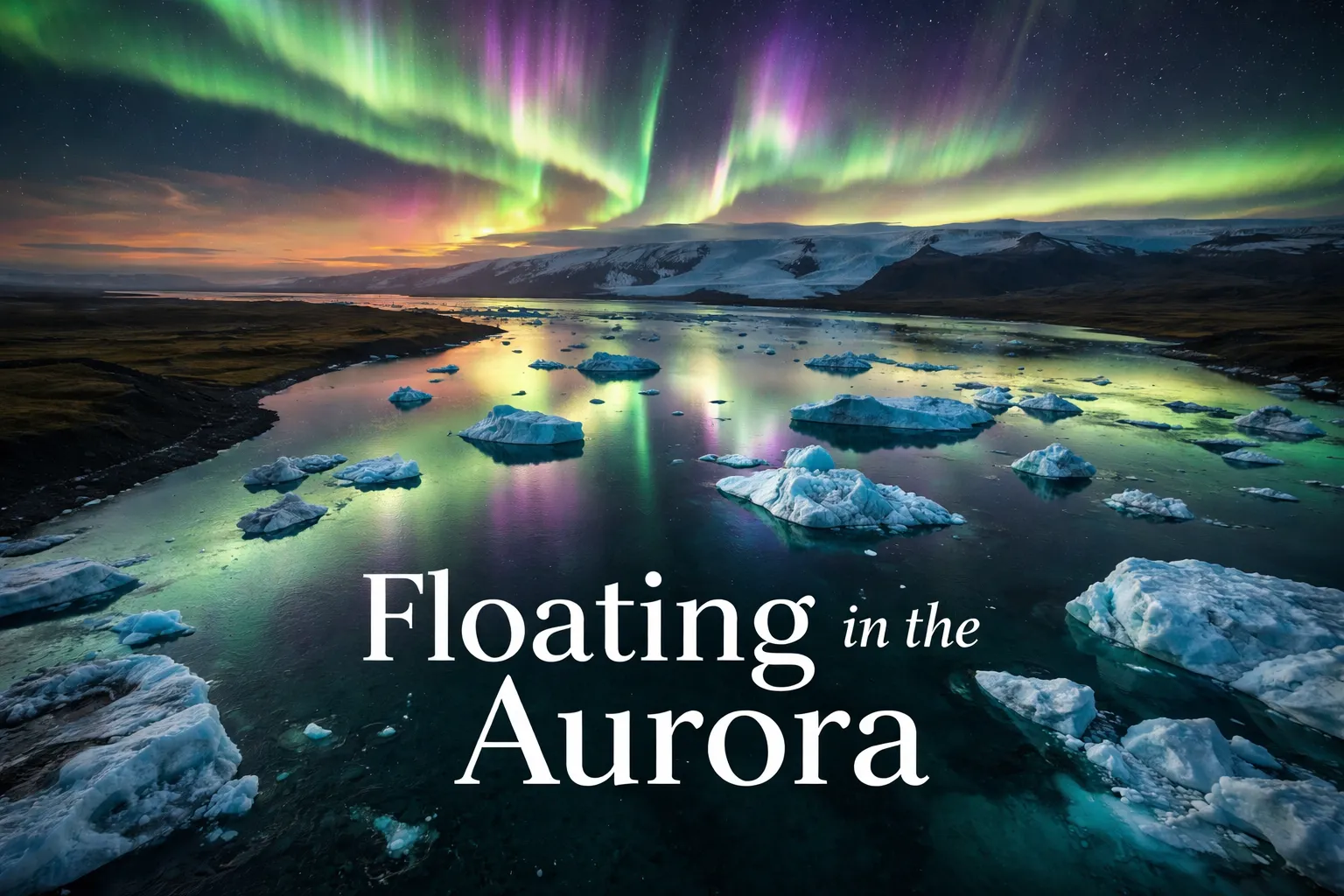
Diesel exhaust from the tour buses idling at Jökulsárlón’s parking lot, forty strangers craning their necks at a sky that hasn’t decided whether it’s putting on a show tonight — and every single one of them shooting straight up with a phone or a tripod, fighting the same compositional headache. Ground-level aurora work always traps you in that upward gaze while you’re simultaneously begging for something interesting in the foreground. The lights and the land end up competing for the same rectangle of frame. Send a drone up to 150–250 meters, though, and that competition just evaporates. The aurora stops being the subject and becomes the atmosphere — it curls above you, reflects off ice and water below you — while the terrain spreads out underneath like something you could actually read.
Get a drone over Jökulsárlón and the lagoon stops looking like a lagoon at all — it becomes something closer to abstract art: hundreds of icebergs inching seaward in a slow-motion parade, each catching green and violet light from above, ringed by pitch black. Standing on the shore, you’re lucky to make out a dozen bergs and a sliver of sky. Climb to 160 meters and suddenly the whole lagoon reads as one glowing organism. The sheer scale of it — something that never quite registers from ground level — finally makes sense from up there.
Over on the Snæfellsnes Peninsula, gaining altitude above Kirkjufell exposes the mountain’s true cone shape set against the moving bands of light. It’s already a well-worn ground-level shot, sure, but climb to 200 meters and you’ll see the waterfalls streaking its slopes pick up the green glow while the entire volcanic peninsula unrolls behind it toward the North Atlantic. It’s the kind of aerial angle that rewrites how you think about a place you assumed you already understood. Right now, most of the standout aurora borealis drone footage coming out of Iceland traces back to this exact spot — drone parked at 180–220 meters, gimbal tilted 30 to 45 degrees down, Kirkjufell anchoring the lower third of the frame while the aurora claims the rest.
Where to Fly for Iceland Drone Photography Aurora
Jökulsárlón Glacier Lagoon
Out of everywhere I’ve flown, this is the spot I’d send you to first for iceland drone photography aurora. Reflective water, drifting ice, the diamond beach along the eastern edge, and open sky stretching every direction — the compositions here feel like they never run out. Climb to 120–180 meters, drop the gimbal to 45 degrees, and the whole lagoon opens up with aurora spanning horizon to horizon. Höfn (HFN) airport sits roughly 80km east, well clear of any controlled airspace, so standard ICETRA open-category rules cover you here without complication.
Kirkjufell, Snæfellsnes Peninsula
Probably the single most photographed subject in Icelandic aurora imagery. Get airborne to 180–250 meters and the mountain’s clean triangular outline gives every shot a natural anchor point. Launch from the lot near Kirkjufellsfoss and ascend gradually — wind picks up hard past 150 meters on this exposed stretch of coast. Pull up ICETRA’s airspace map before you fly; Stykkishólmur carries some advisory restrictions nearby, though Kirkjufell itself is usually clear to fly. The shot to chase: hover due south of the peak at 200 meters, gimbal at 30 degrees, aurora spread across the northern sky above.
Þingvellir National Park
This valley sits right on top of the Mid-Atlantic Ridge, where the North American and Eurasian plates are quite literally tearing apart from each other. Climb a drone to 250–300 meters and you can frame the full rift valley with aurora dancing overhead. It’s one of the more conceptually striking images photography can offer — geologic time laid bare from above, lit by solar wind. One thing worth flagging: Þingvellir carries UNESCO World Heritage status, and although ICETRA’s rules technically govern the airspace, you should always confirm current park-specific drone policy with the Þingvellir National Park Authority before you go, since those rules shift seasonally.
Vík and Reynisfjara Black Sand Beach
The basalt columns at Reynisfjara and the offshore sea stacks of Reynisdrangar make for compositions you won’t find anywhere else. At 80–120 meters, the drone frames black sand, white surf lines, and the stacks below while aurora fills the sky above. Steer clear of flying straight over the beach if people are down there — ICETRA’s rules on uninvolved persons apply here just as everywhere else. When the aurora’s strong, the lava cliffs pick up a faint green tint, producing a scene that looks like it’s been composited in post — it isn’t.
Best Drone Aurora Photography Settings: The Technical Reality of Flying in the Dark
Most people trip up right here, because best drone aurora photography settings run backwards from what ground-based astrophotography teaches you. A tripod can hold a 15–25 second exposure without issue. A hovering drone can’t — anything past 3–4 seconds picks up motion blur from micro-vibration, GPS drift, and the correction as the drone fights the wind, and the aurora itself is moving, so longer exposures just smear the bands. Here’s what actually works:
- ISO: Somewhere between 1600 and 6400, depending on how bright the aurora is. Begin at 3200 and adjust from there. The DJI Air 3S and Mavic 3 Classic sensors handle ISO 3200 cleanly enough for social media and even moderate prints. On a brighter KP 5+ night, ISO 1600 is often all you need.
- Shutter Speed: Cap it at 2–4 seconds — this is the constraint that matters most. A stable drone in wind under 15 km/h handles 2 seconds cleanly. Only push to 4 seconds when conditions are dead calm, Sport Mode is off, and the drone’s locked into a solid GPS hover. My default starting point is 2.5 seconds.
- Aperture: Open it all the way (f/1.7 on the DJI Air 3S wide lens, f/2.8 on the Mavic 3 line). Night flying means shooting wide open, no exceptions.
- White Balance: Set it manually between 3800 and 4200K. Auto white balance fights you the whole night and produces colors that shift shot to shot. Lock it at 4000K and you get aurora’s natural green-into-violet gradient without any unwanted warmth creeping in.
- Shooting Format: Shoot RAW, always. JPEG compression strips out the tonal range aurora post-processing depends on. Push exposure toward the right side of the histogram without clipping your highlights.
- Drone Mode: Stick to Cine or Normal — Sport mode is off the table entirely. Dial down max speed and switch on every stabilization feature available. Let the drone hover 30 seconds before you start shooting so GPS lock has time to settle.
Wind decides everything out here. Once sustained wind crosses 30 km/h, I bring the drone straight down — it starts fighting the gusts, and those micro-corrections show up as blur in your footage. Iceland’s wind can spike without warning to genuinely dangerous speeds, so keep an eye on the on-screen wind readout and set yourself a firm return-to-home threshold before you ever take off.
Battery performance needs real attention once you’re in Icelandic winter conditions. Drop below -10°C and you can lose 30–40% of rated battery capacity. I keep batteries pre-warmed in an inside jacket pocket, carry a minimum of four, and plan for 12–15 minutes of real flight time per battery in the cold — not the 30-plus minutes the spec sheet promises.
Can You Fly a Drone at Night in Iceland for Aurora Footage?
Yes — with a few things to keep straight. ICETRA (Samgöngustofa, the Icelandic Transport Authority) runs on EASA-aligned open-category rules, and there’s no blanket prohibition on flying drones under 25kg at night within subcategories A1/A3. That said, visual line of sight (VLOS) is non-negotiable at all times, which turns night flying into both a practical and legal puzzle — you have to actually be able to see the drone. That’s exactly why strobe lights stop being optional gear and become a legal requirement for compliant nighttime flying.
The rules that actually matter for drone flying northern lights iceland boil down to this: keep 8km clear of airport reference points unless you’ve got authorization (this matters a lot near Reykjavik/Keflavík), never fly over people who aren’t part of your operation, cap your altitude at 120 meters above ground under standard open-category rules, and always run a check on ICETRA’s Digital Sky platform (icetra.is) for any temporary flight restrictions in effect. The major aurora spots — Jökulsárlón, Kirkjufell, Reynisfjara, Þingvellir — all sit comfortably within these boundaries. Just steer well clear of Reykjavik’s city center and Keflavík’s control zone unless you’ve secured specific clearance.
Timing Your Shot: KP Index, Moon Phase, and the Aurora Forecast
Aurora season in Iceland stretches from September into March, with the darkest, statistically busiest stretch falling between October and February. The forecast tool from the Icelandic Meteorological Office (vedur.is) is the single most useful planning resource you’ll find — cloud cover maps paired with a localized 0–9 aurora scale that refreshes every few hours. For real-time KP index alerts, I lean on the Space Weather Prediction Center (NOAA) app.
The strongest aurora borealis drone footage tends to come out of KP 3–5 activity at Iceland’s latitude — you get structured, well-defined bands rather than the washed-out haze weaker events produce. Anything KP 5 and above tends to throw dramatic curtain shapes that punch through even moderate cloud cover. Moon phase plays out differently for aerial work than it does on the ground: a crescent moon casts just enough light on glaciers and black sand to add natural foreground detail without drowning out the aurora in frame. A full moon, surprisingly, still works for drone aurora shots — it lights up the landscape beautifully, though you’ll want KP 4 or higher for the aurora to hold its own against the ambient moonlight.
Why I Finally Stopped Losing My Drone in the Aurora
Chasing the northern lights in near-total dark means your drone effectively disappears the second it clears 150 meters — and once you lose visual contact, the panic sets in fast. I needed a fix that kept the drone visible without wrecking my long exposures.
What works
- Red light reads clearly against the green of the aurora without blowing out the camera sensor — I tracked my drone climbing over Jökulsárlón while the lights were still active overhead.
- Setup goes together even with numb fingers, and the battery holds through a full 3-4 hour aurora session, even when temperatures drop below -10°C.
- The added weight is light enough that it barely touches flight time or stability, even climbing to the 250-meter range you want for wide aurora compositions.
What doesn’t
- The mounting clips come slightly loose out of the box and rattle around in your bag — skip tightening them pre-flight and one light can work its way loose mid-hover (I found that out the hard way over the black sand near Vík).
- When wind picks up or the aurora gets really bright, the red glow can wash out a bit against the light show, leaving you to trust the controller’s distance readout more than your own eyes.
I nearly aborted a shot at Kirkjufell because I couldn’t locate the drone in the glare of a sudden green burst—until the gear caught a reflection and I found it again. That’s when I stopped second-guessing the investment and grabbed the STARTRC Neo 2 Lighted Landing Gear.
Frequently Asked Questions
What altitude should I fly my drone for aurora photography in Iceland?
Recommended altitude ranges vary by location: 120–180m over icebergs at Jökulsárlón, 150–250m at Kirkjufell, and 80–120m over black sand beaches at Vík. For Þingvellir National Park, you can climb to 250–300m to frame the full rift valley with aurora overhead. Always stay below 120m in most areas under standard ICETRA open-category rules.
What camera settings work best for drone aurora photography?
Use ISO between 1600 and 6400 (start at 3200), shutter speed capped at 2–4 seconds, and aperture wide open (f/1.7 on DJI Air 3S, f/2.8 on Mavic 3). Set white balance manually to 3800–4200K, shoot RAW format only, and use Cine or Normal mode with Sport mode off. Keep sustained wind below 30 km/h or bring the drone down.
When is the best time to photograph northern lights with a drone in Iceland?
Aurora season runs September through March, with peak activity October–February. Fly between 10 PM–2 AM local time during active aurora events with a KP index of 3 or higher. A new moon or crescent is ideal; a full moon washes out faint auroras but can light glaciers for foreground detail.
Do I need special permission to fly a drone at night in Iceland?
No blanket night-flight ban exists in open category, but visual line of sight is non-negotiable and strobe lights are a legal requirement for compliant nighttime flying. Stay 8km clear of airports unless authorized, never fly over uninvolved people, and always check ICETRA’s Digital Sky platform (icetra.is) for temporary flight restrictions before launching.
About This Article

Written by Elena Vasquez. Elena Vasquez is a full-time traveler and the founder of Witty Passport. Over fifteen years and more than 50 countries across six continents — including a stretch spent leading groups professionally through Southeast Asia and the remote highlands of South America — she's written the kind of destination guides she always wished existed: practical, specific, and built on real experience rather than recycled itineraries. More about this site.
Scope and limits. Elena is a full-time traveler, not a licensed travel agent or immigration adviser. Entry requirements, visa rules, and advisories change without notice — always confirm against the official government source for your destination and passport before booking.
Verify this against a primary source
Specifics change, and your situation may differ from the one described here. These are the authorities worth checking directly:
- U.S. Department of State — entry requirements and travel advisories
- CDC Travelers' Health — vaccination and health notices by destination
- TSA — current carry-on and screening rules