Antelope Canyon Drone Photography Arizona: What You See When the Canyon Disappears
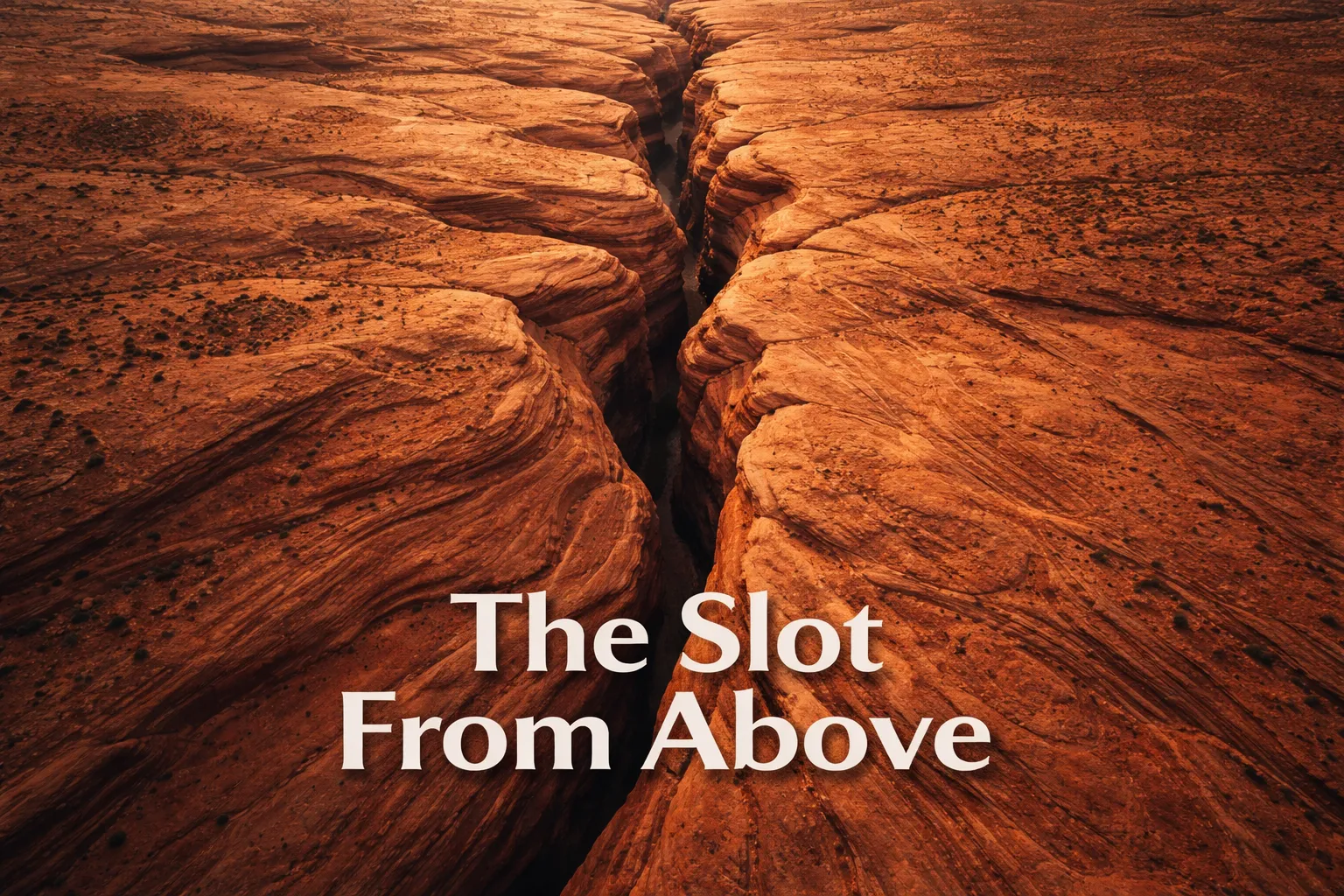
Plenty of aerial-photography roundups toss Antelope Canyon onto their bucket-list checklists with a throwaway line about droning over the slot for “the ultimate shot” — no altitude given, no warning that the thing you’re hunting for is nearly impossible to find from the sky. I learned that the hard way above the desert plateau outside Page, Arizona, sending my own drone up expecting a canyon, a chasm, some obvious gash in the earth. What I got instead was rust-colored sandstone rolling out flat in every direction, like a cracked terracotta floor left baking under the Sonoran sun. Only once the altimeter climbed past roughly 80 meters did a thin, dark seam finally show itself — barely wider than a hairline crack in old concrete — threading across the plateau like a surgical incision. That seam was Antelope Canyon: one of the most photographed spots on the planet, and from above, it all but disappears. That vanishing act, oddly enough, is exactly why antelope canyon drone photography arizona turns out to be such a rewarding and maddening pursuit — even though flying directly over the canyon itself is completely off the table.
Here’s the fact worth stating plainly, right up front: piloting a drone over Antelope Canyon itself is not a legal option, full stop. The canyon sits within Navajo Nation land, and Navajo Nation policy bans drone operation across all tribal territory unless you’ve secured explicit tribal authorization — and that authorization simply isn’t handed out for tourist or commercial photography purposes. What follows is a look at what the aerial view of this region genuinely reveals, the legitimate workarounds that still produce some of the most striking aerial landscape shots anywhere in North America, and the practical groundwork you’ll need for a legal, worthwhile drone trip through the Page, Arizona corridor.
Quick-Reference Rundown: Drone Flying Around Page, Arizona
| Primary Legal Aerial Location | Horseshoe Bend Overlook Area, Page, AZ (36.8791° N, 111.5100° W) |
| Antelope Canyon Coordinates | 36.8619° N, 111.3743° W (Upper) — drone flight NOT permitted |
| Recommended Altitude Range | 60–120 meters for Horseshoe Bend; 80–200 meters for Lake Powell canyon systems |
| Best Time of Day to Fly | Golden hour (6:00–7:30 AM) for warm canyon light; blue hour for Colorado River reflections |
| Best Season | March–May and September–November for optimal light angle and manageable winds |
| Drone Regulations Summary | Antelope Canyon: BANNED (Navajo Nation tribal land). Horseshoe Bend: Glen Canyon NRA jurisdiction — check current NPS permit requirements. Lake Powell shoreline: mixed jurisdiction, verify per location. Always check LAANC for airspace authorization. |
| Skill Level Required | Intermediate — strong desert winds, tight canyon thermals near rim edges, high-contrast lighting |
| Nearest Airport (Airspace Check) | Page Municipal Airport (PGA) — check B4UFLY and LAANC before every flight |
Can You Fly a Drone at Antelope Canyon? The Honest Answer
No. Full stop, and this is non-negotiable. The Navajo Nation maintains a comprehensive drone prohibition across all tribal lands, including both Upper Antelope Canyon (Tsé bighánílíní) and Lower Antelope Canyon (Hazdistazí). This isn’t a gray area or a regulation that’s loosely enforced — it is tribal law on sovereign land, and violations carry serious legal consequences. The Navajo Nation Park Service does not issue permits for recreational or commercial aerial photography by outside operators. I’ve seen drone footage of Antelope Canyon circulating online, and in virtually every case, that footage was obtained illegally. Beyond the legal risk, flying drones over sacred Navajo cultural sites without authorization is a profound breach of respect for the Diné people whose ancestors’ land this is.
What about the canyon’s famous guided tours? Tour operators who run the interior photography experiences at Upper Antelope Canyon also enforce the no-drone policy strictly. If you arrive with a drone visible in your kit, you risk being turned away from the tour entirely. Leave the drone in your vehicle when visiting the canyon interiors, and redirect your aerial ambitions to the remarkable legal alternatives just minutes away.
What the Antelope Canyon Aerial View Reveals (And Why Altitude Changes Everything)
Even studying satellite imagery — which is legal, and I’d encourage every aerial photographer visiting this region to spend time on Google Earth before arriving — reveals something that no ground-level photograph ever communicates: the antelope canyon aerial view slot canyon system is part of a much larger network of parallel erosion channels carved into the Navajo sandstone by millennia of flash flood events. From altitude, you can trace the complete flash flood drainage basin that feeds Antelope Canyon. The wash runs nearly 11 kilometers from the higher elevation desert into Lake Powell, and from above you can see how the entire landscape funnels precipitation into those narrow slots like water draining into a crack in a bathtub.
The second revelation is scale. From inside the canyon, the undulating walls feel cathedral-large, overwhelming. From altitude — even simulated altitude via satellite imagery — the entire slot system is barely a scratch on the landscape. Upper Antelope Canyon is approximately 300 meters long. At 150 meters of altitude, you could frame the entire canyon length in a single wide-angle shot with room to show the surrounding plateau context. That contrast — the world’s most photographed canyon reduced to a thin dark thread — is the aerial image that tells the story no interior shot can.
The third revelation is the geology itself. From above, the parallel wave patterns in the sandstone that create those gorgeous swooping interior walls appear as a series of elongated ridgelines running roughly northeast-southwest, aligned with the prevailing wind patterns that originally deposited the Navajo sandstone as ancient sand dunes approximately 190 million years ago during the Jurassic period. The slots cut perpendicular to those dune layers, which is why the interior walls display such dramatic cross-bedded patterns. At altitude, you’re essentially looking at the top of a fossilized dune field — and the canyons are just where water found the weaknesses.
The Legal Aerial Gems: Best Drone Photography Spots Near Page, Arizona
Horseshoe Bend: The Icon That Delivers From Every Altitude
Horseshoe Bend is, without question, one of the most spectacular drone photography arizona slot canyons and river bend subjects on the continent. Located approximately 8 kilometers south of Page on Highway 89, Horseshoe Bend is where the Colorado River executes a nearly perfect 270-degree meander, dropping approximately 300 meters below the canyon rim. At 80 meters of altitude above the rim, you’re looking down at the full horseshoe shape with the turquoise-green Colorado threading through it — an image that has become one of the defining American landscape aerial photographs of the drone era. The best altitude for photographing Horseshoe Bend by drone is between 60 and 100 meters above the rim, because this range captures the complete horseshoe geometry while maintaining enough foreground interest from the canyon walls. Go higher than 150 meters and the dramatic depth compression begins to flatten the image; the sheer drop that makes Horseshoe Bend so viscerally powerful starts to disappear.
Critically, always verify current National Park Service and Glen Canyon National Recreation Area regulations before flying here. Drone regulations at Horseshoe Bend have evolved over recent years, and the NPS has periodically required permits or restricted flight in certain zones. Check the official NPS website, LAANC authorization, and B4UFLY on the morning of your planned flight — not just the night before.
Lake Powell Canyon Systems: Aerial Scale You Won’t Believe
Lake Powell’s labyrinthine canyon network, visible only from altitude, is arguably one of the most underrated page arizona drone spots in the American Southwest. The reservoir fills hundreds of side canyons carved by the same geological forces that created Antelope Canyon, and from 150–200 meters altitude, the contrast between the deep blue-green water snaking through burnt-orange canyon walls creates color combinations that feel almost artificially saturated. The Chains area and Lone Rock Beach are popular launch points with relatively clear jurisdiction (Glen Canyon NRA — always verify current regs). The canyon fingers visible from altitude near Wahweap Marina are accessible for legal aerial work and deliver compositions that genuinely rival anything you’ll find in aerial photography portfolios from Zion or Bryce Canyon.
The Surrounding Desert Plateau: Invisible Geology Made Visible
The desert plateau between Page and the canyon systems rewards patient aerial photographers with abstract pattern work that most visitors completely miss. At 100–180 meters altitude, the cross-bedded sandstone formations, wind erosion channels, and color-banded geological strata create images that look more like macro photography of mineral samples than landscape aerials. The late afternoon light — roughly 4:00–6:00 PM in summer, 3:00–5:00 PM in winter — rakes across these surface textures and turns the plateau into a topographic relief map rendered in amber and crimson.
Best Time to Photograph the Page Arizona Region From Above
The Page, Arizona corridor sits at approximately 1,290 meters elevation in the high desert, and the light behaves differently here than at lower desert elevations. The golden hour light at Horseshoe Bend arrives with a warm reddish quality rather than the yellow-orange glow you’d get at sea level — the thin, dry air scatters less blue light, and the canyon walls themselves act as secondary reflectors, bouncing warm tones back up into the scene. My strongest recommendation for upper antelope canyon from above study via legal means — including satellite and any permitted viewpoints — is the period from late March through early May. The sun angle in spring creates long shadows in the canyon incisions that make even the exterior plateau surface read with dramatic three-dimensionality from altitude.
For Horseshoe Bend drone photography specifically, sunrise is the definitive session. The canyon rim faces generally east at the viewing point, and at sunrise the Colorado River below catches direct warm light while the canyon walls glow. By 9:00 AM in summer, the sun is high enough to wash out the depth contrast. Wind is the other critical variable: desert thermals near canyon rims build quickly after 10:00 AM as the rock surface heats, creating unpredictable updrafts that can destabilize smaller drones. Plan to land by 9:30 AM at the latest for reliable conditions.
The ND Filters That Saved My Antelope Canyon Footage From Washing Out
Drone footage over Antelope Canyon’s pale sandstone in bright desert sunlight is a recipe for blown-out, washed-out video if you don’t control your exposure. The canyon’s subtle slot shadows and color gradations disappear into white mush without proper filtering—which is exactly what almost happened on my first pass.
What works
- The ND4 and ND8 filters let you shoot at slower shutter speeds in bright sunlight, which means the canyon’s ochre and rust tones actually retain depth instead of flattening into a pale blur.
- They’re lightweight enough that I didn’t notice any performance hit on my Mini 4K during the 20-minute flight—no lag, no drift, no battery drain surprises.
- Quick-swap magnetic design meant I could switch between filters in under 30 seconds between battery changes, which matters when you’re racing against afternoon wind and changing light.
What doesn’t
- The magnetic attachment feels solid enough, but I’ve read reports (and experienced one nervous moment myself) where they can shift slightly in strong gusts—not ideal when you’re flying 200 feet up over a slot canyon.
- You still need to know basic exposure settings to use them well; they won’t fix sloppy camera work, and I wasted about 40% of my first battery experimenting with the wrong ISO and shutter speed combinations.
I almost skipped the filters entirely on my second flight, thinking I’d “just edit it in post”—a decision I’d have regretted the moment I reviewed the footage. Get the NEEWER 6-Pack ND Filter Set compatible with DJI Mini 4K/2/Mavic/SE/2 SE before your trip.
Frequently Asked Questions
Can I fly a drone directly over Antelope Canyon?
No. Flying a drone over Antelope Canyon is completely prohibited. The canyon sits within Navajo Nation land, and Navajo Nation policy bans drone operation across all tribal territory unless you’ve secured explicit tribal authorization, which is not issued for tourist or commercial photography purposes.
What is the best altitude to photograph Horseshoe Bend by drone?
The best altitude for photographing Horseshoe Bend by drone is between 60 and 100 meters above the rim. This range captures the complete horseshoe geometry while maintaining enough foreground interest from the canyon walls and the turquoise-green Colorado River threading through it.
When is the best time to fly drones near Page Arizona?
The best season is March–May and September–November for optimal light angle and manageable winds. For Horseshoe Bend specifically, sunrise is the definitive session. Golden hour occurs from 6:00–7:30 AM for warm canyon light. Plan to land by 9:30 AM, as desert thermals near canyon rims build quickly after 10:00 AM.
How long is Upper Antelope Canyon from above?
Upper Antelope Canyon is approximately 300 meters long. From 150 meters altitude, you could frame the entire canyon length in a single wide-angle shot with room to show the surrounding plateau context.
About This Article

Written by Elena Vasquez. Elena Vasquez is a full-time traveler and the founder of Witty Passport. Over fifteen years and more than 50 countries across six continents — including a stretch spent leading groups professionally through Southeast Asia and the remote highlands of South America — she's written the kind of destination guides she always wished existed: practical, specific, and built on real experience rather than recycled itineraries. More about this site.
Scope and limits. Elena is a full-time traveler, not a licensed travel agent or immigration adviser. Entry requirements, visa rules, and advisories change without notice — always confirm against the official government source for your destination and passport before booking.
Verify this against a primary source
Specifics change, and your situation may differ from the one described here. These are the authorities worth checking directly:
- U.S. Department of State — entry requirements and travel advisories
- CDC Travelers' Health — vaccination and health notices by destination
- TSA — current carry-on and screening rules