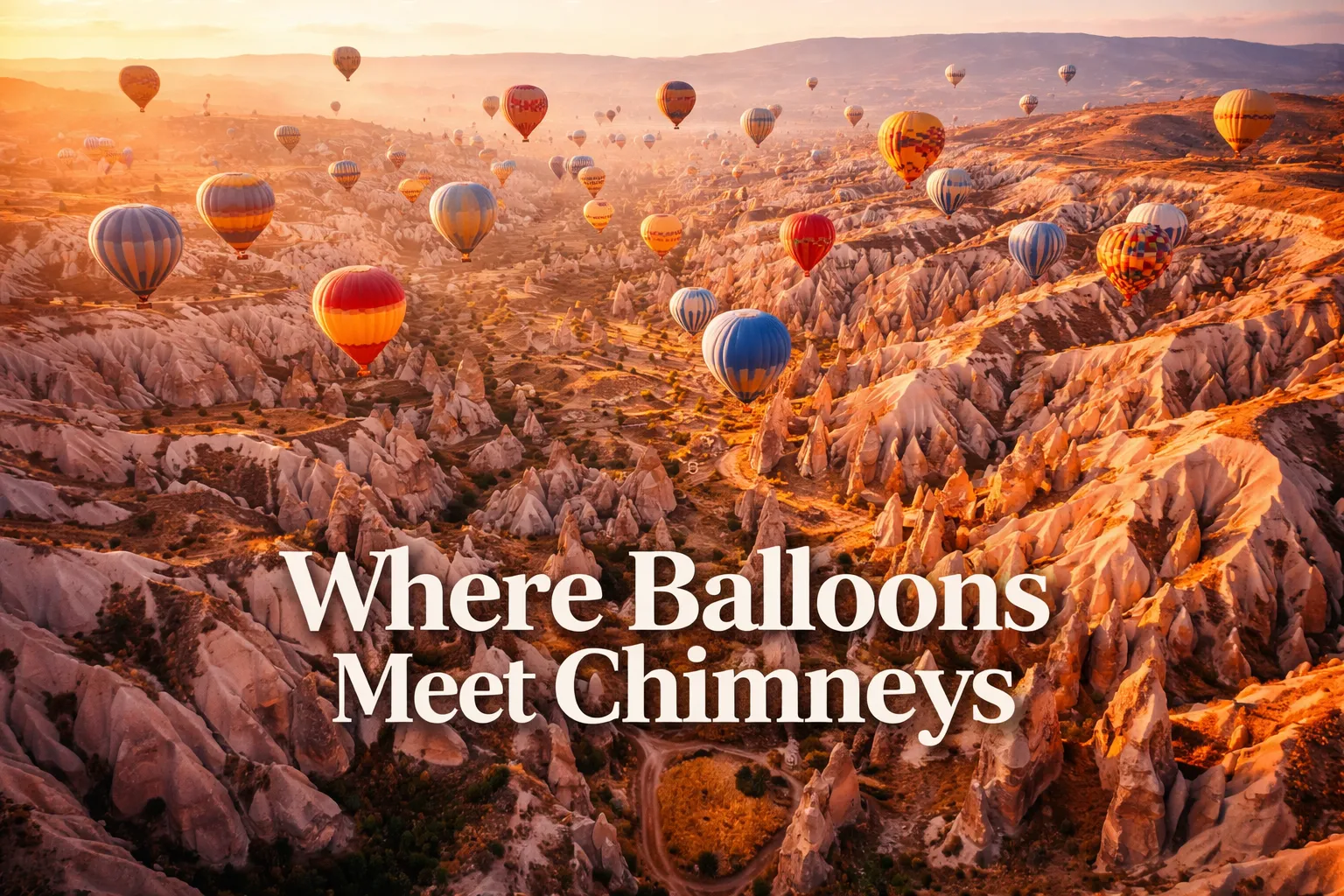
Everyone assumes the fairy chimneys are the whole show in Cappadocia — that you point your camera at the spires from a hilltop terrace, capture the balloons drifting past, and you’ve got the definitive shot. I led groups through this region for years before I ever put a drone in the air here, and I can tell you flatly: the ground-level version is only half the story. The instant my drone cleared the roofline of my cave hotel in Göreme, the landscape below split open into something no terrace view had prepared me for — thousands of pale volcanic spires clustered through the valleys, carved cave openings catching that first orange light, and above all of it, dozens upon dozens of hot air balloons rising like scattered confetti caught mid-fall. People search “Cappadocia drone photography hot air balloons” by the millions each year, and having seen it myself, I get the obsession completely. Nothing shot from the valley floor comes close to what this terrain reveals from 120 meters. What follows is everything I pieced together across three separate dawn flights — the legal restrictions you actually need to know, the compositions worth chasing, the technical headache of sharing sky with 150 balloons, and the moments that made every 4 a.m. wake-up call justifiable.
Cappadocia Drone Flight Brief
| Primary GPS Coordinates (Göreme) | 38.6431° N, 34.8283° E |
| Rose Valley Launch Point | 38.6697° N, 34.8731° E |
| Love Valley Viewpoint | 38.6744° N, 34.8175° E |
| Recommended Altitude Range | 80–200m (legal ceiling 120m in most zones; fly conservatively) |
| Best Time of Day | Civil twilight to 30 minutes before balloon window opens (~05:30–06:00 local time, seasonal); or post-balloon from 09:00 onward |
| Best Season | April–June and September–November (stable winds, golden light, peak balloon launches) |
| Drone Regulations Summary | Registration with Turkey’s SHGM (Sivil Havacılık Genel Müdürlüğü) mandatory; permit required; flying during active balloon hours in restricted zones is prohibited; No-Fly Zones enforced around active balloon corridors — see full section below |
| Skill Level Required | Advanced — dynamic airspace, unpredictable thermal winds, proximity to balloon traffic |
| Difficulty Rating | ⬛⬛⬛⬛⬜ (4/5) |
What Cappadocia Looks Like From Above That Ground Level Simply Can’t Show You
Down in Rose Valley on foot, you register individual fairy chimneys, one after another. Climb to 150 meters above that same valley and what you actually see is the system behind them — a sprawling drainage network of ribbed erosion channels fanning out like a fingerprint pressed into pink tuff, each channel wall pocked with carved openings, the whole logic of the place only readable once you’re high enough to see it laid flat. That’s the real point of cappadocia aerial view fairy chimneys photography: it exposes the hidden order running underneath what looks, from the ground, like pure chaos.
Here’s what actually caught me off guard once I was airborne, none of which any glossy travel spread had ever shown me beforehand:
- The pigeon house cliff faces: At ground level, the carved pigeon holes read as quaint detail work. Climb to 100m and tilt the gimbal roughly 45° downward, and entire cliff walls turn into dense grids of carved facades — hundreds of openings arranged in patterns Cappadocian farmers relied on for generations to harvest pigeon guano as fertilizer. You simply cannot register the scale of this from the ground.
- Ventilation shafts of the underground cities: Around Derinkuyu and Kaymakli, the circular vent openings barely register when you’re standing next to them. From 80–100m directly overhead on a clear morning, though, they resolve as dark punched-out circles across pale rock — the surface signature of cities that descend 18 stories underground. It’s among the strangest sights I’ve ever captured on camera.
- Göreme’s blend of town and rock: From the air, Göreme looks less like a town built beside the fairy chimneys and more like one poured directly into them. Cave windows sit flush against the natural rock face. Hotel terraces seem to grow straight out of the tuff formations. The line between geology and architecture disappears entirely, and you only notice that once you’re up high enough to see both at once.
- The choreography of the balloon fleet: During peak season, as many as 150 balloons launch inside a single 45-minute stretch. Shooting straight down from 200m during the legal pre-balloon window, you can capture the entire launch field at once — baskets still clustered on the ground, envelopes mid-inflation, the earliest balloons already rising while others remain flat. The color arrangement against the pink tuff is genuinely unlike anything else I’ve photographed from the air.
Is Drone Flying Legal in Cappadocia? The Rules and What They Mean on the Ground
This is the part most travel blogs either skip entirely or gloss over. I won’t do that here, because flying illegally over Cappadocia during active balloon operations isn’t a minor technicality — it puts real people in balloon baskets at genuine risk, not just your equipment.
To fly legally under Turkey’s SHGM framework, here’s what’s actually required: any drone weighing over 500g must be registered with the SHGM before it ever leaves the ground. You’ll need a UHA (Unmanned Aircraft) operator certificate. If you’re a foreign visitor, that application has to go through SHGM’s online portal before you land in Turkey — this is not paperwork you can sort out at the airport. Flight inside active TFRs (Temporary Flight Restrictions) is off-limits; these are issued daily throughout Cappadocia during balloon hours, generally somewhere between 05:30 and 08:30 local time depending on season and wind. On top of that, Göreme National Park and the surrounding UNESCO-protected zones carry their own No-Fly Zone designations, entirely separate from the balloon-related TFRs.
Here’s the reality for most people showing up with a drone: that Instagram footage tagged “Cappadocia balloons from above” that you’ve scrolled past a hundred times came from one of two sources — a licensed commercial operator holding a specific SHGM permit, or someone who broke the rules to get the shot. I’m not passing judgment, but I will say this plainly: Turkish aviation authorities are actively enforcing these restrictions, the fines aren’t trivial, and confiscated equipment is a real possibility, not a scare tactic. Your safest legal option is flying before the balloon TFR window opens — during civil twilight, ahead of launch — shooting the terrain without balloons in the frame, then landing well before the restriction activates. Alternatively, the window starting around 09:00 after balloons have cleared still gives you strong light for valley and chimney shots without any airspace conflict.
If capturing balloons and drone footage together is your goal: reach out to licensed operators based in Göreme — a number of them hold commercial permits covering balloon-hour flight windows specifically. Partnering with one is genuinely the only lawful route to that iconic flotilla shot from above.
Where to Actually Fly in Cappadocia: Locations Worth the Setup
Three pre-dawn alarms and one bitterly cold morning on a valley floor later, here’s my ranking of the best drone spots Cappadocia Turkey offers, sorted by how much they actually deliver photographically versus how easy they are to reach.
Rose Valley (Güllüdere)
My top pick for drone photography Cappadocia Turkey right at first light. The valley walls take on a deep amber-pink glow before the sun hits them directly, and the erosion channel network reads beautifully from 100–150m, whether you shoot nadir (straight down) or angle the gimbal at 60°. Launch from the parking area at the northern trailhead, and orient east-facing to catch the warmest light. If you want to reveal the full drainage pattern across the valley, 180–200m is the sweet spot — just stay inside whatever ceiling your permit class allows.
Love Valley
Everyone’s seen the phallic fairy chimneys here from ground level, but drop to 80m and look straight down the valley axis, and they transform into a dense forest of columnar shapes with a natural vanishing point that’s genuinely striking. The move is a low altitude — 60–80m — with the gimbal tilted forward maybe 30° below horizontal, framing down the length of the valley rather than across it. Midday light, oddly enough, actually works well here because the valley runs roughly north-south, letting the chimneys throw dramatic shadows onto each other.
Göreme Town, Shot From the Northeast Ridge
Take off from the plateau northeast of the Open Air Museum and fly southwest at 120m. This angle frames Göreme with the museum’s fairy chimney cluster in the foreground and the town spilling into the valley behind it — the shot that best captures that fusion of town and rock I mentioned earlier. Early morning gives you soft directional light coming in from the east, which wraps around the chimney faces perfectly.
Pigeon Valley (Güvercinlik)
To catch the carved pigeon house facades, fly at 100m with the gimbal tilted 45° downward, moving slowly along the cliff face, parallel to the wall. The texture created by hundreds of carved openings in the tuff is something a telephoto lens on the ground can only hint at. Late afternoon is the best time to shoot, once the western cliff faces catch full sun.
Timing Your Aerial Shots: Dawn, Balloon Hours, and the Golden Window
“Golden hour” gets thrown around too casually in photography circles, but in Cappadocia it’s close to literal. The volcanic tuff forming the fairy chimneys and valley walls already carries a natural warm-pink tone, and under the first 20 minutes of direct sunlight, the entire landscape turns into something that borders on unbelievable — a glowing, rose-colored terrain that will make your histogram look wrong even though it isn’t. That window, starting the moment the sun clears the eastern plateau and lasting roughly 40 minutes after sunrise, is non-negotiable if you want your aerial shots here to actually land.
The catch with hot air balloons Cappadocia from above is that this golden window lines up exactly with balloon operating hours. My workaround: get to town two nights before you plan to fly, watch the actual launch timing yourself from your hotel terrace, and build your drone plan around either the pre-launch setup on the field — which is dramatic on its own, with flat envelopes spread out, crew vehicles moving around, propane flares firing — or the post-flight landscape starting around 09:00, when the light is still strong and the TFR has lifted. April through June and September through November tend to bring the steadiest morning winds; summer often brings thermal instability that grounds balloons entirely and makes drone flying unpredictable.
The Drone That Held Up Against Cappadocia’s Wind and Balloon Traffic
Dawn in Cappadocia leaves zero room for error — you’re working with maybe 20 minutes of ideal golden light, thermals rising unpredictably off the valleys, and dozens of hot air balloons cutting straight across your flight path. What you need is a drone that stays composed, doesn’t drift off position, and won’t drop into a fairy chimney the moment a gust hits it unannounced.
What worked well
- Having two cameras (48MP main plus a 70mm medium tele) meant I could frame balloon clusters without sacrificing foreground detail — capturing both the spires and the balloons in the same shot sounds straightforward until you realize how much distance actually separates them.
- The wind resistance genuinely impressed me; I flew through gusts strong enough to unsettle me, yet the drone held its position like it was anchored — which matters a great deal when you’re hovering over a 200-foot drop trying to nail focus on a balloon 500 meters out.
- The RC 2 screen remote made a real difference in the harsh sunrise glare, where a phone screen is basically unreadable — I could actually see what the drone was seeing instead of cupping my hands around my face like I was hiding from something.
Where it fell short
- It’s heavy enough that Turkish customs flagged it immediately and had me fill out a temporary import form — budget an extra 20 minutes at arrival if you’re routing through Istanbul with this thing in your bag.
- Battery life drops noticeably in the cold morning air compared to what DJI’s specs promise; I got roughly 18 minutes of real flight time instead of the advertised 25 — which sounds fine on paper until your ideal light disappears in 22 minutes and you’re still airborne.
I had one moment on the second morning where a thermal spike sent it climbing faster than I expected and I genuinely thought I was about to lose $1,500 to Cappadocia’s sky, but the stabilization caught it before I needed to touch the sticks. If you’re serious about capturing this landscape, this is the setup that actually delivers. DJI Air 3S Fly More Combo with RC 2 Screen Remote Controller
Frequently Asked Questions
What are Turkey’s drone registration requirements for Cappadocia?
Any drone weighing over 500g must be registered with Turkey’s SHGM before flying. You’ll need a UHA (Unmanned Aircraft) operator certificate, and if you’re a foreign visitor, the application must go through SHGM’s online portal before you land in Turkey—this cannot be completed at the airport.
Can I fly my drone during hot air balloon hours in Cappadocia?
No. Flight inside active TFRs (Temporary Flight Restrictions) is prohibited; these are issued daily during balloon hours, generally between 05:30 and 08:30 local time depending on season and wind. Flying during balloon operations puts people in baskets at genuine risk.
When is the best time to fly a drone in Cappadocia?
The best windows are civil twilight to 30 minutes before balloons launch (around 05:30–06:00 local time), or post-balloon from 09:00 onward. April–June and September–November offer the most stable winds and golden light; summer often brings thermal instability that grounds balloons and makes drone flying unpredictable.
What altitude should I fly at to photograph Cappadocia’s fairy chimneys?
The recommended range is 80–200m, with 120m as the legal ceiling in most zones. For Rose Valley, 100–150m reveals erosion channels beautifully, while 180–200m shows the full drainage pattern. For Love Valley, 60–80m works best to frame the columnar shapes down the valley axis.
About This Article

Written by Elena Vasquez. Elena Vasquez is a full-time traveler and the founder of Witty Passport. Over fifteen years and more than 50 countries across six continents — including a stretch spent leading groups professionally through Southeast Asia and the remote highlands of South America — she's written the kind of destination guides she always wished existed: practical, specific, and built on real experience rather than recycled itineraries. More about this site.
Scope and limits. Elena is a full-time traveler, not a licensed travel agent or immigration adviser. Entry requirements, visa rules, and advisories change without notice — always confirm against the official government source for your destination and passport before booking.
Verify this against a primary source
Specifics change, and your situation may differ from the one described here. These are the authorities worth checking directly:
- U.S. Department of State — entry requirements and travel advisories
- CDC Travelers' Health — vaccination and health notices by destination
- TSA — current carry-on and screening rules