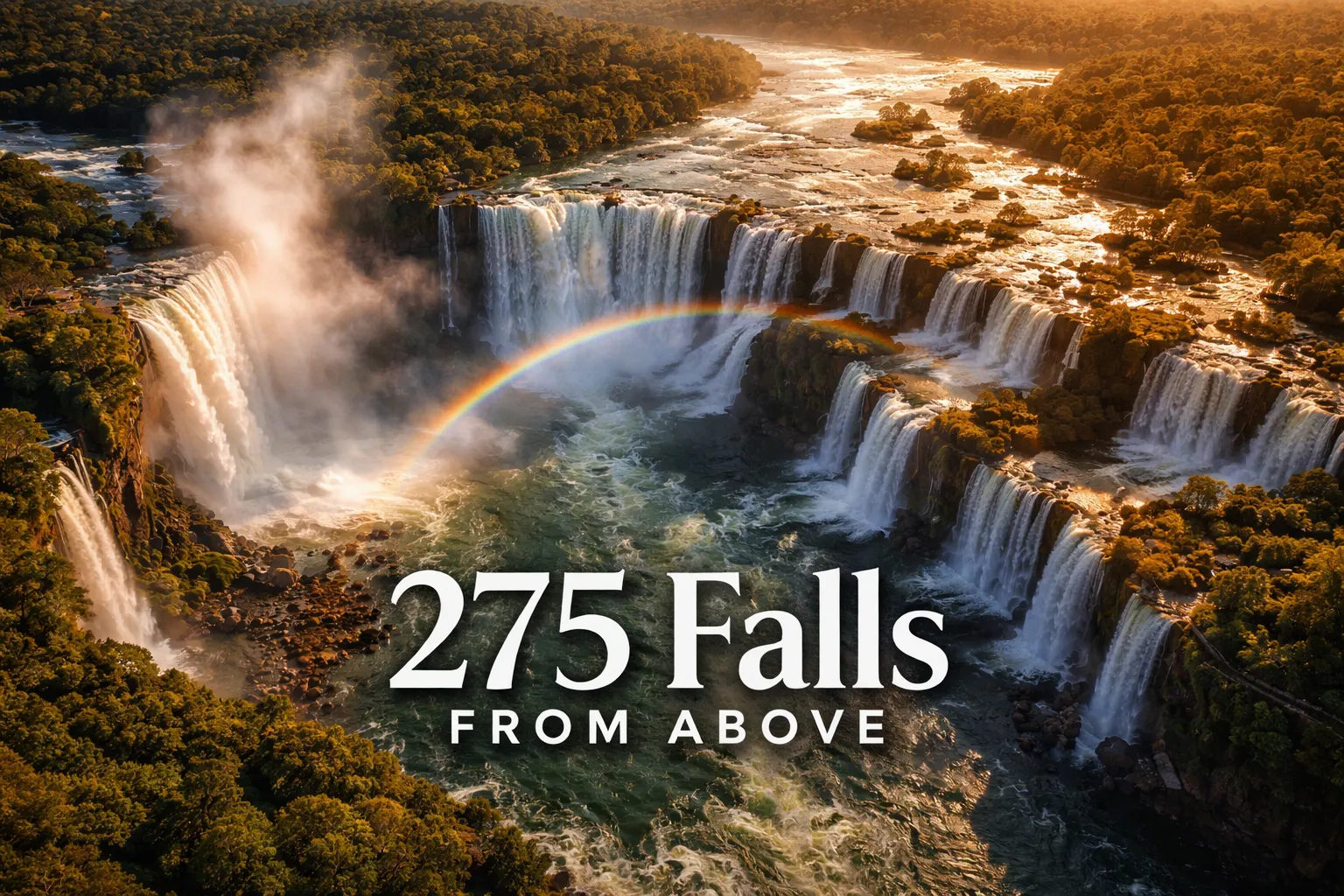
Most travelers assume that once you’ve walked the full length of catwalks on both the Brazilian and Argentine sides, you’ve essentially “seen” Iguazu. You haven’t — not the version that actually explains why this place reduces people to tears. I found that out the moment my drone rose past the treeline and the entire system of 275 waterfalls appeared at once, arranged in a way no boardwalk could ever suggest. Iguazu Falls drone photography aerial work stands apart from anything else in travel photography, not because the falls are big — everyone already knows that — but because their true scale is simply invisible from ground level. Stand on any walkway and you get one dramatic slice of the story. Climb to 120 meters above the river and you get the entire 2.7-kilometer horseshoe at once, the jungle swallowing it from every direction, a permanent rainbow suspended in the mist as if someone had brushed it there on purpose. Time it right, and on a full moon night, a silver lunar rainbow arcs over the Devil’s Throat like it belongs to a different planet entirely.
Drone Flight Brief: Iguazu Falls Aerial Photography At-a-Glance
| Detail | Information |
|---|---|
| GPS Coordinates | -25.6953° S, -54.4367° W (Devil’s Throat viewpoint reference) |
| Recommended Altitude Range | 80–200m for wide establishing shots; 30–60m for close-fall detail |
| Best Time of Day | 07:00–09:30 (golden hour light, low wind, minimal tourist noise) |
| Best Season | November–March (peak flow, rainbow intensity; August–October for clarity) |
| Brazil Side Regulations (ANAC) | Iguaçu National Park is a UNESCO zone — commercial permits required; recreational drone use prohibited inside park boundaries without authorization from IBAMA and ANAC |
| Argentina Side Regulations (ANAC AR) | Argentina’s ANAC prohibits drone flight in Iguazú National Park entirely; enforcement is active and fines are significant |
| Skill Level Required | Advanced — mist interference, GPS instability near the falls, and high humidity demand experienced hands |
| Difficulty Rating | ⭐⭐⭐⭐⭐ (Expert) |
So Is Drone Flight at Iguazu Actually Legal? Here’s the Real Answer
I’m not going to soften this, because plenty of travel blogs conveniently skip it: launching a drone over Iguazu Falls inside either national park is against the law without official clearance, on both the Brazilian and Argentine sides. On the Brazilian side, Iguaçu National Park answers to IBAMA (Brazil’s environmental protection agency) and ANAC (its civil aviation authority). Because the park sits within UNESCO-protected boundaries, any recreational flight requires advance sign-off from both agencies — a process that, in reality, only tends to work for commercial productions with real lead time, local fixers on the ground, and formal production permits. Fly on a whim and you’re risking confiscation and a fine.
The Argentine side isn’t any more forgiving. Argentina’s own ANAC bans drone flight within Iguazú National Park entirely, under Resolución 527/2015 and the national park protection statutes that followed it. Enforcement here is notably alert — rangers walk the catwalks routinely and are specifically trained to spot drone operators in the act. I once talked with a commercial filmmaker who spent three full weeks working through the Argentine permit process; approval eventually came through ANAC alongside the national parks administration (APN), plus coordination with local authorities. For the average traveler, that path simply isn’t practical.
So what can you legally do? The realistic route is booking through a licensed local aerial production company that already carries the required permits — a handful operate out of Foz do Iguaçu on the Brazilian side and Puerto Iguazú on the Argentine side, running authorized aerial tours with properly licensed pilots. Some of these outfits share their footage directly with clients or let photographers tag along on a shoot. That’s ultimately how I ended up with my sharpest aerial images of the Devil’s Throat — through a permitted operator, not by smuggling a drone past a ranger. Everything else circulating on YouTube and Instagram was either filmed under proper authorization, shot before enforcement tightened noticeably around 2018, or filmed illegally. Decide honestly which of those three categories you’re comfortable being in.
What the View From Above Shows That No Walkway Ever Will
Knowing exactly what the aerial perspective reveals matters for two reasons — appreciating the footage that already exists, and briefing any licensed operator you eventually hire. The biggest revelation when you see Iguazu Falls from above drone footage is the horseshoe shape of the whole system, something no ground view can convey. From the walkways, you experience the falls as a linear string of viewpoints. From 150 meters above the Iguazu River, that entire 2.7-kilometer arc suddenly makes sense as one object: a natural amphitheater of stacked cascades, with jungle so dense between sections that the water looks like it’s erupting straight out of solid green. No roads. No structures. Just water and forest repeating itself to the horizon in every direction.
The Devil’s Throat Iguazu aerial composition is, without much competition, the single most dramatic frame available anywhere in South American landscape photography. The Garganta del Diablo — the U-shaped gorge where close to 50% of the river’s entire volume drops 82 meters into a tight canyon — reads from the air as a kind of void: a rectangular slot of blinding white mist and roaring force, forest closing in on three sides, a steady plume climbing 150 meters above it. That mist column is visible for kilometers before you ever reach it. From altitude you can trace individual sheets of water folding into one another across the full width of the chasm. And the permanent rainbow inside the canyon only shows its complete arc from above — down on the walkway, you’re standing inside it; from a drone, you finally see the whole thing.
The seasonal shift in water volume is also something you can only truly read from the air. During the wet season, November through March, an aerial pass shows every channel running at full capacity — individual falls blur together into near-solid white curtains, and the river both above and below turns brown with sediment. Come dry season, August through October, the falls pull apart into distinct, separate cascades, and the basalt shelves and terracing that give the whole system its structure become visible in the gaps between water channels. Neither version is better, exactly — they’re just different photographs entirely.
Which Aerial Shots Are Actually Worth Getting at Iguazu
Straight Down Into the Devil’s Throat
Hold the drone directly over the Devil’s Throat at 60–80 meters above the canyon rim, camera pointed straight down at 90 degrees. What you get is the U-shape of the gorge, white water rushing in from three sides toward the center, and, when the mist cooperates, a glimpse of the dark water far below at the base. No walkway can fake this angle. Early morning gives you the best window, since the mist column sits lower and light enters the canyon at a more flattering angle. One caution: GPS signal near the Devil’s Throat genuinely misbehaves thanks to mist interference and the local electromagnetic environment. Any licensed pilot attempting this shot should be flying manual or ATTI mode rather than trusting automated positioning.
The Full Horseshoe — All 275 Falls in One Frame
Climb to 180–200 meters, positioned above the middle of the river upstream from the main falls, and the entire 2.7-kilometer arc of the waterfall system fits into a single shot. A wide-angle lens helps here (the standard 24mm-equivalent built into most drone cameras does the job fine), and shooting south keeps the rising sun behind you in morning light. The frame ends up with jungle canopy in front, the white curtain of falls across the middle ground, and mist columns rising into blue sky behind it all. This is the shot that actually communicates scale — the one that makes people understand why Eleanor Roosevelt reportedly cried in front of it.
Water Against Jungle, Side On
Drop to 40–60 meters and fly along the edge of the falls rather than above them, and you get the most visually striking contrast in the whole aerial catalog: white water set against the density of subtropical jungle canopy. The Atlantic Forest’s green is so thick and textured from this height that the falls look like they’re tearing through solid fabric. This composition works best in wet season, when the canopy is at its most saturated green, and in mid-morning when the sun sits high enough to light both the falls and the forest evenly.
The Lunar Rainbow — the Hardest Shot of All to Get
On full moon nights between November and March, with the moon high overhead and the falls running at their fullest, the mist above the Devil’s Throat can produce a lunar rainbow — a pale silver-white arc formed by moonlight bending through water droplets. This is, without exaggeration, one of the rarest subjects in aerial photography anywhere on the planet. Getting it on camera requires a licensed night operation flying a drone capable of clean high-ISO, low-light capture, a full moon calendar mapped out months ahead, and cloudless skies on the night it counts. Its rarity is exactly the point — it almost never lines up. If you’re working with a licensed operator, ask for this shot specifically and plan your dates around the full moon calendar well in advance.
The Propeller Guards That Kept My Drone Alive in Iguazu’s Mist
Flying at Iguazu bears almost no resemblance to flying in your own backyard. The spray thrown off by 275 waterfalls hangs as a constant humid haze, and the canyon’s wind currents can shove you toward rocks and railings faster than any flight plan accounts for — which puts your propellers one bad gust away from disaster.
Where they earn their keep
- They’re light enough that you’ll hardly notice any hit to flight time or handling — which matters a great deal when you’re fighting Iguazu’s erratic wind patterns
- When I drifted a bit too close to a canyon wall on my second pass, the guards absorbed the contact instead of the props — a $15 fix rather than a $200-plus replacement
- The quick-release setup lets you swap a scuffed guard in under a minute, which counts for something when you’re racing the light before sunset
Where they fall short
- They widen the drone just enough that threading tight gaps between rock formations feels more cramped — you give up some of the agility you’d have without them
- The plastic clouds over from spray and UV exposure quicker than expected, which can throw off the fit on later flights if you’re not storing them properly in between
I almost didn’t bring guards because I thought they’d ruin my shot composition, and that arrogance nearly cost me a propeller on day one. Create Idea 8Pcs Professional Propeller Guards Drone Propeller Protectors Drone Accessory Kit Compatible with Z908 Pro Quadcopter
Frequently Asked Questions
Is drone flying legal at Iguazu Falls?
No. Launching a drone over Iguazu Falls inside either national park is against the law without official clearance on both the Brazilian and Argentine sides. Brazil requires advance sign-off from IBAMA and ANAC; Argentina’s ANAC bans drone flight within Iguazú National Park entirely under Resolución 527/2015, with active enforcement.
How can I legally get aerial photos of Iguazu Falls?
Book through a licensed local aerial production company that already carries required permits. A handful operate out of Foz do Iguaçu on the Brazilian side and Puerto Iguazú on the Argentine side, running authorized aerial tours with properly licensed pilots who may share footage with clients.
What is the best time to fly drones at Iguazu Falls?
The best time of day is 07:00–09:30 for golden hour light, low wind, and minimal tourist noise. The best season is November–March for peak flow and rainbow intensity, though August–October offers greater clarity if you work with a licensed operator.
What altitude should a drone fly at Iguazu Falls?
Recommended altitude ranges from 80–200 meters for wide establishing shots showing all 275 falls, and 30–60 meters for close-fall detail. Straight-down shots into the Devil’s Throat work best at 60–80 meters above the canyon rim.
About This Article

Written by Elena Vasquez. Elena Vasquez is a full-time traveler and the founder of Witty Passport. Over fifteen years and more than 50 countries across six continents — including a stretch spent leading groups professionally through Southeast Asia and the remote highlands of South America — she's written the kind of destination guides she always wished existed: practical, specific, and built on real experience rather than recycled itineraries. More about this site.
Scope and limits. Elena is a full-time traveler, not a licensed travel agent or immigration adviser. Entry requirements, visa rules, and advisories change without notice — always confirm against the official government source for your destination and passport before booking.
Verify this against a primary source
Specifics change, and your situation may differ from the one described here. These are the authorities worth checking directly:
- U.S. Department of State — entry requirements and travel advisories
- CDC Travelers' Health — vaccination and health notices by destination
- TSA — current carry-on and screening rules