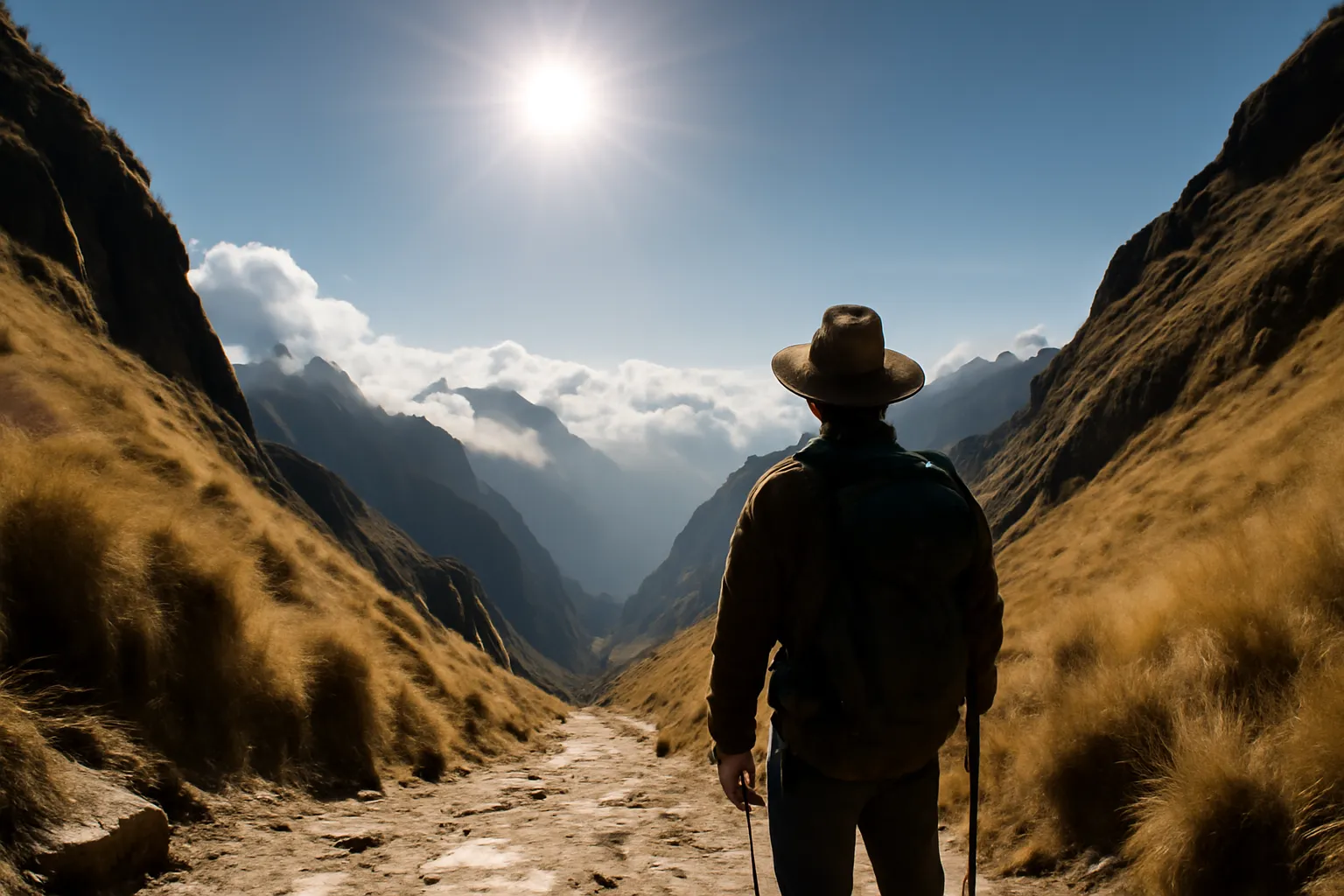
I was standing at 4,215 meters above sea level, gasping at the top of Dead Woman’s Pass, arms raised in triumph like every hiker before me — and I had absolutely no idea my face was being destroyed. That was Day 2 of the Inca Trail, the famous climb to Warmiwañusqa, and the Andean sun was doing something catastrophically efficient to my skin while I was too busy being proud of myself to notice. The air temperature was a perfectly pleasant 15°C. A light breeze was rolling across the puna grasslands. I wasn’t even sweating that much anymore — the worst of the climb was behind me. So I stood there, took seventeen photos, ate half a protein bar, and told my trail companion that this was “genuinely one of the best moments of my life.” It was. It also gave me the worst sunburn I have ever experienced in four decades of traveling to some genuinely brutal climates. By that evening at camp, my face looked like I’d lost an argument with a blowtorch. My lips weren’t just chapped — they were split, bleeding at the corners, and one section across the bow of my upper lip had blistered completely. The bridge of my nose had gone beyond red into something that belonged in a medical textbook. I had applied SPF 30 that morning. I thought I was prepared. The brutal truth about inca trail sun protection high altitude is that almost nobody tells you how dramatically the rules change when you leave sea level behind.
Why UV Exposure Is a Completely Different Beast at High Altitude in Peru
Here’s the physics that nobody puts in the glossy brochures: ultraviolet radiation increases by approximately 10 to 12 percent for every 1,000 meters of elevation gain. Do that math for Dead Woman’s Pass at 4,215 meters, and you’re absorbing somewhere between 40 and 50 percent more UV radiation than you would be at sea level. Not a little more. Nearly half again as much. Your SPF 30 — which blocks about 97 percent of UVB rays at sea level — is now operating in conditions it was never stress-tested for. It’s like bringing a rain jacket rated for a light drizzle to a monsoon and wondering why you’re soaked.
Peru compounds this in ways that are almost cartoonishly unfair. The country sits directly on the equator’s shoulder, meaning the sun travels almost directly overhead at solar noon. There’s no low-angle winter sun giving your skin a merciful geometric break. The rays come straight down, perpendicular to every horizontal surface — including the back of your neck when you’re bent forward grinding uphill for five hours. And the Inca Trail specifically runs through a climatic corridor where clear skies are common during the dry trekking season (May through September), meaning cloud cover isn’t going to save you either.
The cruelest trick altitude plays on trekkers, though, is thermal deception. At 4,000 meters, the thin atmosphere doesn’t retain heat the same way sea-level air does. You feel cool. You’re breathing hard because the air is thin — which means you’re also unconsciously mouth-breathing, and that constant flow of dry Andean air is desiccating your lips faster than you could possibly hydrate them from a water bottle. Meanwhile, the physical exertion of the climb is generating sweat, and sweat is the enemy of sunscreen. Most standard sunscreens wash off with perspiration in roughly 45 to 60 minutes under moderate exertion. Climbing 1,200 meters of elevation gain over five hours is not moderate exertion. By the time I reached the pass, I had probably been effectively unprotected for three hours without realizing it.
There’s also a melanin problem that specifically affects lips that most hikers completely overlook. Lip skin contains virtually no melanin — the pigment that gives your skin its primary natural defense against UV damage. Your lips have almost no biological sun protection whatsoever. They’re also thinner-skinned than any other exposed area on your face. At altitude, with dry air, heavy breathing, and relentless UV, your lips are essentially the canary in the coalmine. Mine failed spectacularly on Day 2, and they kept me awake that night in a way that the muscle soreness in my thighs simply didn’t.
The One Piece of Inca Trail Sun Protection Gear That Changed Everything
After limping into Wiñay Wayna camp that evening with a face that made my guide wince sympathetically and offer me something from his personal kit, I became, let’s say, highly motivated to research this properly. Back in Cusco after the trek, I spent an embarrassing number of hours reading about altitude UV exposure, sweat-proof formulations, and — critically — dedicated lip sun protection. What I landed on for every high-altitude trip since then is a pairing that travels together in my hip-belt pocket like old friends: a SPF 50+ broad-spectrum sunscreen for face and body, and a dedicated SPF lip balm applied constantly and without apology.
For the lip protection specifically, I now never leave for altitude without the Banana Boat Sport Ultra SPF 50 Lip Sunscreen Twin Pack. The twin-pack format is genuinely smart for a multi-day trek — one lives in my hip belt pouch, one lives in my pack as backup, because losing your only lip balm on Day 2 of the Inca Trail is a special kind of catastrophe. The SPF 50 rating matters at altitude in a way it frankly doesn’t matter much at sea level; given the UV multiplier effect, you need every point of protection you can get. It’s also oxybenzone-free, which I appreciate both for personal peace of mind and because when you’re sweating it off your lips into your mouth for four days, the ingredient list suddenly becomes a lot more relevant. It’s travel-sized, so it clears both carry-on restrictions and the weight-consciousness that becomes a religion somewhere around kilometer 8 of this trail.
A few specific features that make this work for high-altitude trekking specifically:
- SPF 50 rating: At 4,200m, you need the altitude multiplier factored in. SPF 30 is simply not the same product it is at the beach.
- Sport formulation: Designed to stay on during sweat-heavy activity, which is the entire Inca Trail experience from roughly 7am to 2pm every day.
- Twin pack: One for the hip belt, one for the pack. Losing your only lip protection mid-trek is not a recoverable situation in the Peruvian highlands.
- Oxybenzone-free: Cleaner ingredient profile for something you will inevitably ingest trace amounts of across four days of hard breathing.
One honest caveat: like all lip balms, this one requires consistent reapplication to work properly at altitude. If you’re the kind of person who applies once and forgets, you’ll still have a bad time. Set a phone alarm for every 30 minutes on Day 2 specifically. That’s not a product failure — that’s altitude physics doing its thing, and no lip balm defeats physics.
How I Actually Use Sun Protection Day by Day on the Inca Trail
The Inca Trail isn’t one uniform experience across four days — the UV risk actually changes significantly by day, and your protection strategy should shift with it.
Day 1: Km 82 to Wayllabamba (3,000m)
This is the “easy” day — relative term — and many trekkers underprotect here because they’re still in the mental framework of sea-level hiking. You’re already at 3,000 meters by the time you start, which means roughly 30 percent more UV than you’re used to. Apply SPF 50+ before the briefing at Km 82, and reapply after the first big river crossing where spray and humidity will compromise your application. Start the lip balm habit now, not on Day 2 when it’s already an emergency.
Day 2: Wayllabamba to Dead Woman’s Pass to Pacaymayu (4,215m peak)
This is the day that ends careers and humbles egos. You leave camp around 6am in cool conditions and spend approximately five hours climbing to the highest point of the entire trail. Apply SPF 50+ before leaving camp, then set a timer for 45 minutes — not 90, not 60, forty-five — and reapply to face, neck, and the back of your hands every single time it goes off. Apply the lip balm every 30 minutes minimum. I’m not being dramatic. This is the day I learned these lessons the hard way so you don’t have to.
Day 3: Pacaymayu to Wiñay Wayna (Cloud Forest Descent)
The cloud forest section lulls you into complacency with its beautiful green canopy and frequent mist. UV can penetrate cloud cover significantly — up to 80 percent of UV passes through light cloud. Keep applying. The humidity here also creates a false sense of skin hydration; your lips still need the balm even if they don’t feel dry.
Day 4: Machu Picchu (2,430m)
Lower altitude, but full, unobstructed sun exposure across open stone terraces with no shade. The site itself acts as a heat trap, and the reflective stone amplifies UV. Don’t abandon your protection routine just because you’ve descended. Cover up, reapply, and keep the lip balm in your pocket. This is also the day you’ll be taking the most photos, which means the most time standing still in full sun with your face tilted upward toward Huayna Picchu. Act accordingly.
Cultural and Practical Tips That Complete Your Inca Trail Experience
Sun protection is the gear story, but the Inca Trail is a cultural experience that deserves its own layer of preparation — particularly around how you present yourself and behave at sacred sites along the route.
The legionnaire hat is not optional. I know it looks deeply unfashionable. I wore one anyway and I would wear one again without hesitation. A hat with a rear neck flap specifically protects the area of skin that is most exposed during uphill hiking — when you’re bent forward into the grade, the back of your neck is effectively pointed at the sun for hours at a time. Standard baseball caps leave this area completely undefended. The legionnaire style solves this problem elegantly, and your neck will thank you.
Hydration directly affects UV damage. This is underreported and genuinely important: dehydration accelerates UV-related skin damage at altitude. Dehydrated skin cells have less capacity to repair UV damage. You should be drinking three to four liters of water daily on the trail anyway for altitude acclimatization — but know that those liters are also protecting your skin from the inside in ways your sunscreen can’t.
Respect the Quechua porters and guides who make this trek possible. They carry extraordinary loads — up to 25 kilograms — at elevations that have most trekkers breathing hard with empty hands. Learn a few words of Quechua (Allillanchu for hello, Sulpayki for thank you), and understand that tipping is both expected and deeply important to their livelihoods. The recommended tip is approximately 30 to 50 soles per porter for the four-day trek.
Dress codes at Machu Picchu are real. The site is a UNESCO World Heritage site and an active area of archaeological significance. Modest clothing that covers shoulders is culturally appropriate. For a deeper dive into how to dress respectfully at sacred sites across the world, our guide on temple dress codes at sacred sites worldwide covers the broader principles that apply everywhere from Machu Picchu to Angkor Wat. And if you want the Peru-specific clothing picture before you pack, the breakdown of cultural clothing expectations is worth reading before you finalize your kit.
The Sun Gate timing matters for sun exposure too. Most trekkers arrive at Inti Punku (the Sun Gate) between 7 and 9am on Day 4. This is actually the highest UV window of the day at altitude. Have your sunscreen and lip balm applied before you start that final morning push — not after you arrive at the gate for the view.
What I Wish Someone Had Told Me Before I Started Climbing
The non-obvious lesson from that lobster-faced evening in Pacaymayu camp isn’t really about sunscreen brands or SPF numbers. It’s about the gap between feeling safe and being safe at altitude. The cool air, the light breeze, the cloud shadows that come and go — they all create a completely convincing sensory experience of manageable conditions. Your skin has no nerve endings that register UV radiation. There’s no warning signal. The damage is silent, cumulative, and then suddenly catastrophic when you see your reflection at camp.
The Inca Trail is one of the most profound hiking experiences on earth. The Quechua people built a civilization at these elevations and knew this mountain sun intimately ��� which is precisely why traditional Andean dress involves layers, hats, and careful coverage that modern trekkers in their moisture-wicking t-shirts cheerfully ignore. There’s wisdom in the wardrobe, if you look for it. Go prepared, go protected, and the experience will be everything you dreamed it would be — including, importantly, the ability to smile in your photos at Machu Picchu without your lips cracking open.
Ready to Tackle Dead Woman’s Pass? Here’s Your Starting Point
Inca trail sun protection high altitude isn’t a detail you can improvise on the trail — the gear needs to be in your pack before you hit Km 82. Build the habit of the 45-minute reapplication alarm into your phone before Day 2, pack a dedicated SPF lip balm in your hip belt where you’ll actually reach it, and wear the unfashionable hat with the neck flap. Your future self — specifically your future self looking at trail photos with a face that hasn’t been destroyed — will be genuinely grateful.
The Banana Boat Sport Ultra SPF 50 Lip Sunscreen Twin Pack now lives permanently in my high-altitude hiking kit alongside my sunscreen and my legionnaire hat. It’s a small thing that solved a painful problem, and the twin-pack means I never arrive at altitude missing the backup.
The Inca Trail itself is extraordinary — one of those experiences that genuinely earns every cliché written about it. The stone stairways built by the Inca centuries ago, the cloud forest dripping with bromeliads, the moment the Sun Gate reveals Machu Picchu below you in the early morning mist. Go. Just go with better lip balm than I had on Day 2.
Affiliate Disclosure: This post contains affiliate links. As an Amazon Associate, I earn from qualifying purchases. If you buy something through my links, I may earn a small commission at no extra cost to you. I only recommend gear I’ve actually used on the road.