No booking page for the South Rim shows you this part: the exact distance between your pillow and the canyon edge. Numbers on a map won’t tell you that from a cabin at Bright Angel Lodge, that distance is about thirty seconds on foot — fleece thrown on, thermos in hand, no engine to warm up, no headlamp scramble through a dark parking lot, no anxious drive wondering if you’ll clear the gate before first light. You just walk out and the canyon is already glowing. That’s the entire case for booking grand canyon south rim lodging inside the park, and once you’ve done it that way, everything else feels like a workaround.
Nobody running a tourism blog wants to say this outright, but basing yourself in Williams or Flagstaff is a mistake dressed up as savings. Sure, the rooms cost less and there’s a Denny’s on every corner. What that math conveniently skips: 1.5 to 2 hours of driving tacked onto each day, a hunt for parking that starts before the sun’s even up, and total absence from the canyon during the two hours it actually performs. If you’ve come this far for the Grand Canyon, you’ve earned the right to sleep inside the South Rim boundary and open your eyes to that view. Here’s how you pull it off.
The Six Lodges Inside Grand Canyon South Rim: What You’re Actually Getting
Six lodging options sit inside the South Rim boundary — and one of them, oddly enough, is down at the canyon floor. Here’s the unfiltered breakdown of each.
El Tovar Hotel: Worth the Splurge
El Tovar has held court on the South Rim since 1905, and it still plays the part of the grand historic lodge better than anywhere else in the park. Anniversary trip, or just feeling like the National Park loyalist you are? Book here. Rim-facing rooms put the canyon right outside your window. The in-house restaurant has a reputation for prime rib that’s earned, not inherited — and yes, you can eat it while the sun drops behind the rim. Wander through the lobby and lounges and you’re briefly back in an earlier, slower era of American travel.
The trade-off: rates run $200–$400+ a night for anything decent, and rooms vanish from the booking system almost immediately. Strategy for beating that comes further down.
Bright Angel Lodge: The Best Bang for Your Buck on the Rim
This is my personal favorite — the strongest option for inside grand canyon lodging south rim if you’re watching your budget. You get historic cabins (a few with working fireplaces), a location practically welded to the rim, and rates that won’t force you into a payment plan. The Bright Angel Restaurant handles comfort food well, and you can’t beat the address — you’re at the canyon’s edge inside a minute of stepping outside your door. Winter is when this place really earns its reputation, since rates drop noticeably in the off-season.
Kachina Lodge & Thunderbird Lodge: The Dependable Middle Ground
Both properties are modern, comfortable enough, and a handful of rooms give you partial canyon views. Neither has the character of Bright Angel or El Tovar, but they’re consistent and predictable. Thunderbird edges out Kachina slightly for families. Availability disappears fast at both, though not with quite the frenzy you see at the historic lodges.
Maswik Lodge: Cheapest Rates, Longest Walk
Plan on a ten-minute walk to the rim here instead of the one-to-two-minute stroll from the other lodges, and don’t expect canyon views from your room. What you’re trading distance for is price — it’s genuinely hard to beat — plus a decent on-site café. If your priority is simply sleeping inside park boundaries rather than staring at the canyon the second you wake up, Maswik does the job.
Phantom Ranch: The Fantasy Option — With an Asterisk
The only place to sleep at the bottom of the canyon, and you can only reach it by mule or by hiking the Bright Angel Trail yourself. It’s the stuff of Grand Canyon daydreams, and it’s brutally hard to book. The catch is a lottery run through recreation.gov, and you’re entering it roughly a year ahead of your trip. Even with that lead time, your odds aren’t strong. Land a spot, though, and dinner and breakfast come included, you sleep in a no-frills cabin, and you experience the canyon in a way that 95% of visitors never come close to.
Locking Down a Reservation: The Real Strategy for Grand Canyon Village Hotels
This is where most people get it wrong. El Tovar, Bright Angel, Kachina, and Thunderbird open their booking windows exactly 13 months out through recreation.gov. Not twelve. Not thirteen and a half. Thirteen, on the dot.
Put an alarm on your phone for the exact moment your travel dates unlock. I’m not exaggerating about the need for this — the rim-view rooms at Bright Angel and every single room at El Tovar can be gone within hours, sometimes minutes. I had my alarm set for 7 a.m. Pacific, right when recreation.gov’s system flips over, and I was already at the keyboard. Landed a rim-view cabin at Bright Angel for a March stay. My sister, who logged on at 9 a.m., found nothing left at all.
Tactics that actually help:
- Save your payment details in your browser ahead of time so checkout takes seconds
- Nail down your exact travel dates before the booking window opens
- Stay flexible on which room type you’ll accept — even a rim-less room still puts you *inside* the park
- Keep checking back if your dates are sold out — cancellations pop up regularly, especially two to four weeks before arrival
- Winter stays are far easier to snag; spring and fall turn into a free-for-all
Campsites and Cheaper Ways to Stay Inside the South Rim
Not up for spending $150-plus a night? Fair enough. Mather Campground is the primary option, reservation-required, tucked into a ponderosa pine forest near the visitor center. Desert View Campground is smaller and first-come-first-served, sitting 26 miles east with rim views that hit harder and skies that go noticeably darker. Both run $15–$25 a night and still get you the “sleeping inside the park” upside.
Bright Angel Campground sits at the canyon bottom, meant for rim-to-rim hikers and serious backpackers — not something most visitors will use, but worth knowing it’s there.
The budget math, plainly: a South Rim lodge room, plus the $35 per-vehicle park entry, plus one dinner out, lands around $250–$300 a night. Camping, plus that same entry fee, plus cooking your own dinner, runs $60–$80 a night. Either path works. Both beat a 90-minute commute each way from Flagstaff.
Where to Shoot the Night Sky on the South Rim: A Milky Way Photography Primer
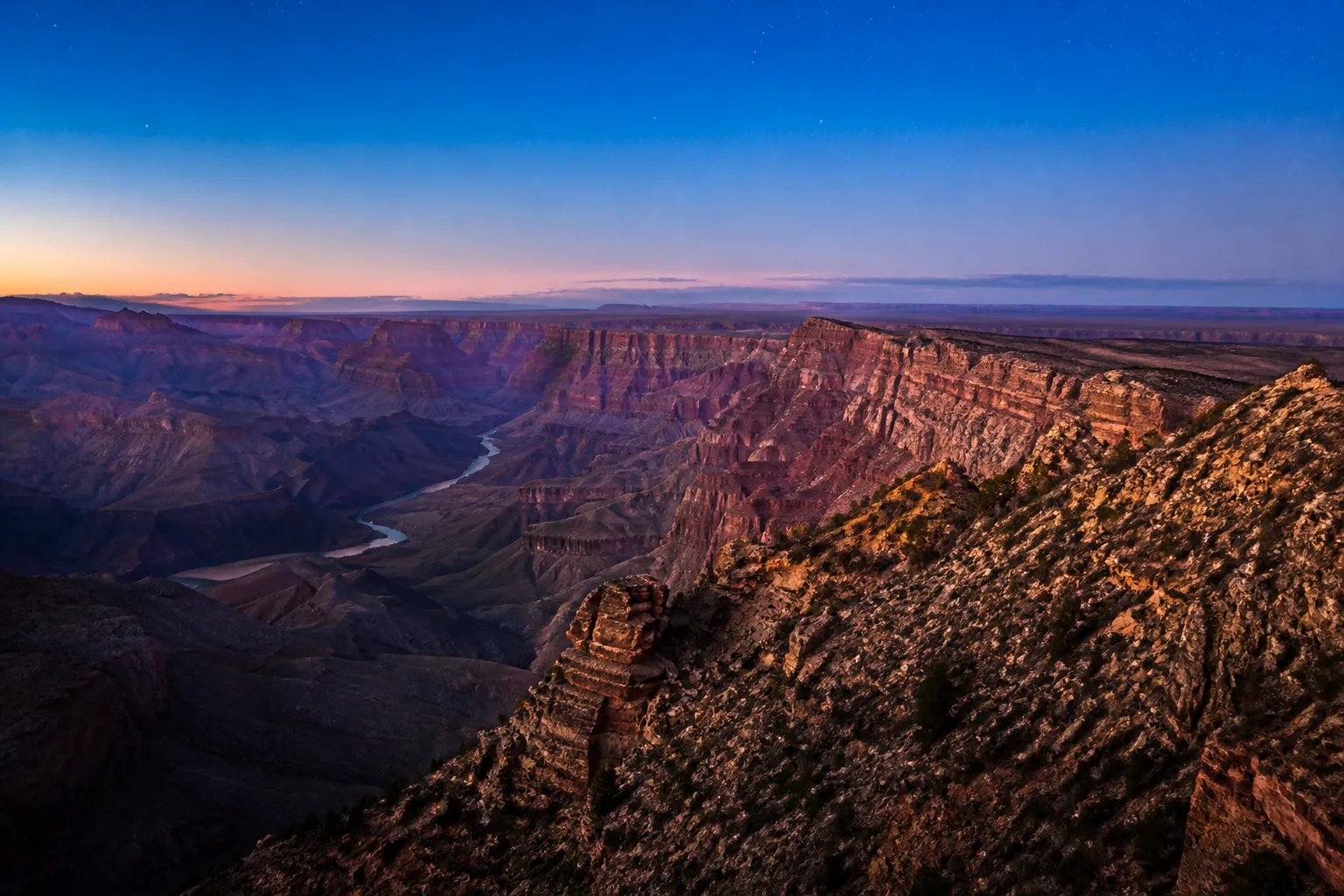
Here’s the extra layer that turns a good Grand Canyon trip into an unforgettable one: what happens after dark. The South Rim’s skies get dark enough in summer to see the Milky Way with nothing but your eyes, and through a camera lens, it’s something else entirely.
Mather Point: The Darkest Spot You Can Reach Without a Car
Consider this the insider pick for grand canyon south night photo spots. It’s about as dark as you can get without driving (the shuttle runs until 1 a.m. in summer), it’s wide open, and the light pollution here is close to zero. The Milky Way arcs right over the canyon from this spot. One catch: there’s no shelter from wind, so bring tripod gear that can handle gusts.
Yavapai Point: The Milky Way Framed by the Canyon
The skies here are a touch less dark than Mather, but the composition wins out — the canyon itself frames the Milky Way. It’s an easy walk from either Bright Angel or Kachina Lodge.
Powell Point: Facing West, With Room to Breathe
Craving fewer people around you? This west-facing overlook draws a smaller crowd and still offers respectable darkness. The shuttle gets you there too.
Desert View Watchtower: The South Rim’s Darkest Skies
Twenty-six miles east of the Village, this is the top-tier choice for south rim grand canyon night photo spots map searches — far enough from any light pollution the developed area throws off. The Watchtower structure itself gives your composition something to anchor to. Got a car and some patience? This is the shot to chase. Get there roughly 45 minutes before twilight fully fades, set up your gear, and wait for the Milky Way to fully emerge.
The Headlamp That Saves You From Eating Dirt on the Rim Trail at 5 a.m.
There’s no streetlight glow on the South Rim, no borrowed light from a nearby town, and zero forgiveness for showing up unequipped. Heading out toward sunrise without a solid headlamp isn’t just annoying — it’s a real hazard, something I learned firsthand the morning I nearly walked straight off a ledge I couldn’t see.
Where it earns its keep
- Switching to red light keeps your night vision intact so the stars stay visible as you walk, rather than washing the whole landscape into blinding white.
- It’s small and light enough to disappear in your pocket until the second you need it — useful when you’re already balancing a thermos, a camera, and a fleece.
- The beam spreads wide enough to reveal rocks and drop-offs along the trail without turning into a spotlight that broadcasts your location to every other pre-dawn hiker out there.
Where it falls short
- Battery life claims run optimistic — I got roughly 8 hours of real use on the high setting, well under the advertised 12-plus.
- The strap tends to loosen when you’re walking fast or bent forward, so expect to keep readjusting it mid-hike more than you’d like.
I almost left mine behind on my second morning, convinced I didn’t need it in the pre-dawn twilight, and I regretted it within 50 feet. Grab the Petzl Tikka before you book your cabin.
Frequently Asked Questions
How far is Bright Angel Lodge from the Grand Canyon rim?
Bright Angel Lodge sits about thirty seconds on foot from the canyon edge. You can step outside your door and reach the rim in one to two minutes, making it ideal if you want immediate access to the view without a long walk.
When do Grand Canyon South Rim lodge bookings open?
El Tovar, Bright Angel, Kachina, and Thunderbird open their booking windows exactly 13 months out through recreation.gov. Set an alarm for the precise moment your travel dates unlock, as rim-view rooms can sell out within hours or minutes.
What’s the cheapest way to sleep inside Grand Canyon South Rim?
Mather Campground and Desert View Campground both cost $15–$25 a night and let you stay inside park boundaries. Desert View sits 26 miles east with darker skies; both require reservations or first-come-first-served availability.
Where’s the best spot for Milky Way photography on the South Rim?
Desert View Watchtower, 26 miles east of the Village, offers the South Rim’s darkest skies with minimal light pollution. Arrive roughly 45 minutes before twilight fully fades to set up and capture the Milky Way with the Watchtower structure as an anchor.
About This Article

Written by Elena Vasquez. Elena Vasquez is a full-time traveler and the founder of Witty Passport. Over fifteen years and more than 50 countries across six continents — including a stretch spent leading groups professionally through Southeast Asia and the remote highlands of South America — she's written the kind of destination guides she always wished existed: practical, specific, and built on real experience rather than recycled itineraries. More about this site.
Scope and limits. Elena is a full-time traveler, not a licensed travel agent or immigration adviser. Entry requirements, visa rules, and advisories change without notice — always confirm against the official government source for your destination and passport before booking.
Verify this against a primary source
Specifics change, and your situation may differ from the one described here. These are the authorities worth checking directly:
- U.S. Department of State — entry requirements and travel advisories
- CDC Travelers' Health — vaccination and health notices by destination
- TSA — current carry-on and screening rules