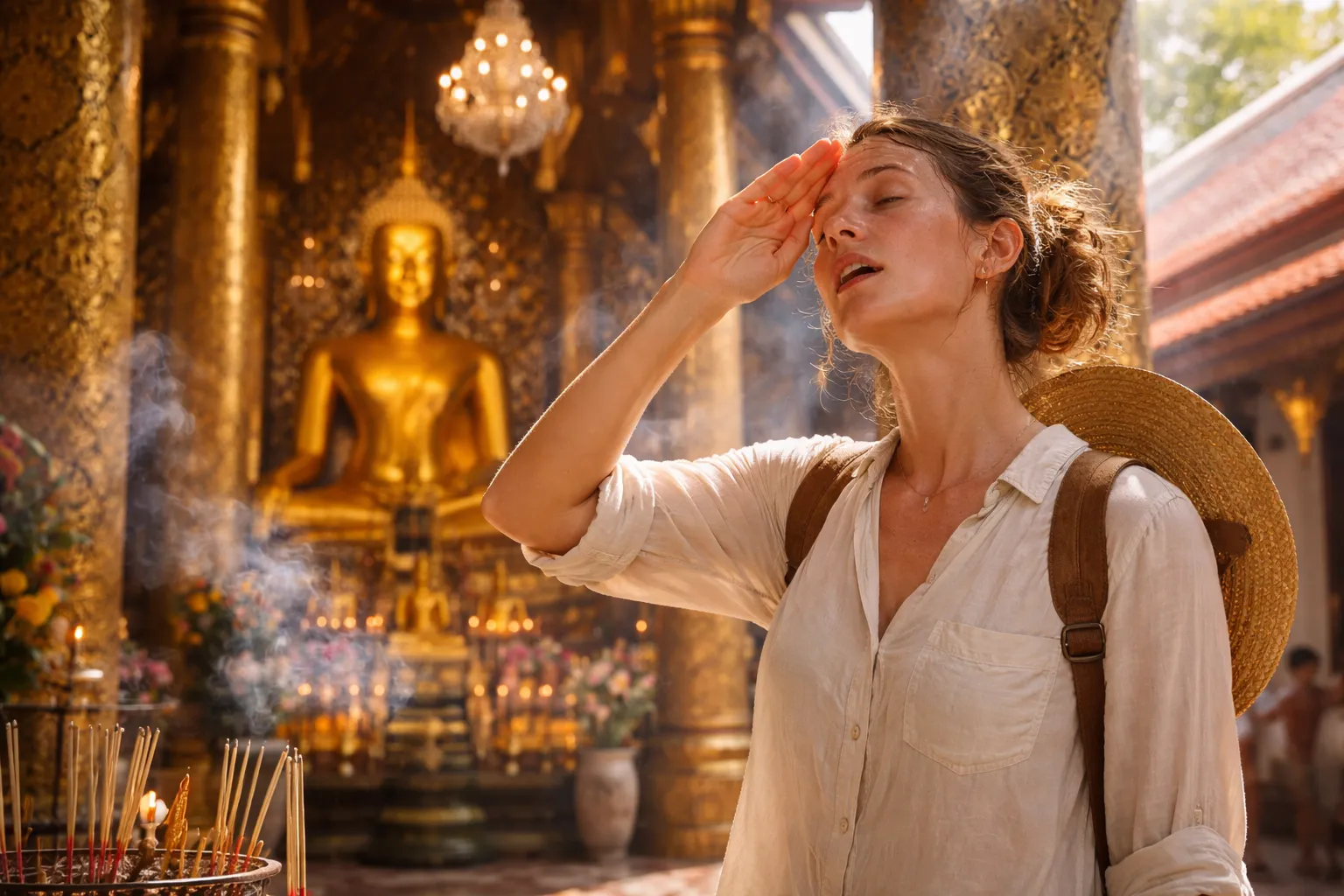
Back when I was still guiding groups through Bangkok, there’s one morning at the Grand Palace I haven’t managed to shake — 8:47 a.m., and I already had a sinking feeling I might not stay vertical much longer.
The gold spires and carved rooflines deserved every bit of awe I’d promised my clients they would inspire — that part wasn’t the problem. The problem was the long pants, the long-sleeved shirt buttoned all the way to my collarbone, and the closed-toe shoes I’d layered on to satisfy Bangkok’s unbending temple dress code. My phone clocked the air at 34°C (93°F), humidity sitting at 78%, and six more temples still waited on that day’s route.
Twenty minutes into the first complex and sweat was already tracing a line down my lower back. Ten minutes after that, the edges of my vision had that unmistakable shimmer to it. By the time I stepped into the chamber holding the Emerald Buddha, I was genuinely running the math on whether a tourist could faint inside Thailand’s holiest room. (Short answer: possible. Also mortifying.)
That near-collapse sent me digging through gear reviews for weeks afterward, and it’s how I eventually landed on the one item that now travels with me every time I’m back in Bangkok: a portable neck fan. Not just any model, though — one that could keep me cool without breaking dress code, and without making me look like I’d wandered off the set of a low-budget sci-fi film.
If you’ve got temple visits on your Bangkok itinerary and you’re already dreading the combination of heat and mandatory modest clothing, this is exactly the situation this story — and the fix that got me through it — was written to address.
Why Temple Heat Is Uniquely Brutal in Bangkok
Here’s what most travel guides skip over about Bangkok’s temples: the heat isn’t just a byproduct of the tropics. It’s climate, dress code, architecture, and city layout all converging at once, and together they’ll wreck you if you walk in unprepared.
The climate itself doesn’t let up. Between March and May, temperatures routinely climb to 35–38°C (95–100°F), and even during the so-called cool season you’re rarely under 30°C (86°F). Humidity is really what does the damage, though. Bangkok sits low near the Chao Phraya River in a tropical basin, so the air doesn’t just feel warm — it feels like a wet towel draped over your shoulders while you’re standing inside a running oven.
Heat alone would be manageable if the dress code weren’t stacked on top of it. Temple culture here comes from a place of genuine respect and modesty, and at the major sites — Wat Pho, the Grand Palace, Wat Arun, Wat Saket — there’s no wiggle room: shoulders covered, knees covered, shoes that close at the toe. There’s no “I’m just passing through” exception. Showing up in a tank top or shorts isn’t a minor faux pas — it reads as disregard for something the local community holds sacred.
So you’re left choosing between dressing appropriately in one of the harshest climates on the planet, or giving up on the temples altogether. Neither option makes sense when the temples are the whole reason you flew to Bangkok.
Then factor in the physical layout of these places. Bangkok’s temples aren’t climate-controlled museums — they’re almost entirely outdoors. The Grand Palace’s courtyards stretch out wide open to the sky. Wat Arun’s steep, famous staircase sits in unfiltered sun with not a scrap of shade in sight. Wat Pho spreads across roughly 80,000 square meters of stone and marble that soak up heat and radiate it right back at you, like walking across a giant solar panel. You’re not moving through air conditioning — you’re crossing an oven with no roof.
Doing a single temple complex justice takes a minimum of 2–3 hours, and if you’re determined to hit several in one day — as any dedicated temple-goer, myself included, tends to attempt — you’re logging 6–8 hours of near-constant outdoor exposure in full-coverage clothing. At that point, figuring out how to stay cool while visiting Bangkok’s temples stops being a minor comfort issue and starts being an actual safety concern.
The Neck Fan That Kept Me From Fainting at the Grand Palace
When the rules force you into something resembling Victorian mourning attire in 34°C heat with 78% humidity, an ordinary handheld fan is basically dead weight. What you actually need is something that lowers your core temperature while leaving your hands free — for a camera, sure, but more realistically for grabbing the nearest pillar the moment spots start creeping into your vision.
Where it earns its keep
- Airflow lands right on your neck and collarbone — exactly where your body sheds heat fastest — so the cooling is real, not just hot air rearranged around your face.
- Being hands-free means you can film a ceremony, jot down notes, or frantically search “heat stroke symptoms” on your phone without worrying about dropping anything.
- Charging via USB let me juice it back up at my guesthouse between temple stops, no chasing down batteries at a shop where I couldn’t read a single label.
Where it falls short
- Run it at full power in that heat and the battery drains fast — figure 4-5 hours before it dies, which isn’t enough to cover a full day of temple-hopping without a mid-day recharge.
- It looks precisely as absurd as you’d imagine, and more than a few tourists gave me the look you’d give someone who’d clearly lost the plot to heat exhaustion.
I’ll admit that at temple number four, I thought the battery had died and nearly surrendered to dehydration, but it turned out I’d just forgotten to flip the switch—and that’s entirely on me. If you’re serious about seeing Bangkok’s temples without collapsing, grab the Morelax Neck Fan, USB Rechargeable Personal Fan.
Frequently Asked Questions
What is Bangkok’s temple dress code?
Bangkok’s major temples—Wat Pho, the Grand Palace, Wat Arun, Wat Saket—require shoulders covered, knees covered, and closed-toe shoes. There’s no exception for passing through; the dress code reflects genuine respect for what the local community holds sacred.
How hot does it get in Bangkok temples?
Between March and May, temperatures climb to 35–38°C (95–100°F). Even during the cool season, temperatures rarely drop below 30°C (86°F). Humidity compounds the problem—Bangkok sits in a tropical basin near the Chao Phraya River, making the air feel like a wet towel draped over your shoulders.
How long does it take to visit one Bangkok temple?
A single temple complex takes a minimum of 2–3 hours to do justice. If you’re visiting multiple temples in one day, you’ll typically log 6–8 hours of near-constant outdoor exposure in full-coverage clothing.
How long does a portable neck fan battery last?
The battery drains fast at full power in Bangkok’s heat—figure 4–5 hours before it dies, which isn’t enough to cover a full day of temple-hopping without a mid-day recharge at your guesthouse or accommodation.
About This Article

Written by Elena Vasquez. Elena Vasquez is a full-time traveler and the founder of Witty Passport. Over fifteen years and more than 50 countries across six continents — including a stretch spent leading groups professionally through Southeast Asia and the remote highlands of South America — she's written the kind of destination guides she always wished existed: practical, specific, and built on real experience rather than recycled itineraries. More about this site.
Scope and limits. Elena is a full-time traveler, not a licensed travel agent or immigration adviser. Entry requirements, visa rules, and advisories change without notice — always confirm against the official government source for your destination and passport before booking.
Verify this against a primary source
Specifics change, and your situation may differ from the one described here. These are the authorities worth checking directly:
- U.S. Department of State — entry requirements and travel advisories
- CDC Travelers' Health — vaccination and health notices by destination
- TSA — current carry-on and screening rules