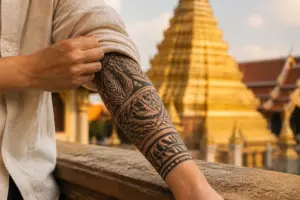

Forty baht and about ninety seconds — that’s the toll at the Grand Palace gate if your knees or shoulders are exposed, paid in the form of a rented wrap pulled from a bin by the entrance while a guard waits. That small, slightly humiliating transaction is exactly why so many people search “what to wear to temples in Thailand” before they’ve even booked flights. The reassuring part is that the actual rules are short and simple once someone lays them out for you, and getting your outfit for temple in Thailand right doesn’t mean rebuilding your entire suitcase around it.
What follows is a practical rundown of Thailand temple outfits for men and women both — the lightweight pieces that hold up in tropical heat, plus a plan for the moment you realize you’ve shown up in shorts and a tank top anyway. Whether your first stop is Wat Pho in Bangkok or a quiet neighborhood wat in Chiang Mai, you’ll finish this knowing what belongs in your bag, and how to avoid getting waved off at the door.
Here’s a scene I know a little too well: fresh off an overnight bus, still fuzzy from too many hours of recycled AC air, standing in front of Wat Pho — genuinely one of the most breathtaking temples you’ll lay eyes on — while a soft-spoken guard looks at your sleeveless sundress and gives a small, apologetic shake of the head. No translation needed. You understand instantly, and you also realize you simply didn’t plan your outfit around this exact moment. I’ve lived this exact scenario myself, more than once, and so has nearly every traveler I’ve ever guided through this region. That’s the whole reason this guide exists — because working out what to wear to temples in Thailand shouldn’t be the thing that costs you entry, or your composure.
A Thai temple — a wat — is a working place of worship, not a photo set. Covering up isn’t some arbitrary hoop set up to inconvenience tourists; it’s simply the respectful move. And the reassuring news is that respectful doesn’t have to mean stifling, itchy, or overheated. You just need the real rules in your head and a couple of well-chosen items in your bag. Let’s break it down.
The Dress Code for Visiting Temples in Thailand: What Actually Matters
If you want the full breakdown of restrictions and what happens when you show up unprepared, I’ve laid it all out in my complete Thailand temple dress code guide. For now, here’s the condensed version you need before we get into actual outfits.
The Thai temples dress code boils down to three things you really can’t skip:
- Shoulders stay covered. Tank tops, halters, and tube tops are all out. Cap sleeves generally pass; spaghetti straps do not.
- Knees stay covered. Shorts, mini skirts, and short dresses will stop you at the gate. Anything midi-length or longer works.
- Nothing sheer or overly revealing. Even if the hemline is technically long enough, a see-through maxi skirt won’t pass inspection.
Enforcement varies — the Grand Palace in Bangkok is notoriously strict, while small rural wats tend to look the other way. My honest recommendation, though: dress for the strictest version every single time. It costs you nothing, and it spares you the awkward shuffle-of-shame near the entrance.
Sleeve Length Rules for Thailand’s Temples
This is far and away the question I hear most, so here’s the short version: shoulders must be covered, but you don’t need full-length sleeves to do it. Cap sleeves — the style that just clears the shoulder and covers the upper arm — get accepted almost everywhere. Short sleeves work fine. Three-quarter sleeves are great too. What doesn’t fly: spaghetti straps, off-the-shoulder tops, strapless anything, and those wide-neck tees that slide down one shoulder mid-walk.
In practice, the sweet spot is a short-sleeved or cap-sleeved top or dress made from something breathable. Given Thailand’s heat and humidity, full-length sleeves make sense only if they’re ultralight linen or moisture-wicking — otherwise you’ll regret it. Cap sleeves check the modesty box while keeping you from turning into a puddle, which is a real risk in Bangkok come April.
Fast Answers on Shoes, Dresses, and Whether You Need a Head Covering
Are Flip-Flops or Birkenstocks Okay Inside a Temple?
Yes, without hesitation — flip-flops, sandals, and Birkenstocks are all fine for visiting Thai temples. You’ll be pulling your shoes off before entering any temple building regardless, so slip-on footwear is genuinely the smart pick; Birkenstocks in particular feel almost built for a day of Bangkok temple-hopping. One catch: if steep stairs are involved (Wat Arun, this means you), go with something that actually grips, not a flip-flop that’s flattened into a hazard.
Is a Dress Acceptable at a Thai Temple?
Definitely — and in this heat, a dress might be the single most comfortable option you’ve got. The only requirement is that it covers knees and shoulders: a midi or maxi cut with cap or short sleeves gets you through every temple gate in the country without issue. If your go-to dress has thin straps, just drape a scarf or a light cardigan over your shoulders and you’re covered, literally and otherwise.
Do Women Have to Cover Hair or Arms at Thai Temples?
Nope — and this catches a lot of travelers off guard, since head coverings simply aren’t part of the Thai Buddhist temple etiquette. It actually runs the opposite direction from some other traditions: hats and caps come off before anyone steps inside, no exceptions for gender. As for arms, only the shoulders need covering — forearms are fair game, and short sleeves are entirely acceptable.
Thailand Temple Outfits That Actually Work
The One Dress That Won’t Have You Overheating Between Temples
A day of temple-hopping in Thailand usually means hours on your feet, uneven stone underfoot, shoes coming off and back on repeatedly — all while staying within dress codes that demand covered shoulders and knees. I found out the hard way that a truly “temple-ready” dress has to do more than meet the rules: it has to breathe, move with your body, and not leave you drenched by your third monastery of the afternoon.
What works
- An ankle-grazing maxi length that stays clear of temple floors and doesn’t snag when you’re barefoot heading up stairs — a bigger deal than it sounds once you’re moving between prayer halls.
- Fabric that genuinely breathes in 35°C heat with full humidity — I made it to the main chedi without soaking through, a stark difference from the cotton sundress that failed me the day before.
- Short sleeves that satisfy the coverage rule without the bunching or sweat marks longer sleeves invite, and they still read as respectful rather than overdressed for the occasion.
What doesn’t
- The loose, flowy silhouette can read as shapeless if that’s not your style, and it eats up suitcase space fast — a real problem when you’re packing light for a week of back-to-back temples.
- Darker shades hide dust and grime far better than pale ones — light colors pick up every trace of temple-grounds dust and need a quick wash after basically every outing if you want to reuse them.
I almost ditched this dress after the first temple because the fit felt so loose I questioned whether it actually looked intentional, but by day three of my Chiang Mai temple circuit, I realized that looseness was exactly why I wasn’t miserable. ANRABESS flowy short-sleeve maxi dress
Frequently Asked Questions
What happens if you wear shorts to a Thai temple?
If your knees are exposed at the Grand Palace gate, you’ll pay forty baht to rent a wrap from a bin by the entrance while a guard waits. The rental covers you temporarily, but the easier approach is dressing for the strictest dress codes before you arrive—it costs nothing and spares the awkward moment at the door.
Do you need to cover your hair at Thai temples?
No, head coverings aren’t part of Thai Buddhist temple etiquette. In fact, hats and caps come off before anyone steps inside, with no exceptions for gender. Only shoulders need covering; arms and hair are fine.
Are cap sleeves acceptable at Thailand temples?
Yes, cap sleeves get accepted almost everywhere at Thai temples. Short sleeves and three-quarter sleeves work fine too. The rule is that shoulders must be covered, but you don’t need full-length sleeves to meet it—spaghetti straps and off-the-shoulder tops don’t pass.
Can you wear flip-flops inside a Thai temple?
Yes, flip-flops, sandals, and Birkenstocks are all acceptable for visiting Thai temples since you’ll remove your shoes before entering any temple building anyway. Slip-on footwear is the smart choice, though steeper stairs like those at Wat Arun call for something with actual grip.
How to Put On a Temple Wrap Without a Changing Room
Here’s what nobody tells you until you’re standing in direct sun outside Wat Phra Kaew, holding a rental sarong, with twelve people behind you in the queue: most temple entrances have zero private changing space. There’s a bin of wraps, a sign, and an expectation that you’ll figure it out. I learned my technique the hard way — tangled in a sarong, one sandal off, blocking traffic. You don’t have to.
The key reframe is this: you’re covering, not changing. Draping something over what you’re already wearing is faster, easier to do in public, and exactly as compliant as removing your shorts and replacing them with something else. Work with that.
- Wrap a sarong or long scarf over your shorts, not instead of them. Hold the fabric behind you, wrap it around to the front, overlap one side over the other, and tuck or tie it at your hip. Done in about ten seconds. Aim for ankle or at least knee length — if the sarong is short, tie it lower on your hips rather than at your waist to buy a few extra inches of coverage.
- Use a large scarf, pashmina, or sarong as an instant shoulder cover. For a tank top or sleeveless shirt, drape it across your shoulders and knot it loosely at one side rather than wrestling a full sleeved layer over your head in a crowd.
- Bring a hair tie, clip, or small safety pin. This is genuinely the biggest upgrade. Securing a wrap at the waist takes three seconds with a clip versus thirty seconds of tuck-and-hope, and it won’t slide off the moment you start walking. A safety pin lives happily in a day bag and costs nothing.
- If there’s a restroom nearby, use it. Even a basic one. A thirty-second detour to swap into proper layers over swimwear is almost always worth it when the alternative is fumbling in a crowd without a mirror.
Keep a lightweight scarf in your bag on any temple day and this entire process becomes a non-event. Two minutes of prep at your accommodation, zero stress at the gate.
About This Article

Written by Elena Vasquez. Elena Vasquez is a full-time traveler and the founder of Witty Passport. Over fifteen years and more than 50 countries across six continents — including a stretch spent leading groups professionally through Southeast Asia and the remote highlands of South America — she's written the kind of destination guides she always wished existed: practical, specific, and built on real experience rather than recycled itineraries. More about this site.
Scope and limits. Elena is a full-time traveler, not a licensed travel agent or immigration adviser. Entry requirements, visa rules, and advisories change without notice — always confirm against the official government source for your destination and passport before booking.
Verify this against a primary source
Specifics change, and your situation may differ from the one described here. These are the authorities worth checking directly:
- U.S. Department of State — entry requirements and travel advisories
- CDC Travelers' Health — vaccination and health notices by destination
- TSA — current carry-on and screening rules