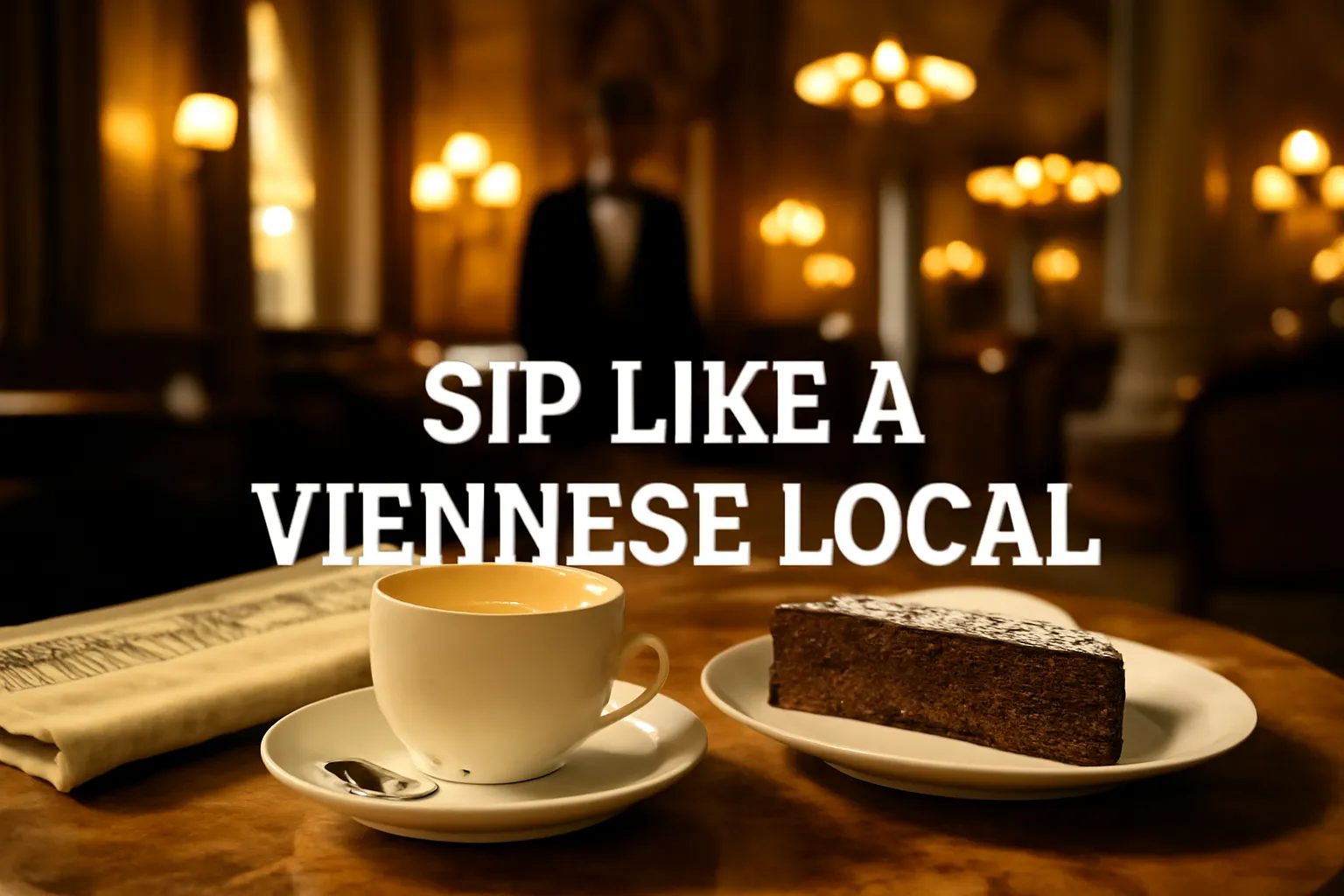
What actually makes a Viennese coffee house different from, say, a Parisian café or an Italian espresso bar? The honest answer: nobody is trying to turn your table over. Order a Wiener Melange, watch a waiter glide past your marble-topped table for the third time without so much as a glance toward the door, and it clicks — Vienna solved something most cities never bothered to address. A seat in one of these rooms isn’t a transaction or a caffeine pit stop; it’s closer to a worldview, delivered in a gilded room that smells faintly of newsprint. Spend an afternoon in one and every other coffee culture you’ve known will start to feel a little rushed by comparison. This isn’t hyperbole on my part, either — Vienna’s coffee house tradition holds UNESCO Intangible Cultural Heritage status, and that recognition isn’t handed out for a well-pulled shot. It’s awarded when an entire city organizes its social and intellectual life around sitting still and declining to leave.
Why Vienna Coffee House Culture Is Unlike Anything Else on Earth
The first coffee house in Vienna opened its doors back in the 1680s, and the city has spent the centuries since refining the craft of doing absolutely nothing in a chair, expertly. The Wiener Kaffeehaus rests on a premise that sounds almost radical now: once you’ve paid for your coffee, the clock stops. Grab a newspaper off the wooden rack near the entrance, order a single cup, and claim the next two hours as your own private territory. Nobody hurries you along, nobody hovers nearby waiting for the table to open up. A waiter in formal black and white delivers your coffee on a silver tray alongside a small glass of water — always the water, always unasked-for — and then retreats, leaving you entirely undisturbed. Read that as courtesy, not neglect. The Viennese have long understood that some of the world’s sharpest ideas were hashed out at coffee house tables, and interrupting that process is bad form. Freud drank here regularly. Trotsky pushed chess pieces around a board at Café Central. Arthur Schnitzler more or less lived in these rooms. Once a city’s coffee houses have shaped its literature, its political movements, and its psychoanalytic canon, “grabbing a coffee” stops meaning anything simple at all.
What You’re Actually Ordering: A Vienna Coffee Vocabulary Primer
Before you walk up to the counter of a proper Viennese coffee house and ask for “a coffee,” spare yourself the blank stare and learn a handful of terms first. The menu runs longer and stranger than most first-timers expect, and getting your order right is one of those small, satisfying wins.
- Wiener Melange — the city’s signature pour and the natural place to start. Espresso crowned with steamed milk and a soft layer of foam, poured into porcelain. Softer and milkier than a cappuccino, and a reliable first move.
- Einspänner — a strong black coffee in a glass, buried under a generous dome of unsweetened whipped cream. You sip through the cream rather than around it. It reads as indulgent on paper and delivers exactly that in the cup.
- Kleiner Brauner / Großer Brauner — a small or large espresso with a little pitcher of cream on the side. Quiet, no fanfare, consistently good.
- Verlängerter — the name translates to “lengthened,” and that’s exactly what it is: a Brauner diluted with extra hot water. Close cousin to an Americano, though a Viennese barista will politely reject that comparison.
- Fiaker — named for the city’s horse-drawn carriages, a strong black coffee laced with rum and finished with whipped cream. Best ordered mid-afternoon, once you’ve decided to fully surrender to the day.
- Kapuziner — a small coffee with just a dash of cream, tinted the brown of a monk’s habit — hence the name. Consider it the cappuccino’s ancestor, and feel free to order it with a bit of smugness.
One rule worth committing to memory: that glass of water arriving beside your coffee isn’t a subtle cue to finish up. Staff will quietly top it off while you sit there for hours. Treat it as the small ritual it’s meant to be.
Vienna’s Coffee Houses Worth Actually Seeking Out
Café Central
Tucked inside the Palais Ferstel on Herrengasse, Café Central holds its own as one of the most theatrical interiors in a city stacked with them — vaulted neo-Gothic ceilings, arched marble columns, a grand piano brought out on weekend afternoons. Trotsky reportedly spent early-1900s afternoons here hunched over a chessboard, and there’s now a wax figure of him near the entrance, which lands somewhere between charming and slightly odd depending on your politics. A Melange runs roughly €5–6, and weekends bring a proper queue. Show up on a weekday morning instead and give the breakfast menu the time it deserves.
Café Sperl
Where Central caters to tourists with a taste for history, Sperl caters to anyone who wants to feel briefly like a struggling artist circa 1880 — and remarkably little has shifted here since. The billiard table remains, the bentwood chairs are original, and the regulars are still reading physical newspapers rather than phones. Sperl reads as lived-in, not curated, and that distinction matters more than it sounds. Order an Einspänner and whatever looks best on the pastry cart rolling past. Plan on €5–8 for coffee and cake together.
Café Hawelka
Dim, tight on space, and bohemian in a way that feels earned rather than staged — Hawelka has drawn Vienna’s artists and thinkers since the 1930s, and the artwork lining the walls was mostly traded for coffee over the decades rather than purchased. The real reason to show up, though, is the Buchteln: warm, yeast-based buns stuffed with plum jam, served exclusively after 10pm. Build your evening around that window. It’s not a hardship.
Café Sacher and Demel
These two names have been feuding for generations over one question: whose Sachertorte is the “authentic” one. Hotel Sacher, positioned behind the Vienna State Opera, and Demel, over on Kohlmarkt, fought this out in actual courtrooms for years. The distinction, in short: Sacher layers its apricot jam inside the cake, Demel places it beneath the chocolate glaze. Sampling both and picking a side isn’t optional — it’s practically the assignment. Expect to pay around €7–9 for a slice with schlagobers (whipped cream) at either address.
What Belongs on Your Plate Alongside the Coffee
Food in a Viennese coffee house isn’t a footnote to the drink order — treat it with the same seriousness. Sachertorte aside, here’s what merits your attention:
- Apfelstrudel — warm apple and cinnamon rolled inside pastry thin enough to see through, finished with vanilla sauce or whipped cream. Pair it with a Melange for a proper afternoon Jause (Vienna’s version of teatime, generally 3–4pm).
- Kaiserschmarrn — shredded, caramelized pancake dusted with powdered sugar, served alongside plum compote. Essentially dessert masquerading as a main dish, and I say that with total admiration.
- Topfenstrudel — a curd-cheese strudel, lighter and more restrained than its apple relative. Goes especially well with a Verlängerter.
- Palatschinken — thin Austrian crepes, usually filled with jam or nut paste. Perfect at breakfast. Equally perfect at literally any other hour.
Coffee House Manners: How to Not Look Like a First-Timer
Viennese waiters get called brusque more often than they deserve — I’d describe it differently: formal, efficient, and operating under the assumption that you already know what you want. That’s not rudeness, it’s a different flavor of hospitality, one built around leaving you alone rather than performing warmth at you. A handful of guidelines will keep things smooth. Greet your waiter when you order — don’t skip this. Tipping is standard and appreciated: round up or add roughly 10%, and hand it directly to the server rather than leaving cash on the table. When you’re ready to settle up, the phrase is “Zahlen, bitte” — no waving, no snapping fingers. And never apologize for camping out over a single cup for two hours; that’s the entire premise of the place, not a violation of it. Mornings, from opening until around 11am, run quieter and suit a leisurely breakfast. The 3–5pm window is peak pastry territory for the afternoon Jause. Evenings shift the mood toward something more social, with wine and Wiener schnitzel taking over the tables at certain spots.
Old-School Coffee Houses Against the New Specialty Wave
Alongside its grand institutions, Vienna has quietly built a legitimate specialty coffee scene, and the two camps seem to coexist without any real friction. Jonas Reindl Coffee Roasters, with outposts near the Votivkirche and Westbahnhof, pours some of the finest single-origin filter coffee anywhere in Central Europe, inside a pared-back, Nordic-leaning space. Kaffeefabrik, over in the 4th district, roasts its own beans on-site and treats sourcing with a level of intensity usually reserved for natural wine circles. If brewing methods and bean origin genuinely interest you, this is your scene. My actual advice, though: don’t pick a side. Spend mornings at Café Central or Sperl with a Melange and something sweet, wander the city, and swing by Jonas Reindl in the afternoon for a carefully extracted filter coffee. Vienna is one of the rare cities where a centuries-old tradition and a cutting-edge coffee scene both operate at the top of their game simultaneously. Choosing sides here would just be shortsighted.
Rounding Out Your Day: Vienna’s Food Scene Beyond the Coffee House
A coffee house crawl slots neatly alongside the rest of what Vienna serves up food-wise. Kick off your morning with breakfast at a traditional coffee house, then walk over to the Naschmarkt — the sprawling open-air market stretching along the Wienzeile — for some mid-morning browsing. Stalls here cover Austrian cheeses and cured meats, Turkish spices, fresh-pressed juice, and some genuinely excellent falafel. Grab ingredients to go, or park yourself at one of the market’s sit-down spots for lunch (figure €12–18 for a proper meal). Come evening, head to the wine taverns on the city’s edges known as Heurigen — Grinzing, Sievering, and Neustift am Walde are the classic destinations — for glasses of Grüner Veltliner alongside cold spreads of bread, lard, and pickles. And if midnight finds you still wandering, detour to a Würstelstand. These sausage stands, scattered across the city, are practically a civic institution: grab a Käsekrainer (cheese-stuffed sausage) with mustard and bread, and eat it standing on the sidewalk at 1am next to taxi drivers and opera patrons still in black tie. Few food experiences in Europe feel as genuinely democratic.
A One-Day Coffee House Route Worth Following
This loop stays within Vienna’s historic first district, linking four landmark coffee houses that are all a short walk apart:
- 9am — Café Central (Herrengasse 14): A breakfast Melange with a Kipferl (crescent roll). Take in the ceiling. Flip through a newspaper you can’t actually read.
- 11am — Demel (Kohlmarkt 14): Pause for a slice of Sachertorte and watch the pastry team at work behind the glass display kitchen. Grab a box of chocolates before you leave.
- Afternoon — Naschmarkt wander: Follow the Ringstrasse down to the market and graze without a plan.
- 3:30pm — Café Sperl (Gumpendorfer Straße 11): Proper afternoon Jause territory — Apfelstrudel with vanilla sauce and an Einspänner.
- 10pm — Café Hawelka (Dorotheergasse 6): Back for the famous Buchteln. Order a Fiaker. Linger as long as you want — that’s really the whole point of the day.
The Small Guide That Saved Me From Ordering by Charades
Vienna’s coffee house culture runs on unwritten rules that show up everywhere — which districts pour the best Melange, which cafés actually welcome someone who wants to sit for hours versus which ones will guilt a tourist into clearing out after 20 minutes. Without something reliable to reference, you’ll either miss the real experience entirely or wander into a tourist trap charging €8 for a mediocre cup.
Where it delivers
- The neighborhood-by-neighborhood detail tells you exactly which districts hold the coffee houses where locals nurse one cup for three hours — specific enough to be useful, compact enough to actually finish before your plane touches down.
- The etiquette section demystifies the whole thing without condescension — it explains why waiters leave you alone on purpose and what “Melange” actually means, no pretentiousness attached.
- It’s small enough to toss in a day bag, so you’re not hauling a 600-page brick around just to confirm you’ve walked into the right café or ordered the right drink.
Where it falls short
- The maps run small and occasionally outdated — one spot billed as a “must-visit” had shut down two years before my trip, which stung after I’d planned an entire morning around finding it.
- It assumes some baseline German, so if pronunciation has you completely stumped, the compact format only offers so much hand-holding.
I almost ditched it halfway through my first morning, thinking it was too general, but by day two I realized how often I was checking the neighborhood guide before wandering into a new district. Rick Steves Pocket Vienna turns out to be the difference between authentic stumbling and lost tourist stumbling.
Frequently Asked Questions
What is a Wiener Melange and how is it made?
A Wiener Melange is Vienna’s signature coffee: espresso crowned with steamed milk and a soft layer of foam, poured into porcelain. It’s softer and milkier than a cappuccino, making it a reliable first order for visitors trying Viennese coffee culture for the first time.
How long can you stay at a Viennese coffee house?
Once you’ve paid for your coffee, you can stay as long as you want—there’s no time limit. Grab a newspaper from the wooden rack near the entrance and claim the next two hours as your own private territory. Staff will quietly top off your water glass while you sit for hours without pressure to leave.
What should I order at Café Hawelka after 10pm?
Order the Buchteln, Vienna’s famous warm yeast-based buns stuffed with plum jam, served exclusively after 10pm at Café Hawelka. Pair them with a Fiaker—a strong black coffee laced with rum and finished with whipped cream—and linger as long as you want.
How much does coffee cost at Café Central or Café Sperl?
At Café Central, a Melange runs roughly €5–6. At Café Sperl, plan on €5–8 for coffee and cake together. Both are landmark coffee houses located within Vienna’s historic first district, a short walk apart.
About This Article

Written by Elena Vasquez. Elena Vasquez is a full-time traveler and the founder of Witty Passport. Over fifteen years and more than 50 countries across six continents — including a stretch spent leading groups professionally through Southeast Asia and the remote highlands of South America — she's written the kind of destination guides she always wished existed: practical, specific, and built on real experience rather than recycled itineraries. More about this site.
Scope and limits. Elena is a full-time traveler, not a licensed travel agent or immigration adviser. Entry requirements, visa rules, and advisories change without notice — always confirm against the official government source for your destination and passport before booking.
Verify this against a primary source
Specifics change, and your situation may differ from the one described here. These are the authorities worth checking directly:
- U.S. Department of State — entry requirements and travel advisories
- CDC Travelers' Health — vaccination and health notices by destination
- TSA — current carry-on and screening rules