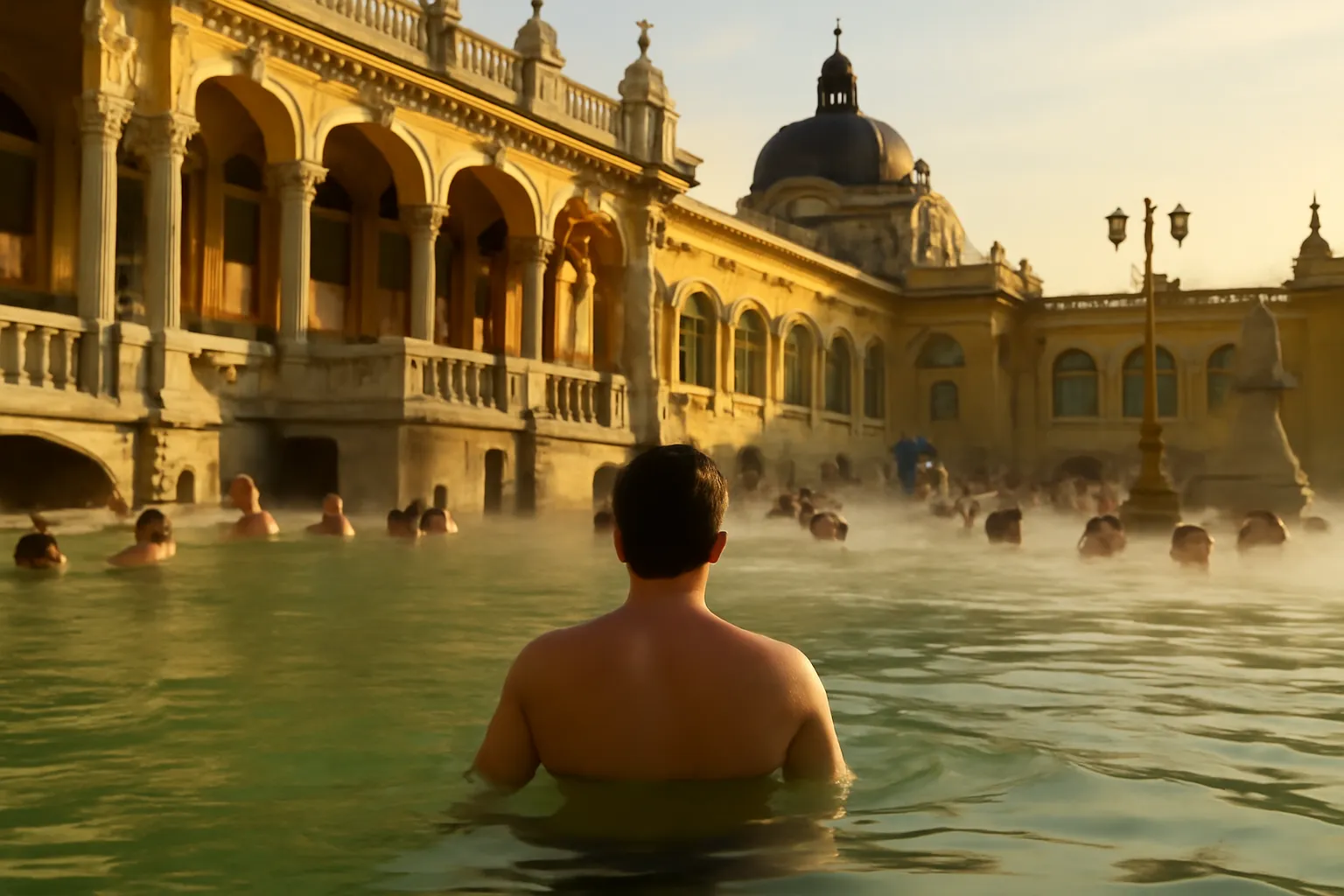
Four seconds. That’s how long I had to decide whether to do something reckless before the whole scene disappeared for good. I was chest-deep in one of the outdoor pools at Széchenyi, watching my own breath merge with the steam rising off 38°C water into a frozen Budapest January, when an elderly Hungarian gentleman began setting up his chess pieces on the floating board drifting between us — unhurried, exact, clearly a Tuesday ritual he’d kept up for thirty years running. Behind him, the neo-baroque facade glowed yellow under the floodlights, theatrical as a stage set. Steam curled past the carved stone archways in slow ribbons. Somewhere across the water, a cluster of tourists burst into laughter over something I couldn’t hear. It was, without exaggeration, the single most Budapest moment I’ve ever witnessed with my own eyes — and my phone was sealed away two buildings and two sets of doors from where I stood, inside a cabinet roughly the size of a carry-on, in a changing room I half-suspected was in a different postal code entirely. I’d taken the advice everyone gives: lock up your valuables, be present, live in it. Sound philosophy. Terrible for anyone who actually wants the photo. So I stayed there in the thermal water, fully aware I was watching something I’d never get to see again, and completely powerless to record it. If you’ve been searching budapest thermal baths what to bring, let this spare you the exact soggy, helpless regret I felt.
Why Protecting Your Phone at Budapest’s Thermal Baths Is a Uniquely Complicated Problem
Here’s what most guidebooks leave out entirely: the water filling Budapest’s celebrated pools isn’t just heated tap water with a good origin story attached. It’s mineral-dense groundwater that’s spent somewhere between 2,000 and 30,000 years working its way through limestone bedrock before it ever reaches those tiled basins. Széchenyi’s supply in particular runs heavy with calcium, magnesium, hydrogen carbonate, and sulfate — figures that belong on a lab report, not a spa menu. Sulfate-rich water happens to be far harder on electronics than the chlorinated water you’d swim in back home. It works its way past button seals, creeps into charging ports, and calcifies inside speaker grilles in ways no amount of rice will undo. I’ve sat with enough fellow travelers nursing dead iPhones in Budapest cafés to know this isn’t a theoretical warning.
More than 120 natural thermal springs run beneath Budapest, which is exactly why bathing culture here goes back to the Romans, who founded Aquincum on this spot in the first century AD. The Ottoman occupation of the 16th and 17th centuries only deepened that tradition, leaving behind hammams that still function as working baths today — Rudas, dating to 1550, chief among them. The Austro-Hungarian era then added its own architectural flourish: Széchenyi, opened in 1913, remains the largest medicinal bath complex in Europe, spread across 18 pools ranging from 18°C to 40°C. Gellért followed in 1918, an Art Nouveau showpiece with its famous wave pool and mosaic-covered interiors so ornate they look like a cathedral someone decided to flood. None of this is resort décor. These are living monuments still doing the job they were built for.
Which is exactly why the photo urge is so strong — and exactly why pulling it off is so aggravating. The budapest spa etiquette tourists usually read up on stops at “shower before entering,” but the actual challenge is logistical: you’re cycling between pools of drastically different temperatures over three to four hours, moving from indoor to outdoor spaces where winter’s temperature gap fogs up any exposed screen almost instantly, and every locker trip means drying off, getting dressed, retrieving your key, then reversing the entire process just to get back in. Faced with that hassle, most visitors just leave the phone locked away for good. Then they spend the ride back to their accommodation quietly grieving every shot they never took.
And then there’s Sparty — the weekend-night spa parties Széchenyi throws, DJs spinning poolside, the water glowing under shifting colored lights until the whole scene reads like a fever dream crossed with a Renaissance painting. Missing those photos isn’t a small letdown. It’s a genuine one.
The Waterproof Pouch That Made It Through My Chess Match at Széchenyi
Smartphones and thermal water make an awful pairing — you want to capture the surreal beauty, check the time, maybe text a friend soaking in a different pool, but a single wrong splash means shopping for a $900 replacement in a country where you barely speak the language. I learned this the hard way on an early Budapest trip, before I’d bothered sorting out any waterproof solution at all.
What holds up
- That seal genuinely does its job — dozens of underwater photos and clips later, across bath complexes all over Europe, not a drop has gotten through.
- Full functionality survives the plastic barrier, even in cold water — the touchscreen responds normally, so there’s no fumbling with settings once you’re back up on the deck.
- Buoyancy sounds like a throwaway feature until you’re neck-deep watching it bob calmly on the surface, rather than sinking straight down like your friend’s bare, unprotected phone.
Where it falls short
- The lanyard is the weak point — mine gave out after roughly nine months of regular use, though I’ll admit part of that’s on me for yanking it out of the water too hard, too often.
- Skip letting it fully dry between uses and condensation builds up inside, which turns into a real problem across back-to-back bath days when your screen goes too foggy to actually frame a photo.
I nearly didn’t bring one to Budapest that January—I convinced myself I could just be careful—but watching that Hungarian man settle in for his chess game made me suddenly aware I’d need proof this moment happened. Hiearcool Waterproof Phone Pouch meant I could actually play in that game without anxiety.
Frequently Asked Questions
What minerals are in Széchenyi thermal bath water?
Széchenyi’s water runs heavy with calcium, magnesium, hydrogen carbonate, and sulfate. These minerals have spent between 2,000 and 30,000 years working through limestone bedrock before reaching the pools. The sulfate-rich composition is significantly harder on electronics than chlorinated water, creeping past seals and calcifying inside ports and speaker grilles.
How many thermal springs exist under Budapest?
More than 120 natural thermal springs run beneath Budapest, which is why bathing culture here goes back to the Romans, who founded Aquincum on this spot in the first century AD. This deep geothermal heritage shaped the city’s identity across the Ottoman and Austro-Hungarian eras.
What’s the temperature range at Széchenyi baths?
Széchenyi, which opened in 1913, remains the largest medicinal bath complex in Europe, with 18 pools ranging from 18°C to 40°C. The outdoor pools reach 38°C, making the temperature contrast particularly dramatic when bathing during Hungarian winters.
When did Rudas and Gellért thermal baths open?
Rudas dates to 1550 and still functions as a working bath, a legacy of Ottoman occupation in the 16th and 17th centuries. Gellért followed in 1918 as an Art Nouveau showpiece, featuring a famous wave pool and ornate mosaic-covered interiors.
About This Article

Written by Elena Vasquez. Elena Vasquez is a full-time traveler and the founder of Witty Passport. Over fifteen years and more than 50 countries across six continents — including a stretch spent leading groups professionally through Southeast Asia and the remote highlands of South America — she's written the kind of destination guides she always wished existed: practical, specific, and built on real experience rather than recycled itineraries. More about this site.
Scope and limits. Elena is a full-time traveler, not a licensed travel agent or immigration adviser. Entry requirements, visa rules, and advisories change without notice — always confirm against the official government source for your destination and passport before booking.
Verify this against a primary source
Specifics change, and your situation may differ from the one described here. These are the authorities worth checking directly:
- U.S. Department of State — entry requirements and travel advisories
- CDC Travelers' Health — vaccination and health notices by destination
- TSA — current carry-on and screening rules