The thin checkered cloth they handed me at the entrance to Çemberlitaş Hamamı was roughly the size of a large dish towel. A man in a white apron gestured toward the changing cubicles, said something in Turkish, and disappeared. I stood there holding what I’d later learn was a pestemal — the traditional Turkish bath wrap — wondering whether I was supposed to wear it, tie it, or use it as a blindfold so I wouldn’t have to watch myself figure out the first two options. If you’re researching turkish hammam what to bring first time, you’re already smarter than I was. I walked in with nothing but a travel-sized shampoo and a dangerous level of confidence. The shampoo was unnecessary. The confidence evaporated within thirty seconds. What followed was one of the most disorienting, unexpectedly transcendent experiences of my entire life — a two-hour ritual inside a 16th-century marble bathhouse where I was scrubbed, kneaded, soaked, and essentially rebuilt from the cellular level. But first, I had to survive the excruciating awkwardness of not knowing a single thing about what was happening or what I was supposed to do about any of it.
Why Turkish Hammam Etiquette Is Uniquely Disorienting for First-Time Visitors
Let’s start with some context, because Çemberlitaş isn’t just any spa. It was designed by the legendary Ottoman architect Mimar Sinan — the same man responsible for the Süleymaniye Mosque — and completed in 1584. When you step through those heavy wooden doors off Divan Yolu Street in Istanbul’s old city, you’re entering a building that has been continuously operating as a public bathhouse for over 400 years. That history is part of what makes the hammam experience so powerful. It’s also part of what makes it so utterly confusing for anyone who grew up showering alone in a bathroom with a lock on the door.
Turkish hammam etiquette for tourists is a genuine knowledge gap, and nobody at the door is handing out instruction manuals. Here’s what first-timers typically stumble through:
The Nudity Protocol
Men remove everything and wrap the pestemal around the waist, securing it toga-style. It covers from hip to mid-thigh, and that’s it. Women’s sections traditionally allow for more coverage — bathing suits or underwear are acceptable — but the etiquette varies by hammam. At tourist-facing historic hammams like Çemberlitaş, women typically keep swimwear on. At local neighborhood hammams, customs lean more traditional. What nobody tells you: underwear under the pestemal is uncomfortable, creates weird tan lines in the steam, and immediately identifies you as someone who didn’t do their research. Save yourself the experience.
The Sequence of Rooms
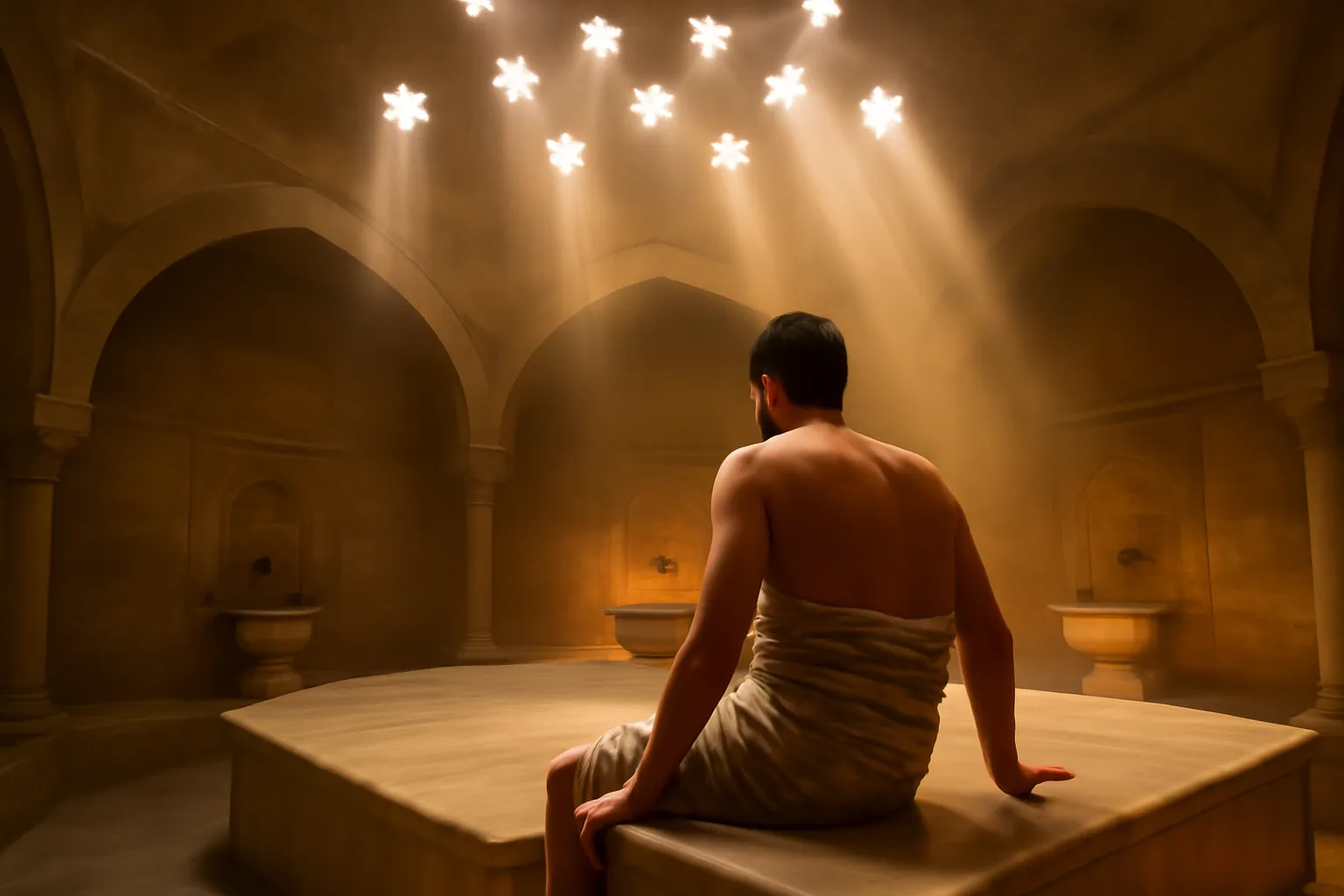
A proper hammam follows a specific architectural and thermal journey. You start in the camekân (the domed changing room), then move through the ılıklık (a warm intermediate room for acclimatizing), and finally enter the sıcaklık — the hot room, where temperatures hover between 40°C and 50°C (104°F–122°F). At the center of the sıcaklık is the göbektaşı, a large heated marble platform — literally “belly stone” — where you lie flat and slowly surrender your entire concept of personal space. The heat does something to you. Time stops. Marble is surprisingly comfortable after the first five minutes.
The Kese Scrub
Your tellak (bath attendant) will appear eventually, wearing what looks like a scratchy oven mitt called a kese. The scrubbing that follows is not a gentle spa exfoliation. It is vigorous, efficient, and occasionally borderline aggressive in the best possible way. Enormous gray rolls of dead skin will emerge from your body like something from a nature documentary. This is normal. This is the point. Do not apologize for having skin. The tellak has seen it all and is completely unbothered. The foam massage (köpük) that follows involves a pillowcase-sized bag of lather and feels like being washed by a very thorough cloud.
The Tipping Question
Standard tipping at a Turkish hammam is 15–20% of the service cost, handed directly to your tellak at the end — not left at the desk, not included in the entrance fee. At Çemberlitaş, a full scrub and foam massage runs around 750–900 Turkish lira (prices shift with exchange rates, always confirm on arrival). Tip in cash, in Turkish lira, handed personally. It’s the difference between a transaction and an acknowledgment of genuine craft.
Authentic vs. Tourist Trap
The Sultanahmet neighborhood is gorgeous and convenient, but it’s also lined with hammams that charge five times the local rate for a fraction of the experience. Çemberlitaş Hamamı and Kılıç Ali Paşa Hamamı in Tophane are the two historic hammams worth splurging on — they’re genuine, beautifully maintained, and the staff actually knows what they’re doing. Avoid anywhere with a laminated English menu out front and a commission-earning hotel concierge recommendation.
The One Piece of Gear That Changed Everything (And What to Wear in a Turkish Bath)
After emerging from Çemberlitaş looking like a boiled lobster who had recently found inner peace, I did what any self-respecting travel obsessive does: I went back to my hotel room and researched for two hours. The single thing I wished I’d known before walking in — the one practical detail that would have improved the entire experience — was this: bring your own pestemal.
The cloths provided at tourist-facing hammams are often thin polyester substitutes that don’t absorb steam properly, slip constantly, and feel nothing like the real thing. A genuine Turkish pestemal is woven from natural cotton, gets softer with every wash, and is the correct traditional wrap for the experience. It’s also just a significantly better towel in every measurable way.
The one I now travel with everywhere is the DEMMEX Organic Diamond Turkish Bath & Beach Towel — 100% Oeko-TEX certified cotton, prewashed, 71 inches by 36 inches. Here’s specifically why it works for this context:
- The size is right. At 71″x36″, it wraps properly around any body type for the hammam, drapes over the göbektaşı without bunching, and is large enough to actually dry off with afterward. The flimsy squares handed out at some tourist hammams are genuinely too small to function as real wraps.
- It’s actually quick-drying cotton. The flat-weave construction means it dries in a fraction of the time a terry cloth towel takes — critical when you’re moving between the hot room and the cool-down area and don’t want a sopping cloth hanging off you for twenty minutes.
- It packs down to almost nothing. Rolled up, it fits in the palm of your hand. In a travel context where every cubic inch of bag space is contested territory, this matters enormously.
- It functions well beyond the hammam. Over the course of a two-week Turkey trip, I used it as a beach towel in Ölüdeniz, a blanket on a night bus from Istanbul to Cappadocia, a makeshift scarf in a mosque, and a picnic blanket at Galata. A good pestemal is a travel multi-tool.
One honest limitation: If you’re used to plush terry cloth towels and need that thick, hotel-robe feeling after a shower, a pestemal will feel spartan by comparison. It’s efficient, not luxurious in the fluffy sense. But for the hammam specifically — and for lightweight travel generally — that’s exactly the point.
How I Actually Use It: Real Scenarios From the Hammam Experience in Istanbul
Let me walk you through how the pestemal actually functions during a full hammam visit, because knowing the sequence makes the whole thing dramatically less stressful.
In the Camekân (Changing Room)
You’re assigned a private wooden cubicle to undress and store your belongings — there’s usually a lockable cabinet. Strip down, wrap the pestemal around your waist (men) or use it as a full wrap or toga (women), and slip on the wooden clogs (takunya) they provide. The key is securing the pestemal firmly at the hip. Tuck the corner under a fold, not over. It holds better. Bring your own pestemal and you already look like someone who’s done this before, which is a small but genuine psychological advantage when you’re about to walk into a steam room full of strangers.
On the Göbektaşı
The heated marble platform in the center of the sıcaklık is where you spend the bulk of the passive part of the experience. Lay your pestemal flat on the marble — both for hygiene and comfort — and lie face-up. The stone radiates heat from below while steam fills the room from above. Do nothing. Stare at the domed ceiling with its small star-shaped skylights. Let the heat do its work. Turkish regulars around you will be chatting, dozing, entirely unbothered. Aim for fifteen to twenty minutes before the tellak arrives. This is not the moment to check your phone. Leave it in the locker.
During the Kese and Köpük
The tellak will motion for you to move to a raised marble ledge at the side of the room. Set your pestemal aside — you’ll be on bare marble for the scrub. The kese mitt works on wet skin, so you’ll be splashed with bowls of warm water first. Try not to tense up. The scrubbing is thorough but not painful. Breathe through it. The foam massage afterward involves being essentially enveloped in lather — it’s deeply weird and deeply wonderful. Afterward, your pestemal goes back on for the walk to the cool-down area.
The Cool-Down and Tipping Moment
You’ll return to the camekân where a staff member brings tea — accept it, it’s part of the ritual — and you’re given time to cool down gradually. This is when you tip your tellak directly. Have cash ready in a pocket of whatever bag you brought in. Count it out beforehand. Hand it with both hands, make eye contact, say teşekkür ederim (thank you). It takes four seconds and means something.
Essential Turkish Hammam Etiquette Tips That Complete the Experience
Beyond the pestemal and the sequence, there are a handful of cultural etiquette details that transform the hammam from a tourist activity into an actual cultural experience.
Don’t Rush
A proper hammam visit takes ninety minutes to two hours. Budget accordingly. Don’t book a hammam at 4:30 PM when you have a dinner reservation at 6:00. The entire point of the ritual is that time dissolves. Schedule it for a morning or a rest afternoon, not as a quick interlude between sightseeing stops.
Hydrate Before and After
The heat is significant. You’ll sweat more than you expect. Drink water before you go in. The tea they offer in the cool-down room is a start, but stop somewhere afterward for a proper drink. The area around Çemberlitaş has several decent tea houses on Divan Yolu Street where you can sit outside and let the world slowly come back into focus.
Understand the Gender Separation
Most traditional hammams are separated by gender, either with entirely different buildings (common in older hammams) or time-separated sections. Çemberlitaş has separate sections for men and women, both equally beautiful. Mixed hammams exist but are almost exclusively tourist-oriented operations. Know what you’re booking and what the setup is before arrival.
What to Actually Bring
- Your own pestemal (see above — it makes a real difference)
- Flip flops or sandals for the walk from changing room to hot room (optional — they provide wooden clogs, but your own sandals are more comfortable)
- Cash in Turkish lira for the tip
- A small bottle of water
- Minimal jewelry — leave rings and watches in the hotel safe
- An open mind and approximately zero expectations about personal space
If you’re planning a broader Istanbul itinerary around cultural experiences, it’s worth knowing that the hammam pairs beautifully with an early morning visit to the Süleymaniye Mosque (which, again, Sinan also built — the man had a remarkable portfolio) and an afternoon wander through the Grand Bazaar neighborhood. The day has a satisfying architectural and sensory arc to it.
For anyone nervous about Istanbul as a first-time destination, it’s genuinely one of the most navigable major cities in the world. Our guide to Istanbul for first-time visitors covers the logistics of getting between the European and Asian sides, neighborhood breakdowns, and how to avoid the most common tourist mistakes in Sultanahmet.
What I Wish Someone Had Told Me Before My First Hammam
Here’s the non-obvious thing about the hammam: the discomfort of not knowing what to do is actually part of the experience. Not knowing the sequence, being handed a cloth without instructions, watching Turkish locals move through a ritual they’ve known since childhood while you stand there recalibrating your sense of normal — that is the gap between tourist and traveler. The hammam specifically rewards surrendering control. You don’t speak the language, you don’t know the rules, you’re wearing a linen wrap in a 16th-century steam room, and somehow everything is fine. Better than fine.
The tellak who scrubbed me at Çemberlitaş had clearly done this approximately forty thousand times. He was efficient, professional, and completely uninterested in my confusion. That was oddly freeing. You don’t need to perform competence. You need to show up with reasonable preparation, basic cultural respect, and willingness to let go of the itinerary for two hours. The hammam takes care of the rest.
Go early. Tip well. Say thank you in Turkish. Let someone who really knows what they’re doing scrub three weeks of travel off your skin. You’ll feel extraordinary.
Ready for Your First Turkish Hammam? Here’s Where to Start
If there’s one thing I’d urge anyone researching turkish hammam what to bring first time to actually do before walking through those wooden doors, it’s this: pack a real pestemal. The DEMMEX Organic Diamond Turkish Bath Towel is the one I bring everywhere now — through hammams in Istanbul, beaches in Bodrum, and mosques across Anatolia. It’s earned its permanent spot in my bag.
But the towel is genuinely the easy part. The harder and more rewarding part is booking the hammam, showing up, and letting yourself be completely out of your depth for a couple of hours inside one of the most remarkable buildings in Istanbul. Çemberlitaş Hamamı is on Vezirhanı Caddesi, a short walk from the tram stop of the same name. Kılıç Ali Paşa Hamamı is in the Tophane neighborhood and worth the slightly longer trip. Both accept online reservations. Both are the real thing.
Istanbul has a way of getting into you slowly and then all at once. The hammam is often the moment it happens. Go find out why.
Affiliate Disclosure: This post contains affiliate links. As an Amazon Associate, I earn from qualifying purchases. If you buy something through my links, I may earn a small commission at no extra cost to you. I only recommend gear I’ve actually used on the road.