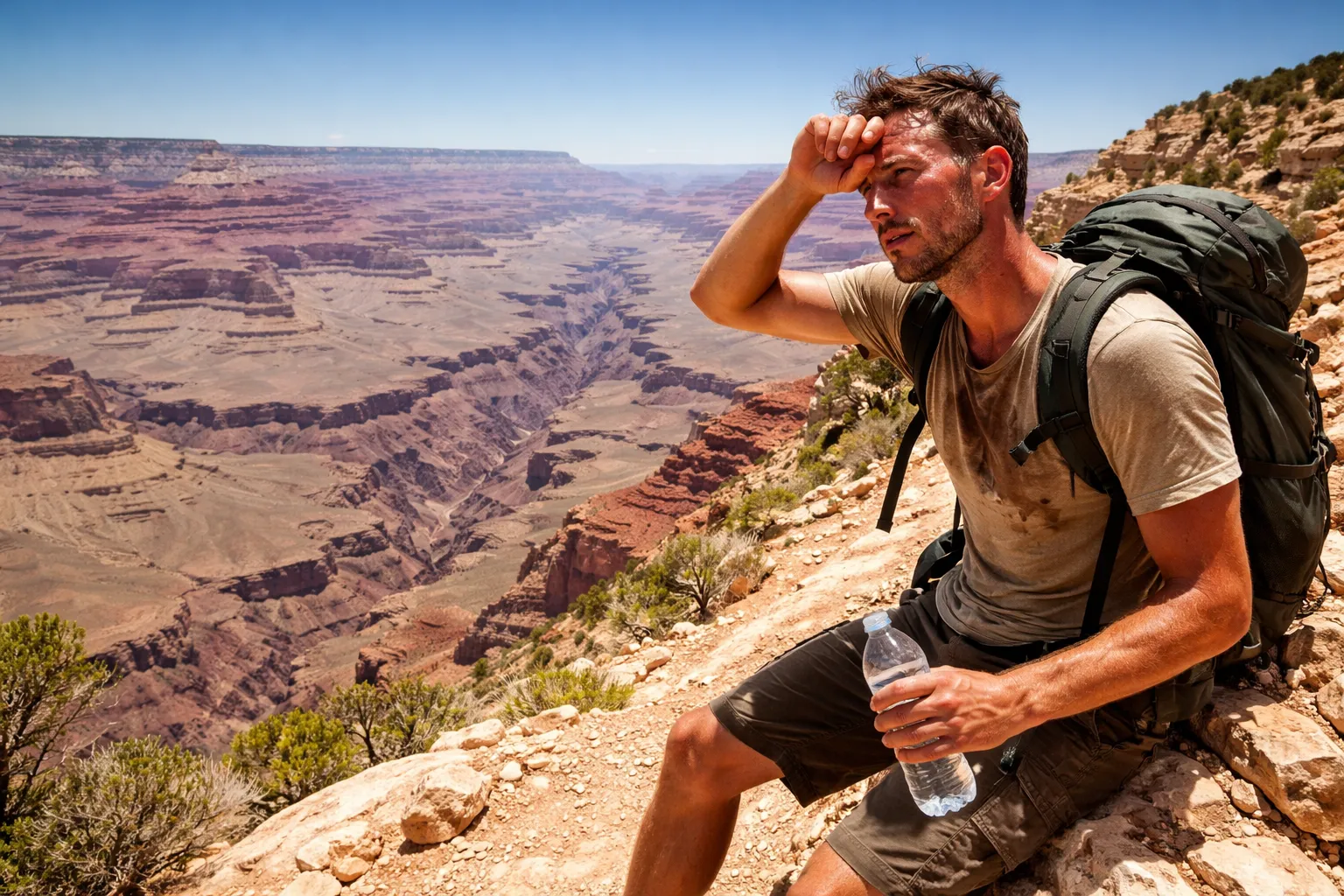
Every South Rim trip-planning guide treats “afternoon” as just another slot on the schedule, not a red flag worth flagging. I’d argue hard against that framing after watching a red helicopter bank twice over the Bright Angel Trail, then drop low, its rotors kicking up dust that hung motionless in June’s 104°F, 2 p.m. air — like a warning nobody down there had gotten around to reading. Somewhere below the rim, a hiker was being loaded onto a stretcher.
I’d staked out a spot at the South Rim lodge with an iced tea, feeling that particular guilty relief you get watching a stranger’s crisis and thinking, that could’ve been me. The full story came out days later: the hiker had started the below-rim descent carrying just two 500ml bottles. In the middle of a Grand Canyon summer. Do the math and it’s grim — barely a liter total, on a trail where the heat alone demands at least a liter every hour.
That rescue never really left me. Not because I want to scare you into staying on the rim (though a little fear is warranted — the Park Service logs upward of 250 heat-related rescues a year here), but because it confirmed something I’d already half-suspected from my own close calls: the gear you pack before you ever reach the trailhead can be the actual line between a great trip and an airlift out. I spent the following summer chasing a fix for the canyon’s hydration problem, running through bottle after bottle, vest after vest, gravity-fed systems, all of it — and what I landed on wasn’t the priciest or most technical option. The best hydration pack for Grand Canyon hike conditions turned out to be whichever one removed enough friction that I’d actually drink from it, consistently, without having to think about it.
What follows is how I quit collapsing on Grand Canyon trails, and the single piece of gear responsible for that turnaround.
Why Dehydration Is Uniquely Dangerous at the Grand Canyon South Rim
Most hiking destinations get harder as you climb. The Grand Canyon flips that logic entirely — geologists sometimes call it an inverted mountain, and that’s not just poetic license. You start at 7,000 feet on the South Rim, in air that’s thin and comparatively cool. Then you step onto Bright Angel or South Kaibab, and instead of climbing toward the difficulty, you’re descending straight into it — a desert floor that only gets hotter and meaner the lower you go.
Reach the Colorado River and you’ve dropped 4,500 feet and picked up roughly 15 extra degrees compared to where you began. Come summer, that’s not a mild 90°F — it’s a routine 104 to 110°F in whatever shade you can find, and shade is in short supply. Your legs are already spent from the way down, sweat is pouring off you, and the entire climb back out is still waiting. That return leg is where dehydration turns fatal.
The cruelest part of the canyon’s heat is how dry it is. Somewhere humid, sweat beads on your skin and nags you to drink. Here, it evaporates before you even register it. Your shirt looks bone dry. You feel completely normal — until you don’t, and suddenly you’re nauseous and dizzy with early heat exhaustion at mile five of what was supposed to be an easy eight-mile day.
The trail infrastructure works against you too. Starting elevation alone — 7,000 feet at the rim — already stacks the dehydration odds against you, and once you’re below the rim, reliable water gets scarce fast:
- South Kaibab Trail: Zero water sources, full stop. Whatever you’re carrying when you start is everything you’ll have.
- Bright Angel Trail: There’s water at Indian Garden (1.5 miles in) and Phantom Ranch (4.5 miles in), but only from May through September. Hike it in winter or shoulder season and you’re carrying every drop yourself.
- Rim Trail: The gentlest of the three on paper, but still fully exposed to summer sun, and its easy reputation makes people underprepare for it.
The Park Service isn’t subtle about this: their summer guidance is one liter of water for every hour on the trail, which puts a four-hour hike at a four-liter minimum, no negotiating. Add in how consistently people misjudge how long the canyon actually takes — the climb out always outlasts your estimate — and you’ve got exactly the setup I watched play out that June afternoon.
The 2-Liter Bladder That Kept Me Off That Same Stretcher
The canyon doesn’t grade on a curve for fitness level or trail experience. At 104°F, dehydration moves fast, and by the time your body’s flagging the problem, it’s already in trouble. I found that out firsthand, and what separated a safe hike from a helicopter ride out came down to one thing: carrying enough water, and actually drinking it on schedule.
Where it earns its keep
- Two liters of capacity means no rationing sips through a mile of switchbacks — you drink because you’re thirsty, not because you’re pretending you’re fine while secretly counting ounces.
- It rides flat against your back, so you’re not lugging what feels like extra dead weight in the heat, which matters when the canyon is already draining you dry.
- The bite valve lets you drink on the move — no bottle caps to fumble with, no pause in your rhythm on a steep stretch where every step actually counts.
Where it comes up short
- Skip topping it off completely before you leave, and you’ll spend the second half of the hike guessing — the reservoir’s opaque, so there’s no quick glance to check how much is left.
- In serious heat, the drinking tube warms up more than you’d like, and the bladder can pick up a faint plastic taste if it’s baked in the sun between refills.
I almost ditched the hydration pack halfway down the trail because it felt like dead weight, but when I hit the hottest stretch of the canyon floor around mile 5, I understood why that helicopter had been circling. Get yourself a lightweight hydration backpack with a 2L water bladder.
Frequently Asked Questions
How much water do I need per hour hiking Grand Canyon trails?
The Park Service guidance is one liter of water for every hour on the trail. For a four-hour hike, that’s a four-liter minimum with no negotiating. This accounts for the extreme heat and dry conditions that cause sweat to evaporate before you register it, making dehydration dangerously hard to notice until heat exhaustion sets in.
Which Grand Canyon trails have water sources available?
Bright Angel Trail has water at Indian Garden (1.5 miles in) and Phantom Ranch (4.5 miles in), but only from May through September. South Kaibab Trail has zero water sources. Rim Trail is fully exposed to summer sun with no reliable water access, so you must carry every drop yourself on all three.
What temperature does it reach at the Colorado River in summer?
The canyon floor reaches a routine 104 to 110°F in summer. This is roughly 15 extra degrees compared to the 7,000-foot South Rim where you start. The extreme heat, combined with the dry air that evaporates sweat before you notice it, makes dehydration dangerously difficult to detect.
How many heat-related rescues happen at Grand Canyon annually?
The Park Service logs upward of 250 heat-related rescues a year at the Grand Canyon. These incidents highlight why carrying sufficient water and drinking consistently on schedule is critical, especially on below-rim trails where the heat intensifies as you descend.
About This Article

Written by Elena Vasquez. Elena Vasquez is a full-time traveler and the founder of Witty Passport. Over fifteen years and more than 50 countries across six continents — including a stretch spent leading groups professionally through Southeast Asia and the remote highlands of South America — she's written the kind of destination guides she always wished existed: practical, specific, and built on real experience rather than recycled itineraries. More about this site.
Scope and limits. Elena is a full-time traveler, not a licensed travel agent or immigration adviser. Entry requirements, visa rules, and advisories change without notice — always confirm against the official government source for your destination and passport before booking.
Verify this against a primary source
Specifics change, and your situation may differ from the one described here. These are the authorities worth checking directly:
- U.S. Department of State — entry requirements and travel advisories
- CDC Travelers' Health — vaccination and health notices by destination
- TSA — current carry-on and screening rules