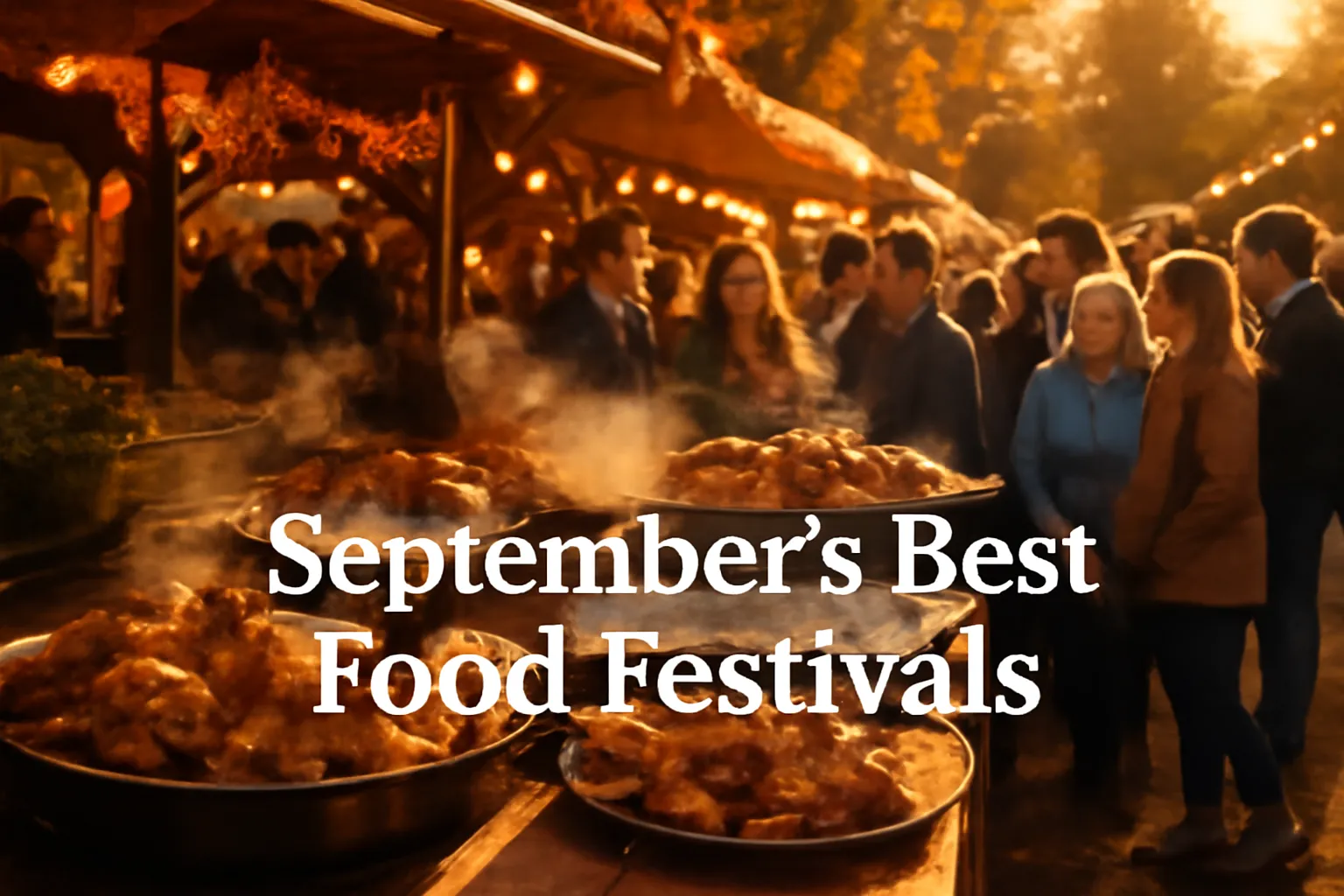
Every “best time to visit” guide flattens September into a single throwaway line — shoulder season, mild weather, thinner crowds — and stops there. That’s technically true and completely misses the point. I don’t structure trips around monuments or beaches or a checklist of “must-see” landmarks; I structure them around what’s cooking, specifically the dishes that only exist in one town, for a few weeks a year, made by people who’ve been refining the recipe since before I was born. If you share this particular affliction (not a disorder, a lifestyle, I’ve made my peace with it), September is the month everything lines up. The food festivals September harvest season produces are, honestly, unrivaled — the summer swelter finally breaks enough that standing packed into a crowd feels good instead of punishing, farms and orchards everywhere hit their absolute peak at once, and cultures with zero connection to each other all independently decided autumn deserves a proper celebration involving far too much food and not nearly enough regret. This is the month my entire year revolves around, and this list is basically my love letter to it.
| Festival | Location | Dates | Entry Cost |
|---|---|---|---|
| Oktoberfest | Munich, Germany | Mid-September through first weekend of October | €15–€18 per Mass; €20–€30 per main dish |
| Mistura | Lima, Peru | Early-to-mid September (~10 days) | 20–30 Peruvian Soles (~$5–$8 USD) |
| San Sebastián Gastronomika | San Sebastián, Spain | Typically early October (~4 days) | €300–€600 for professional passes |
| Mid-Autumn Festival | China, Taiwan, Vietnam | 15th day of 8th lunar month (September or early October) | $5–$20 USD for mooncakes |
Why September Quietly Runs the World’s Food Festival Calendar
There’s a convergence that happens every September that most travel calendars barely mention. Across the Northern Hemisphere, harvests are cresting all at once — grapes, grains, root vegetables, orchard fruit — so local ingredients are performing at their peak. At the same time, the worst of the summer crowds have started to thin, airfares ease off their summer highs, and the weather across much of Europe and Asia settles into that crisp-not-cold zone where eating outdoors at a festival is actually a pleasure rather than an endurance test. It’s the single best culinary window of the entire calendar year.
It also helps to understand the two main flavors of festival you’ll run into this month. Harvest festivals revolve around the ingredient itself — they exist to celebrate what came out of the ground, to honor the farmers who grew it, and to put raw regional abundance on display. Chef festivals flip that around and revolve around technique — bringing together culinary talent to show off what skilled hands can do with those same ingredients. September, somehow, hands you both, sometimes in the same seven days. For anyone obsessed with food, that means alternating between feast tables stacked with roasted pork knuckles and Michelin-starred tasting menus and calling the whole thing “research.” Let’s get into the list.
Best Food Festivals Fall Season: The September Harvest Lineup
1. Oktoberfest — Munich, Germany
Dates: Typically mid-September through the first weekend of October (~16–17 days)
Location: Theresienwiese, Munich, Bavaria
Sure, everyone’s heard of Oktoberfest. Most people also assume it’s basically a beer festival with a side of pretzels, and that assumption needs correcting right now: Oktoberfest is genuinely one of the great harvest food festivals on the planet, and if beer steins are the only thing you’ve associated with it, you’ve been missing most of the point. What’s happening inside those enormous tents, food-wise, is remarkable — deeply Bavarian, and not the least bit shy about it.
- Hendl (rotisserie chicken): Whole birds turned on a spit until the skin goes golden and shattering, eaten by hand off a sheet of wax paper. One of the great festival foods, full stop.
- Schweinshaxe (roasted pork knuckle): A hefty pork leg with a crackling crust that demands both hands and abandons any pretense of table manners. The skin cracks like glass. It’s magnificent.
- Kaiserschmarrn: A shredded, cloud-like pancake dusted in powdered sugar and paired with plum compote. Dessert is not optional here.
The vibe: Controlled mayhem with a genuinely huge heart. Lederhosen, brass bands blasting, long communal tables where you’ll be clinking steins with strangers from half a dozen countries before your second round arrives. The energy inside the tents — especially the older ones like Hofbräu-Festzelt or Augustiner-Festhalle — has no real equivalent anywhere else on the festival circuit.
Practical tip: Lock in your tent (“table”) reservations 6–12 months ahead if you want a guaranteed seat inside the major tents on a weekend evening. Weekday mornings still have walk-in space, but it disappears quickly. Plan on roughly €15–€18 per Mass (one liter of beer) and €20–€30 per main dish. Bring shoes built for standing and walking — you’ll rack up more distance than the schedule suggests.
2. Mistura — Lima, Peru
Dates: Typically early-to-mid September (~10 days)
Location: Parque de la Exposición, Lima, Peru
If Mistura hasn’t crossed your radar yet, drop what you’re doing and go look it up. Widely regarded as the most significant food festival anywhere in the Americas — and that’s not a claim I make casually — Mistura celebrates the sheer scale of Peru’s culinary diversity. This is a country with somewhere around 3,000 potato varieties and 55 kinds of corn, plus a coastline, an Amazon basin, and high-altitude Andean terrain each turning out completely different produce. Mistura exists to honor all of it at once, pulling in over half a million visitors every year.
- Ceviche: Lima essentially invented the modern ceviche standard, and tasting it here ��� fresh, local, properly finished in leche de tigre — will reset your expectations completely.
- Anticuchos: Grilled beef heart skewers straight off street carts, smoky and seasoned with ají panca. Don’t let the ingredient list put you off.
- Picarones: Sweet potato and squash doughnuts finished with a chancaca syrup drizzle. Best eaten hot, straight from the fryer.
The vibe: Unpretentious and fiercely proud. This isn’t a showcase reserved for star chefs — it’s Lima’s top restaurants set up right alongside grandmothers running street stalls, regional producers, and farming cooperatives. Celebrity names like Gastón Acurio (the man whose vision more or less shaped modern Peruvian cuisine) share the same grounds as indigenous communities demonstrating cooking traditions passed down for generations. It’s moving to witness, and it also happens to taste incredible.
Practical tip: Daily entry tends to run about 20–30 Peruvian Soles (roughly $5–$8 USD), which makes this one of the best value-for-money food festivals anywhere. Combine your Lima trip with time in the Miraflores food scene — the city easily earns a few extra days purely for eating. Confirm exact dates on the official festival site, since the schedule has moved around in recent years.
3. San Sebastián Gastronomika — Basque Country, Spain
Dates: Typically early October (often announced in late September, ~4 days)
Location: Kursaal Congress Centre, San Sebastián (Donostia), Spain
If Mistura is the soul of the festival world, Gastronomika is the brain. This is less a festival than a culinary summit — some of the most technically gifted chefs alive, gathered in a city that already carries more Michelin stars per capita than nearly anywhere else on Earth. Basque cuisine doesn’t do anything halfway, and this four-day congress is where the highest-level conversation in global gastronomy actually happens. It’s chef-driven through and through, and being in the room feels like watching the future of food get written live.
- Pintxos (Basque tapas): The city’s bar-hopping pintxos scene justifies the trip on its own — small, precise creations built from anchovy, jamón, Idiazabal cheese, and inventive modern pairings.
- Bacalao al pil-pil: Salt cod cooked into a gelatinous garlic-olive oil emulsion. Looks simple, takes real skill to pull off, and tastes remarkable.
- Txakoli wine: A local white, bone-dry with a faint sparkle, poured from a height to aerate it before drinking. Pairs beautifully with every single thing on this list.
The vibe: Polished and intellectually sharp, but still warm in that particular Basque way. Mornings inside the Kursaal are given over to chef demos and panel talks; evenings belong to the Parte Vieja (old town), moving from one pintxos bar to the next with a glass of Txakoli in hand. The two halves of the day balance each other perfectly.
Practical tip: Professional congress passes can run €300–€600 or more, but honestly the city itself is the real festival — timing your visit to festival week and simply eating your way through the old town captures most of the magic without a badge. Book lodging 4–6 months ahead, since the city books out fast during that stretch. If Spanish food culture is your thing, check our destination guides on wittypassport.com for more Basque Country travel inspiration.
4. Mid-Autumn Festival / Moon Festival — China, Taiwan, Vietnam
Dates: 15th day of the 8th lunar month — falls in September or early October (~1 week of celebrations)
Location: Across China, Taiwan, Vietnam, and Chinese diaspora communities worldwide
Few holidays anywhere are as tightly bound to a single food as the Mid-Autumn Festival, so if you find yourself near a city with a strong Chinese, Taiwanese, or Vietnamese community come September, pay attention. The whole occasion centers on the mooncake — a dense, elaborately patterned pastry stuffed with lotus seed paste, salted egg yolk, red bean, or increasingly wild modern flavors. Bakeries spend months preparing their versions. Families trade boxes of them the way some of us trade bottles of wine. It’s a deeply ritual-bound food tradition, and watching it unfold is genuinely lovely.
- Mooncakes: Classic baked Cantonese-style versions, snowskin editions out of Hong Kong and Taiwan, and modern flavors like matcha or durian — worth lining up and comparing side by side.
- Pomelo: The fruit of the season — eaten fresh, and also used as decoration. Sweet, sharp, and refreshing in equal measure.
- Family reunion feasts: The main meal on the peak night typically brings whole roasted meats, glutinous rice dishes, and taro preparations that shift beautifully from region to region.
The vibe: Warm, family-centered, and quite literally glowing. Lanterns hang everywhere, kids parade glowing paper animals through the parks, and families lay out blankets to watch the full moon come up. Taipei has turned the occasion into a massive communal barbecue tradition, with city parks packed full of grills and the smell of marinated meat drifting through the night air. Down in Hội An, Vietnam, the river fills with floating lanterns instead. Every version has its own particular magic.
Practical tip: The date shifts every year, so check the lunar calendar before you plan around it. If you’re in Taiwan, Taipei’s Dihua Street turns into a full-blown mooncake market in the weeks leading up to the festival. Set aside roughly $5–$20 USD for a decent box of mooncakes to bring home — they travel better than you’d expect.
Stitching Together a Multi-Festival September Around the World’s Harvest Celebrations
Here’s the part that genuinely excites me about the harvest food festivals around the world that all land in September: a handful of them sit close enough together, geographically, that you can string them into one continuous trip. As someone who plans entire vacations around meals, this is the rare kind of logistics planning that actually makes me want to open a spreadsheet.
The European Food Festival Circuit: Kick things off in San Sebastián during Gastronomika week (early October, though it’s worth arriving in late September while the city’s already buzzing in anticipation). From there, a train or a budget flight gets you to Munich in time to catch Oktoberfest’s final week. The rail route from San Sebastián to Munich, routed through either Paris or Zurich, is genuinely scenic, takes under a day, and runs €80–€200 depending on how early you book. In under two weeks you’ll have hit two of the planet’s standout september food events autumn brings around, eaten well beyond reason, and collected excellent stories involving both pintxos bars and pork knuckles.
The Americas + Asia stretch: If you’re up for the bigger commitment, an early-September stint in Lima flows naturally into a Southeast Asia leg timed to catch the Mid-Autumn Festival later that same month. Getting from Lima to Tokyo or Taipei means a serious transpacific haul, but for anyone who takes food travel seriously, it’s the kind of itinerary that defines a year.
What to Pack for Fall’s Best Food Festival Season
Let’s talk about what to actually wear to these things, because the right gear makes the difference between a miserable soggy afternoon in Munich and a genuinely comfortable one. September weather across the Northern Hemisphere is notoriously unpredictable — warm afternoons that drop sharply once the sun goes down, occasional rain that rolls in without warning, and outdoor festival spaces that offer little protection from any of it. Layering is non-negotiable. A lightweight base layer, a mid-weight fleece or sweater you can tie around your waist, and a packable waterproof jacket will handle nearly every scenario these festivals throw at you. The key is choosing pieces that don’t take up much space in your luggage — you’ll want room for the food souvenirs you’ll inevitably accumulate.
Frequently Asked Questions
How much does it cost to enter Mistura food festival in Lima?
Daily entry to Mistura typically runs about 20–30 Peruvian Soles, which is roughly $5–$8 USD, making it one of the best value-for-money food festivals anywhere in the world.
What are typical prices at Oktoberfest in Munich?
At Oktoberfest, plan on roughly €15–€18 per Mass (one liter of beer) and €20–€30 per main dish. Tent reservations are recommended 6–12 months ahead for guaranteed weekend evening seating in the major tents.
When does the Mid-Autumn Festival happen in September?
The Mid-Autumn Festival falls on the 15th day of the 8th lunar month, which means it falls in September or early October. You should check the lunar calendar before planning your trip, since the date shifts every year.
How much should I budget for mooncakes at Mid-Autumn Festival?
Set aside roughly $5–$20 USD for a decent box of mooncakes to bring home. They travel better than you’d expect and are worth comparing side by side across different bakeries.
About This Article

Written by Elena Vasquez. Elena Vasquez is a full-time traveler and the founder of Witty Passport. Over fifteen years and more than 50 countries across six continents — including a stretch spent leading groups professionally through Southeast Asia and the remote highlands of South America — she's written the kind of destination guides she always wished existed: practical, specific, and built on real experience rather than recycled itineraries. More about this site.
Scope and limits. Elena is a full-time traveler, not a licensed travel agent or immigration adviser. Entry requirements, visa rules, and advisories change without notice — always confirm against the official government source for your destination and passport before booking.
Verify this against a primary source
Specifics change, and your situation may differ from the one described here. These are the authorities worth checking directly:
- U.S. Department of State — entry requirements and travel advisories
- CDC Travelers' Health — vaccination and health notices by destination
- TSA — current carry-on and screening rules