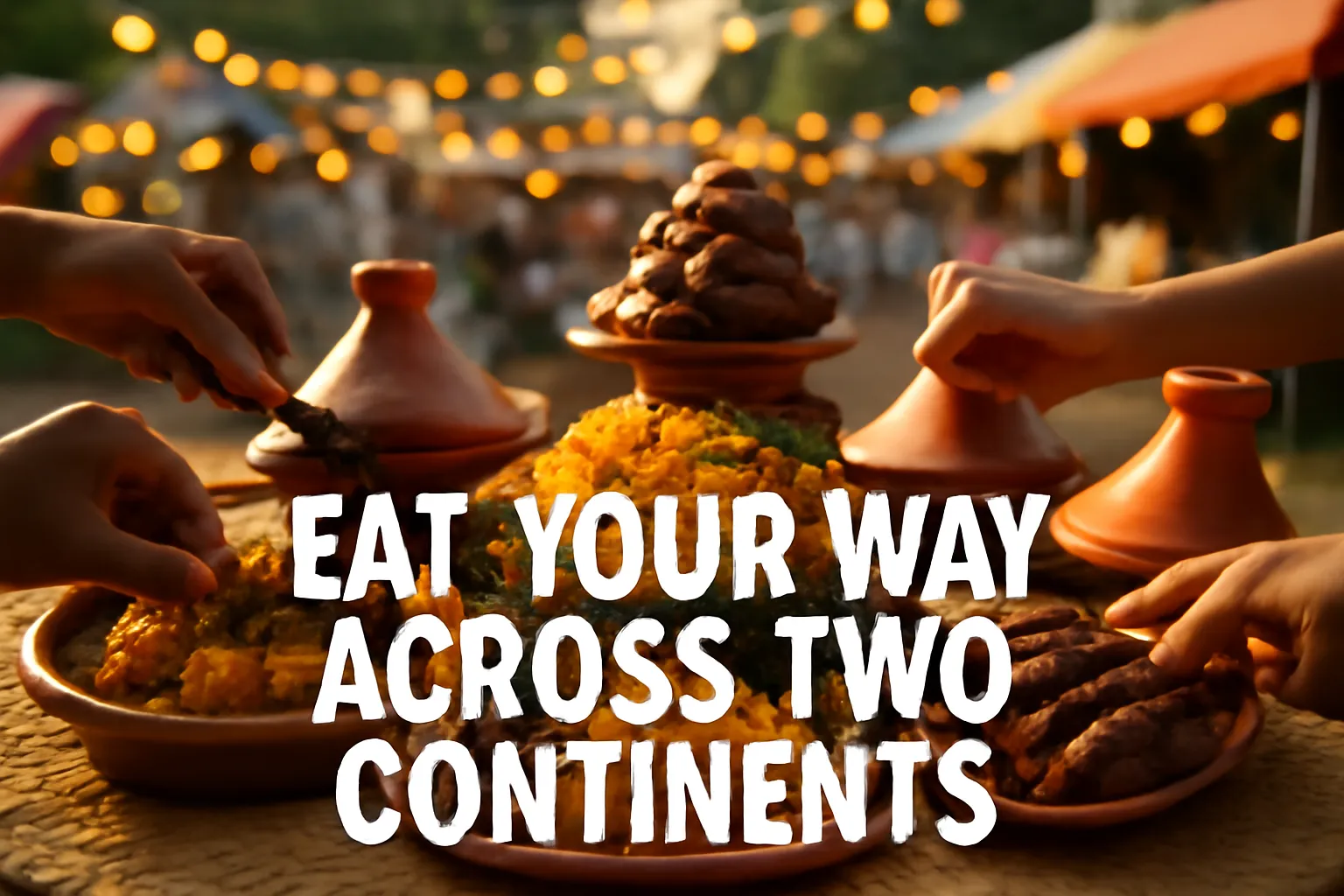
Twenty dollars. That’s roughly the ceiling on what a full day of festival eating costs across half the destinations in this piece — and once that number sinks in, it changes how you plan an entire trip. I don’t build vacations around flights or hotel deals; I build them around a single search query: “where can I eat something that will completely reorganize my sense of reality,” and then I work backward from whatever answer surfaces. If that sounds like your kind of travel logic — the kind that’s justified a red-eye flight purely for something hot and wrapped in paper at a market stall — then keep reading. August is exactly the right window to start scouting the best food festivals Africa Middle East has on offer, and I’ll say it plainly: this part of the world gets shockingly little airtime in food travel writing. These are continents where feeding a guest is practically a language of its own, where meals are communal, hands-on, and loud with joy in ways a camera phone will never fully capture, and where one plate can quietly hold centuries of trade routes, migration patterns, and family history. Get ready, because your next itinerary is about to be dictated entirely by your appetite.
Why Africa and the Middle East Are the Next Frontier for Food Travel
Food-focused travel across Africa and the Middle East is finally getting its due — and frankly, it’s decades late. These two regions have been shaping the world’s palate, and its spice racks, for thousands of years. Consider the logistics: the Silk Road cut straight through the Arabian Peninsula. East African harbors were among the earliest hubs of global commerce. West African cooking is the backbone of a massive share of what gets marketed as American Southern food. And still, when travel sites publish their annual “top food festivals” lists, they gravitate toward European cheese fairs and Asian night markets, over and over. Nothing against a good cheese fair — but there’s an entire universe of extraordinary eating happening on these two continents that deserves far more attention. What sets african food festivals to visit apart is how eating here refuses to be a solitary act. Nobody’s clutching a tiny plastic fork at a sampling booth. You’re seated on a mat, legs crossed, digging into a shared platter with your right hand, surrounded by people who treat feeding you as an expression of affection. Middle east food events carry that identical generosity — tables buckling under mezze, the smell of oud drifting through the room, tea appearing before you’ve even asked for it. These are the kinds of meals that shift something in you permanently. And the scaffolding for food tourism in both regions is expanding quickly — boutique culinary tours, chef-guided market wanders, festival lineups that now compete with anything Europe puts on. This is the window to go.
Durban July’s Food Scene (South Africa)
Quick Festival Snapshot
- Location: Durban, KwaZulu-Natal, South Africa
- Typical Dates: First Saturday of July, with related food happenings stretching across the days around it
- Duration: One day for the race itself, but the food culture surrounding it stretches things into a full long weekend
On paper, Durban July is a horse race — arguably South Africa’s most glamorous one — but the people who love food aren’t showing up for the horses. Durban’s culinary personality is one of the more compelling on the continent, shaped by the meeting point of Zulu tradition and the sizable South African Indian community that’s called this coastal city home for over 150 years. What comes out of that mix doesn’t resemble anything else. Braai smoke drifts along the beachfront, street vendors spoon curry into hollowed loaves of bread — yes, that’s bunny chow, and yes, it lives up to the hype — and restaurants turn out Indian-Zulu fusion plates that have no business working as well as they do. The mood around Durban July’s food scene is charged: sequins everywhere, Durban Poison cocktails in hand, and heat thick enough to make a cold beer feel like divine intervention. Set aside roughly R150–R300 (about $8–$16 USD) for a proper bunny chow meal plus drinks at a local joint. Practical tip: Make time for Victoria Street Market and its spice stalls — grab a bag of Durban masala for the trip home, and your kitchen will never taste the same again. For a deeper dive into South Africa’s food culture, our South Africa destination content has plenty more.
Lagos Food Festival (Nigeria)
Quick Festival Snapshot
- Location: Lagos, Nigeria
- Typical Dates: Shifts year to year, usually landing in November — start locking in flights early
- Duration: Roughly 3 days
If you’ve ever wondered why jollof rice inspires near-religious arguments across West Africa, the Lagos Food Festival won’t end the debate — it’ll just make it far more delicious. This festival celebrates Nigerian cuisine with the exact same intensity Lagos brings to everything else: loud, unapologetic, generous, fully alive. The ongoing jollof wars (Nigeria against Ghana, permanently) unfold in cook-off competitions that pull in huge crowds and even bigger opinions. Beyond the rice, there’s suya — spice-crusted grilled meat on skewers, the undisputed benchmark of street food — and bowls of egusi soup served with pounded yam, a dish so warming it might as well be a hug rendered in carbohydrates. The festival attracts chefs, food bloggers, and home cooks from across the continent, and the whole scene carries that distinctly Lagos energy: dressed to impress, high-spirited, deeply shared. Plan on spending around ₦5,000–₦15,000 ($3–$10 USD) on food over the course of a day — more if you’re sampling widely, which you absolutely should. Practical tip: Reserve your Lagos accommodation at least two months ahead — the city books up quickly during major events, and the better spots near Victoria Island disappear fast. Vegetarian travelers won’t struggle here either; Nigerian cooking has an incredible range of bean dishes, plantains, and vegetable stews that hold their own without meat.
Fez Festival of World Sacred Music — and the Street Food Around It (Morocco)
Quick Festival Snapshot
- Location: Fez (Fès), Morocco
- Typical Dates: June, generally the second or third week
- Duration: 9 days
The Fez Festival of World Sacred Music is, technically, a music event — but showing up and talking only about the music would be a real travel failure, and I say that with affection. During festival season, the medina of Fez becomes one of the most overwhelming, beautiful, sensory-saturated places I’ve ever stood in with food in hand, and the street food alone earns back the airfare. Fez is where Moroccan cooking shows its most confident, classical side. There’s pastilla — that improbable layering of shredded pigeon or chicken, almonds, and cinnamon tucked into paper-thin warqa pastry and dusted with powdered sugar — and you’ll wonder why it isn’t standard fare everywhere. There’s slow-braised tagine with preserved lemon and olives, the kind that’s clearly been simmering since well before you got out of bed. Wander the old medina’s alleys and you’ll find msemen flatbread griddled fresh for around 5 dirham (under $0.50 USD). International visitors flock here for the festival, giving the city’s riads and restaurants a genuinely cross-cultural buzz, though the food stays firmly, authentically Moroccan. Halal is simply the default here, which makes things effortless for Muslim travelers wanting to eat freely and adventurously. Practical tip: Riads sell out months ahead during festival season, so start hunting in March or April for a June trip. Some festival events are ticketed and some are free, but the street food itself costs nothing beyond your appetite and pays off endlessly. Morocco stands out among food travel Africa destinations, and Fez in particular will spoil you for every mediocre tagine you eat afterward.
The Date Festival (Saudi Arabia and UAE)
Quick Festival Snapshot
- Location: Al-Ahsa, Saudi Arabia, plus various UAE locations including Al Ain and Dubai
- Typical Dates: August into September, timed to the date harvest
- Duration: Roughly 2 weeks, spread across several events
August might be the single best month to be anywhere in the Gulf if dates are your thing — and I mean that with zero exaggeration. Harvest season turns markets, festivals, and entire communities in Saudi Arabia and the UAE into a running celebration of what could be the most overlooked fruit around. If the sad, shriveled dates from a holiday cheese platter are your only reference point, this festival will rewrite that relationship completely. You’ll try hundreds of varieties you’ve never encountered — Medjool barely scratches the surface. There’s Sukkari (honeyed, near-caramel), Khalas (deep toffee notes, the pride of Al-Ahsa), and Barhi (so tender they nearly melt on contact). The festivities in Saudi Arabia’s Al-Ahsa region — a UNESCO World Heritage agricultural landscape — include date auctions, live cooking demos, and competitions that treat this fruit with total seriousness. Over in Dubai and Al Ain, markets and cultural programming build around the harvest with traditional music, falconry shows, and hospitality that never seems to run out. Dates always arrive alongside Arabic coffee (qahwa) as a welcome gesture, and there’s no more graceful way to start a day. Getting into the date markets is typically free; set aside money for buying dates to bring home — figure at least AED 50–100 / SAR 50–100 for a decent haul. Practical tip: Dress modestly, particularly at Saudi events — light, breathable layers covering shoulders and knees are both respectful and, frankly, sensible in August heat. If Dubai’s food scene has already won you over, there’s more Dubai content on WittyPassport worth browsing, and the Date Festival slots neatly into a longer Gulf food itinerary — our Jordan destination guides make a natural next stop on that same trip.
The Spice Kit That Rescued My Durban Kitchen Experiment
Here’s what nobody tells you about chasing food festivals through unfamiliar cities: eventually you’re standing in an Airbnb kitchen at midnight, desperate to recreate whatever you just ate, with no local spices in reach and a minibar stocked with nothing but instant coffee. Durban taught me this lesson the hard way.
What worked
- The canvas bag squashes down flat enough to slide into a carry-on without eating up the space of a whole shoe — useful when you’re already hauling festival outfits and camera equipment.
- Ten jars turned out to be the right number — enough variety to cook something with actual depth, rather than just “seasoned” tap water, without turning into a full spice shop packed across continents.
- The jars seal properly, which I didn’t fully register until I watched someone else’s turmeric detonate across their suitcase at Johannesburg airport.
What didn’t
- The labels are minuscule and rub off within about three trips, so unless you can identify every spice by smell alone, you’ll be guessing quite a bit by the halfway point of your travels.
- It doesn’t fix the actual obstacle: locating a kitchen to begin with. In Durban, roughly half the places I checked had nothing but a kettle and good intentions — no stove in sight.
I almost left it behind before my last trip—thought it was overkill, thought I’d just eat out every meal—but the moment I had access to a functioning kitchen and actual cumin, I remembered exactly why I packed it. Travel Spice Kit with 10 Spice Jars and Canvas Seasoning Storage Bag
Frequently Asked Questions
How much does food cost at African and Middle Eastern festivals?
Across roughly half the destinations covered, a full day of festival eating costs around twenty dollars. At Lagos Food Festival, plan on ₦5,000–₦15,000 ($3–$10 USD) daily; Durban bunny chow meals run R150–R300 ($8–$16 USD); and msemen flatbread in Fez costs around 5 dirham (under $0.50 USD).
When should I visit the Fez Festival of World Sacred Music?
The Fez Festival of World Sacred Music takes place in June, generally the second or third week, and lasts 9 days. Start booking riads in March or April for a June trip, as they sell out months ahead during festival season.
What is the best time to visit date festivals in Saudi Arabia and UAE?
August into September is the best time, timed to the date harvest and lasting roughly 2 weeks spread across several events. The festivals occur in Al-Ahsa in Saudi Arabia plus various UAE locations including Al Ain and Dubai.
How early should I book Lagos accommodation during food festival season?
Reserve your Lagos accommodation at least two months ahead, as the city books up quickly during major events and better spots near Victoria Island disappear fast. The Lagos Food Festival typically lands in November.
About This Article

Written by Elena Vasquez. Elena Vasquez is a full-time traveler and the founder of Witty Passport. Over fifteen years and more than 50 countries across six continents — including a stretch spent leading groups professionally through Southeast Asia and the remote highlands of South America — she's written the kind of destination guides she always wished existed: practical, specific, and built on real experience rather than recycled itineraries. More about this site.
Scope and limits. Elena is a full-time traveler, not a licensed travel agent or immigration adviser. Entry requirements, visa rules, and advisories change without notice — always confirm against the official government source for your destination and passport before booking.
Verify this against a primary source
Specifics change, and your situation may differ from the one described here. These are the authorities worth checking directly:
- U.S. Department of State — entry requirements and travel advisories
- CDC Travelers' Health — vaccination and health notices by destination
- TSA — current carry-on and screening rules