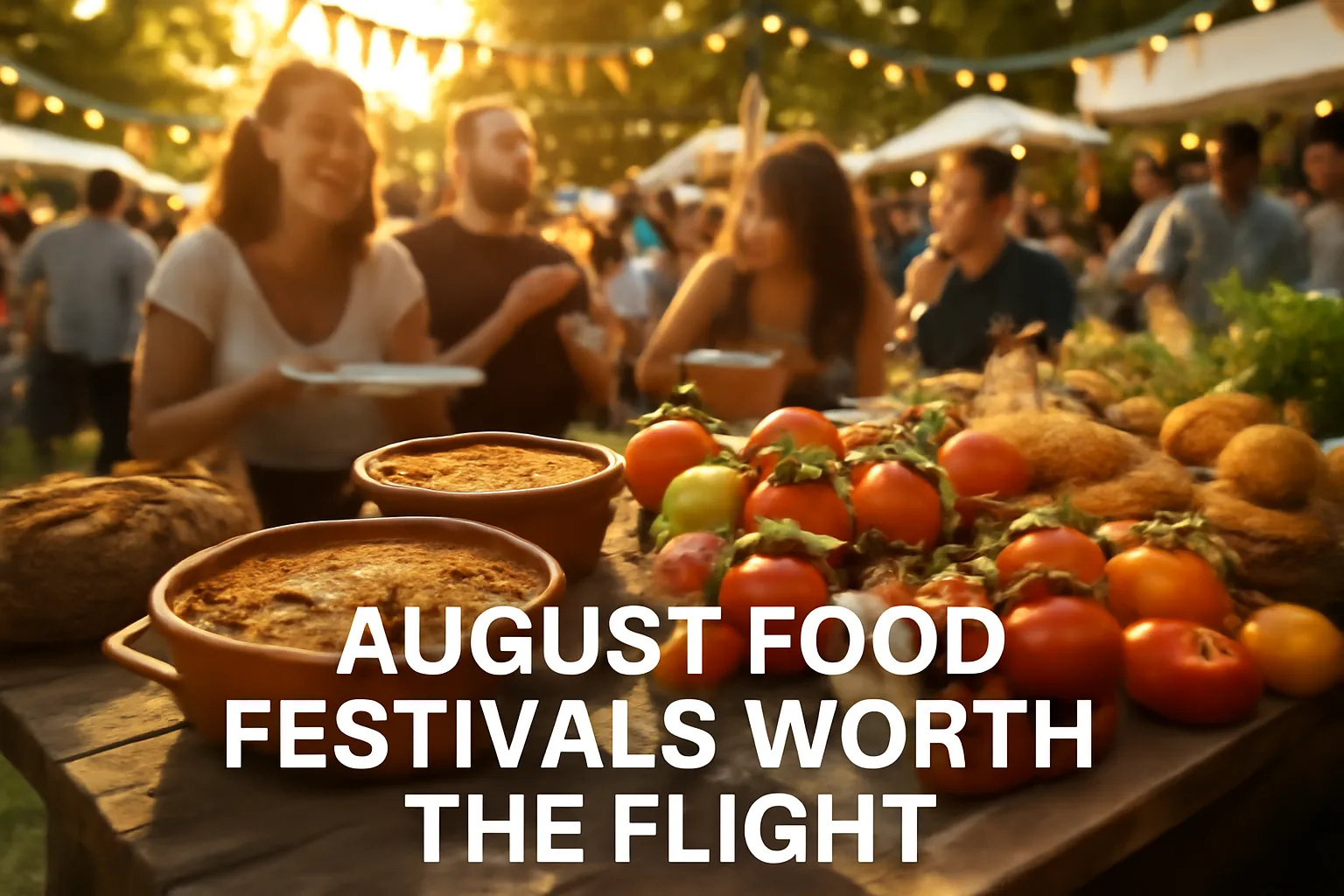
Most people assume a food festival is something you stumble into as a bonus while traveling for some other reason — never the actual point of booking a flight. That assumption is wrong, and I can prove it: I have built entire international trips around a single food event, skipping the Michelin-starred dining room and the cooking class in favor of a festival where a stranger hands you something on a stick and the wine costs four euros. August in Europe is peak season for exactly this kind of glorious chaos, and if you haven’t yet shaped a trip around the continent’s best food festivals in August Europe style, you’re leaving the better version of summer travel untouched. August is Europe’s harvest party on a continental scale — stone fruit gets absurd, tomatoes hit their ceiling, and nearly every small town has some centuries-old excuse to cook something enormous and invite the whole surrounding region. Forget the polished, geotagged food events clustered in the capital cities. These are the unvarnished ones. And they are absolutely worth the flight.
Why August Is the Best Month for Food Travel in Europe
What drives European food festivals in late summer is simple: the food itself basically demands a celebration. August marks harvest, when everything turns abundant, faintly chaotic, and perfectly ripe all at once. Farmers, cooks, and entire villages have spent the whole year waiting for this exact window, and the festivals inherit that pent-up energy. There’s a warmth to August food events that no ticketed winter market can fake — everyone’s outdoors, the evenings run long, the rosé stays cold, and somewhere a grandmother is stirring a pot roughly the size of a compact car. Beyond the atmosphere, August also hands you the smartest combo-trip logic of the whole year. Several of the best festivals this month land alongside or just before major cultural events, which means you can stack a cultural itinerary on top of a serious eating agenda in a single trip. As someone who plans food travel Europe August trips with real devotion, that kind of efficiency genuinely delights me.
The August Food Festivals Worth Crossing Europe For
1. Edinburgh Food Festival — Edinburgh, Scotland
Few combo trips in all of August travel beat this one, at least none I’ve stumbled across. The Edinburgh Food Festival runs roughly four days from late July into early August, deliberately timed to overlap the opening stretch of the Edinburgh Festival Fringe — the largest arts festival on the planet. George Square Gardens turns into an open-air market and tasting ground where Scottish producers, chefs, and artisan makers set up shop, and the energy matches only what Edinburgh delivers during Fringe season. You’ll find yourself biting into handmade haggis bon bons next to someone in full costume rushing off to their one-person show, and it’s honestly one of the best experiences I recommend to any traveler.
- Must-try dishes: Oatcakes topped with smoked salmon, haggis reinvented however the vendor feels like that day, and a Scotch pie from a baker who genuinely knows their craft
- Typical dates: Late July to early August, roughly 4 days
- Vibe: Energetic, inventive, unmistakably Scottish — this isn’t a tourist trap, it’s a genuine celebration of Scottish food culture riding alongside world-class arts festival energy
- Practical tip: Lock in Edinburgh accommodation at least three months ahead if you’re visiting during Fringe overlap — prices triple and rooms vanish quickly. Budget roughly £10–£20 for entry depending on ticketed tastings, though most of the general market is free to browse.
2. La Tomatina Week — Buñol, Spain
Sure, La Tomatina is famous for the tomato-throwing brawl held the last Wednesday of August in Buñol, a small town roughly an hour outside Valencia. But what deserves more attention is the full week of celebration surrounding it, genuinely one of the most overlooked august food events to travel for anywhere in Europe. That week brings paella competitions, street food stalls, freely poured local wine, and a late-summer Spanish exuberance the tomato fight alone can’t capture. Buñol’s population swells from around 9,000 residents to nearly 50,000 visitors on fight day, so if you’d rather get the food culture without the full-blown chaos, arriving a day or two early to catch the week’s other events makes for an entirely different — and arguably richer — trip.
- Must-try dishes: Paella Valenciana cooked properly over open flame, pan con tomate made from the festival’s own tomato surplus, and whatever jamón crosses your path
- Typical dates: Last Wednesday of August, plus the full week of festivities surrounding it
- Vibe: Loud, joyful, thoroughly communal — this is a town that genuinely loves a party and wants you in on it
- Practical tip: The tomato fight itself requires a ticket, and they sell out months ahead (roughly €10–€12 per person). Base yourself in Valencia for an easy day trip, or book a small guesthouse right in Buñol for the full-immersion version.
3. Aarhus Food Festival — Aarhus, Denmark
Denmark’s second city rarely gets the credit it deserves on the food travel circuit, which is frankly baffling given that Aarhus has quietly become one of the most exciting food cities in Northern Europe. The Aarhus Food Festival runs roughly three days in late August, built entirely around New Nordic principles — seasonal, hyper-local, fermented, foraged, and fiercely serious about sourcing. Expect chefs working heritage grains and cold-smoked fish in ways that will reshuffle whatever you thought Scandinavian food could be. The festival draws local producers alongside internationally recognized Nordic chefs, and somehow the price point stays far more reasonable than comparable events in Copenhagen.
- Must-try dishes: Open-faced smørrebrød piled with seasonal toppings, anything built around cloudberries or sea buckthorn, and fermented dairy in whatever inventive form the chefs dream up
- Typical dates: Late August, roughly 3 days
- Vibe: Deliberate, design-conscious, quietly innovative — built for people who eat with intention rather than just appetite
- Practical tip: Aarhus is an easy reach from Copenhagen by train (about 3 hours) or via direct flights from several European hubs. Set aside roughly 300–500 DKK (about €40–€70) per day for tastings and meals, and grab tickets for any chef-led events well in advance since they sell out quickly.
4. Fête du Cassoulet — Castelnaudary, France
This one is for anyone convinced Europe’s best food moments happen not in Paris, not in Lyon, but in a modest Languedoc market town of roughly 11,000 residents, every single one of whom holds a firm opinion on the correct ratio of white beans to duck confit. The Fête du Cassoulet unfolds over roughly four days in late August in Castelnaudary — the town that claims, quite rightfully, to be cassoulet’s birthplace. This slow-cooked stew of white beans, sausage, duck, and pork rind might be the single most comforting dish French cuisine has ever produced, and eating it at the source, during a festival built entirely around honoring it, belongs on the list of any serious food traveler.
- Must-try dishes: Cassoulet Castelnaudary — the official original, strictly defined by local chefs — alongside local Languedoc wine and the region’s duck rillettes if you can track them down
- Typical dates: Late August, roughly 4 days, anchored by a grand parade and cooking competition
- Vibe: Small-town French pride on full display — the Grand Parade of the Grand Brotherhood of the Cassoulet is one of those distinctly-French spectacles that makes you fall for regional culture all over again
- Practical tip: Castelnaudary sits about 45 minutes by train from Toulouse, making it a simple day trip or overnight stop from a larger base. Most festival tastings and street food run affordably (€5–€15), and this pairs naturally with a wider Languedoc wine country road trip.
The Hat That Made It Through Four Boozy August Festivals Without Blowing Away
Picture yourself packed into a crowded Alsace vineyard or shoulder-to-shoulder at a Spanish jamón festival — the last thing you need is your hat surrendering to a wine-fueled crowd, or the afternoon sun turning your face the color of the tomatoes you just ate. A wide-brimmed hat with genuine UPF protection isn’t a luxury — it’s what separates enjoying tasting number eight from retreating under an umbrella like you’ve thrown in the towel.
What works
- The brim is wide enough to actually shade your face and shoulders — not some token two inches that leaves your ears to fend for themselves and burn like a cautionary tale.
- Khaki disappears into nearly every European backdrop without screaming “safari costume,” so you’re not the one neon tourist lighting up every crowd photo.
- It’s sturdy enough to survive being crammed into a backpack between festival days and still pop back into shape, instead of looking like it just came out of a laundry hamper.
What doesn’t
- In genuine wind — and August delivers plenty of it in certain regions — you’ll still be one gust from chasing it through a vineyard like you’ve completely lost the plot.
- Khaki shows every drop, which becomes a problem the moment your eight-euro wine ends up as your hat’s problem mid-tasting.
I questioned whether it was worth packing until day two of the Turckheim Wine Festival, when the woman next to me—hatless—started squinting like a angry pirate at 2 p.m. Get yourself the FURTALK Sun Hat for Women with UPF 80+ Wide Brim Panama Fedora in Khaki.
Frequently Asked Questions
What are the four best food festivals in August across Europe?
The Edinburgh Food Festival (late July to early August), La Tomatina Week in Buñol, Spain (last Wednesday of August), the Aarhus Food Festival in Denmark (late August), and the Fête du Cassoulet in Castelnaudary, France (late August) are four major August food celebrations worth planning trips around.
How much does it cost to attend La Tomatina tomato fight in Buñol?
The tomato fight itself requires a ticket costing roughly €10–€12 per person, and tickets sell out months ahead. However, the full week of festivities surrounding the fight, including paella competitions and street food stalls, is accessible without a ticket.
What’s the best base city for visiting Castelnaudary’s cassoulet festival?
Castelnaudary sits about 45 minutes by train from Toulouse, making it a simple day trip or overnight stop from a larger base. Most festival tastings and street food run affordably between €5–€15.
How far in advance should I book Edinburgh accommodation during Fringe overlap?
Lock in Edinburgh accommodation at least three months ahead if you’re visiting during Fringe overlap, as prices triple and rooms vanish quickly. Budget roughly £10–£20 for entry depending on ticketed tastings, though most of the general market is free to browse.
About This Article

Written by Elena Vasquez. Elena Vasquez is a full-time traveler and the founder of Witty Passport. Over fifteen years and more than 50 countries across six continents — including a stretch spent leading groups professionally through Southeast Asia and the remote highlands of South America — she's written the kind of destination guides she always wished existed: practical, specific, and built on real experience rather than recycled itineraries. More about this site.
Scope and limits. Elena is a full-time traveler, not a licensed travel agent or immigration adviser. Entry requirements, visa rules, and advisories change without notice — always confirm against the official government source for your destination and passport before booking.
Verify this against a primary source
Specifics change, and your situation may differ from the one described here. These are the authorities worth checking directly:
- U.S. Department of State — entry requirements and travel advisories
- CDC Travelers' Health — vaccination and health notices by destination
- TSA — current carry-on and screening rules