This post contains affiliate links. As an Amazon Associate, I earn from qualifying purchases at no extra cost to you.
It was 2:40 a.m. in the Bucharest Gara de Nord train station, and I was attempting to sleep on a bench using my wadded-up rain jacket as a pillow. My neck was at an angle that would concern a physiotherapist. A stray dog had already investigated my boots twice. And my train to Sofia wasn’t leaving for another four hours. That night — sweaty, stiff, and slightly feral — was when I finally admitted I needed a proper travel pillow. Not a U-shaped neck donut from the airport gift shop. Something real. This Sea to Summit travel pillow hostel review is the result of everything that came after that bench in Romania, including 30 hostels across four continents, a dozen overnight trains, and more budget flights than my spine would like to remember.
I’d resisted travel pillows for years. They felt like a concession — an admission that I wasn’t the tough, pack-light traveler I fancied myself. But here’s what 16 years on the road actually teaches you: comfort gear that earns its weight is not a luxury. It’s strategy. A bad night’s sleep in a Hanoi hostel dorm means a foggy museum visit the next morning. A ruined neck on the overnight bus from Medellín to Cartagena means you arrive hunched and miserable. The math eventually adds up.
So I did the research, bought the pillow, and then actually used it — obsessively, across real trips, in real conditions. Here’s everything I found out.
Why I Chose the Sea to Summit Aeros Premium Inflatable Travel Pillow
Before landing on the Sea to Summit Aeros Premium Inflatable Travel Pillow, Regular, Navy Blue, I had tried three alternatives. First was a compressible foam pillow from a no-name brand. It was soft but packed down to roughly the size of a cantaloupe. Not exactly a win for a 40-liter backpack. Second was a classic U-shaped inflatable neck pillow I grabbed in a Heathrow terminal. It made me look like I was recovering from whiplash surgery, and it leaked air somewhere over Frankfurt.
Third was a stuff-sack pillow — the kind where you shove your fleece inside and pretend it’s fine. Reader, it is never fine.
Sea to Summit kept appearing at the top of every serious gear review I read. The brand has a strong reputation among ultralight backpackers and long-term travelers — people who actually stress-test their kit. The Aeros Premium line uses a brushed 75D polyester top surface (softer against skin) over a 40D nylon base, with a curved ergonomic shape designed to cradle your head whether you sleep on your side or back. That combination of packability, surface feel, and ergonomic design is what made me pull the trigger.
First Impressions: Small Package, Surprisingly Serious Build
When it arrived, I held the stuff sack in my palm and genuinely laughed. It’s tiny. Packed down, the Regular size is about 12 x 7 cm — roughly the size of a large lemon. It weighs 67 grams. I’ve carried heavier boarding passes.
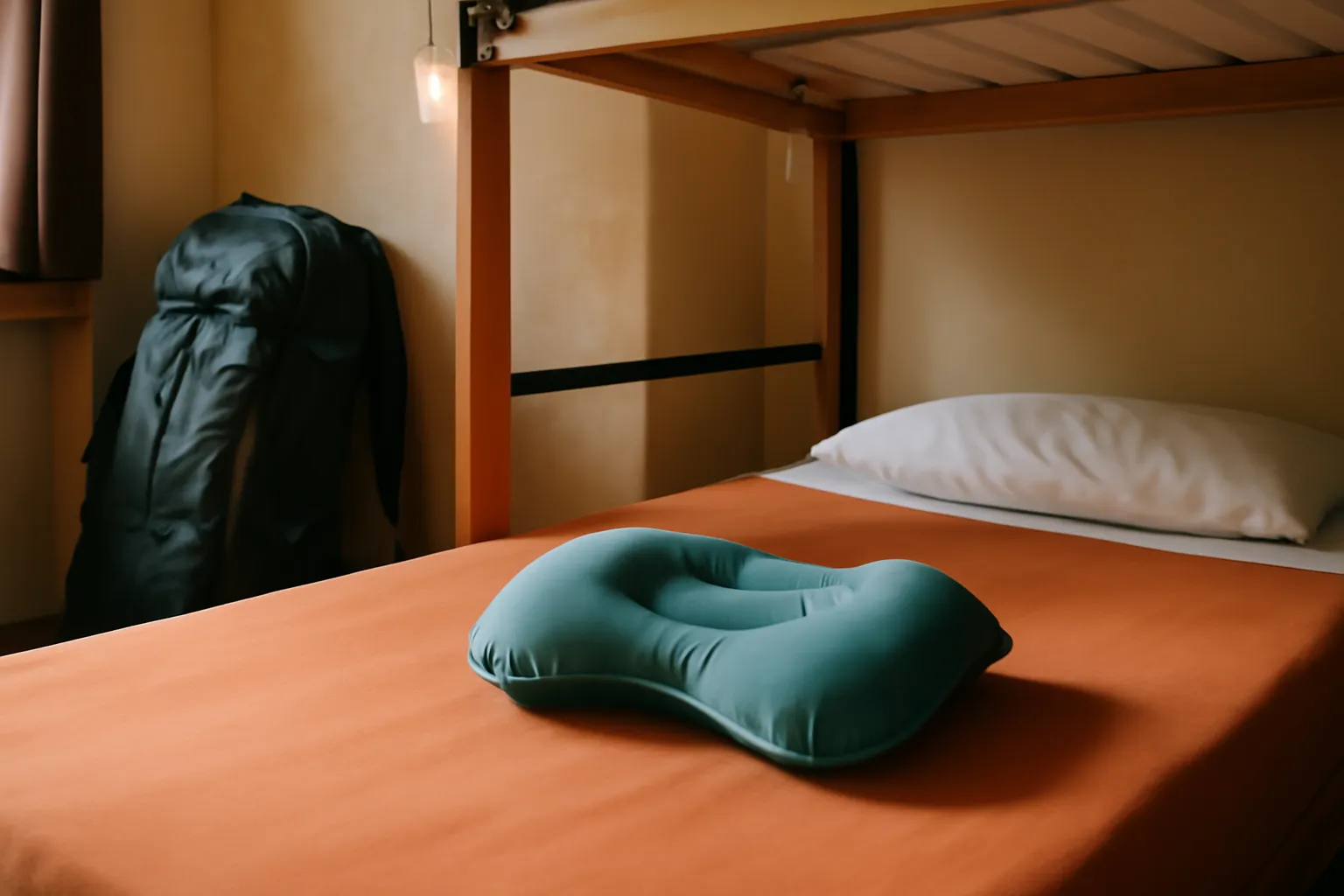
Unpacking it for the first time revealed a pillow that looked more premium than I expected at this price point. The brushed top surface has a softness that’s immediately noticeable — not silky, but matte and slightly velvety. It doesn’t feel like you’re sleeping on a glorified pool toy. The inflation valve is a twist-and-blow system that’s intuitive once you figure it out: turn the valve one direction to inflate, another to deflate. No fighting with it at midnight.
Inflated fully, the Regular measures approximately 42 x 30 x 11 cm. The curved shape dips slightly in the center, which is intentional — it keeps your head from rolling off the edge. Build quality feels solid. The seams are clean. Nothing about it screams “this will fail in three months,” which, after the Heathrow neck pillow debacle, was a genuine concern of mine.
On the Road: 30 Hostels and Counting
Let me walk you through how this actually got used, because the conditions matter.
Southeast Asia: The Hostel Dorm Gauntlet
My first real test was a four-week trip through Vietnam, Cambodia, and Thailand. Hostel dorm rooms in this region are often… atmospheric. Thin mattresses, communal fans, mystery sounds at 3 a.m. The pillow provided on most hostel bunks is either non-existent or a flat foam square that smells like broken dreams.
The Sea to Summit Aeros Premium Inflatable Travel Pillow changed this entirely. In a six-bed dorm in Hoi An, I slept on my side with it fully inflated and woke up without a stiff neck for the first time in days. In Bangkok, I deflated it slightly to get a softer feel — one of the great underrated features of an inflatable pillow is adjustable firmness. You dial it in to your preference. That’s something a foam pillow simply cannot offer.
Practical tip: always keep the pillow inside the stuff sack in your daypack during hostel stays. It’s small enough that it could walk off if left on a bunk.
Overnight Trains and Budget Flights
The overnight train from Kraków to Prague. The budget flight from Lisbon to Marrakech with the seat that didn’t recline. The ferry from Athens to Santorini, where I stretched out on a bench on the upper deck. The Sea to Summit Aeros Premium Inflatable Travel Pillow, Regular came to all of these. On side-sleeper situations — the train berth, the ferry bench — it worked beautifully. On flights, I wedged it between my head and the window, which is honestly its best use case. The shape conforms better to that awkward window-shoulder angle than a traditional flat pillow.
One note: it is not a neck pillow in the traditional wraparound sense. You’re placing it against a surface and resting your head on it. If you need something that straps around your neck for upright sleeping on a plane, that’s a different product category entirely.
What Actually Held Up (And What Didn’t)
After 30 hostel stays, multiple long-haul trips, and about 18 months of regular use, here’s the honest durability report.
What held up beautifully:
- The inflation valve has never leaked. Not once. This alone puts it miles ahead of the Heathrow disaster pillow.
- The seams are intact after significant use. No bubbling, no separation.
- The brushed surface has not pilled or degraded. It still feels noticeably softer than the base fabric.
- The stuff sack drawstring has not frayed. Minor point, but gear accessories always seem to fail first.
The one moment it fell short:
In a cold-weather hostel in Queenstown, New Zealand, I noticed the pillow felt slightly cooler to the touch than I expected. The brushed surface helps, but it’s still air inside a thin membrane — not insulating in the way a down or foam pillow would be. In warm climates, this is irrelevant. In genuinely cold dorms (and some hostels in New Zealand keep their heating at “suggestion” levels), I pulled a t-shirt over it for extra warmth. Slightly annoying. Easily solved.
Also worth noting: the pillow did develop one very slow, almost imperceptible leak around month fourteen. By “slow,” I mean I had to re-inflate it once midway through a long overnight journey. I contacted Sea to Summit’s customer service, sent photos, and they replaced it without fuss. That experience matters. Good gear brands stand behind their products.
The Downsides — Because There Are Always Some
This is the section most gear reviews skip. I refuse to.
The price. At the time of writing, this pillow sits in a range that might make budget travelers wince. It is not a five-dollar airport pillow. However — and this is important — it is also not something you replace every trip. Amortized over 18 months of use, it’s cost me less than a single bad meal in an overpriced tourist restaurant.
Inflation takes effort. It requires ten to fifteen good puffs of breath to reach full firmness. Not strenuous, but noticeable at altitude or when you’re exhausted and just want to sleep.
It is not a substitute for a proper pillow at home. Obvious, perhaps, but worth saying. This is a travel tool, not a bedroom upgrade. At maximum inflation, it’s still firmer and less plush than a quality home pillow. If you’re a princess-and-the-pea sleeper under all conditions, manage expectations accordingly.
The noise. Inflatable pillows make a faint crinkle when you shift positions. It’s subtle — less than a cheap emergency mylar blanket — but in an absolutely silent dorm room, you may hear it. Your dorm-mates probably won’t. You might. This bothered me for the first two nights and then became completely irrelevant.
Size calibration matters. The Regular size suits most adult heads. However, if you have a larger frame or tend to sleep with your shoulder elevated on the pillow, consider whether you’d benefit from the Large. I tested the Regular extensively and found it perfect for my use case, but this is worth thinking through before purchasing.
Sea to Summit Travel Pillow Hostel Review: Final Verdict
After 30 hostels, four continents, and more awkward sleeping positions than I care to count, the Sea to Summit Aeros Premium Inflatable Travel Pillow, Regular, Navy Blue earns a genuine, unequivocal recommendation. It is the best travel pillow I have used. Not because it’s perfect, but because its compromises are minor and its strengths are exactly what a long-term traveler needs.
Buy this if you are:
- A frequent hostel traveler who suffers through thin, communal pillows regularly
- Someone who does overnight trains, ferries, or long-haul flights more than twice a year
- A pack-light traveler who needs every gram and every cubic centimeter justified
- A side sleeper or back sleeper who needs reliable neck support in variable conditions
- Someone who has already tried and been burned by cheaper inflatable alternatives
Skip this if you are:
- Taking one short trip per year and sleeping mainly in hotels with proper pillows
- Primarily a plane sleeper who needs upright neck support — you want a different pillow shape
- Traveling with checked luggage and no real size constraints — a compressible foam pillow may suit you better
The bench in Bucharest was a long time ago. These days, I inflate my pillow somewhere over the Mediterranean or wedge it between my face and a hostel bunk ladder, and I sleep. It is a small, unglamorous victory. Travel is full of those. Collect enough of them and the whole trip gets better.
Also Worth Considering: The Neck Pillow Alternative
If upright sleeping is your primary challenge — specifically long flights where you can’t lean against a window or surface — take a look at the Product Reviews Travel Tips hostel gearinflatable pillowlightweight travelSea to Summittravel pillow