Let me be completely honest with you: I have rearranged entire vacation schedules, booked last-minute flights, and once ate four consecutive lunches just to experience a single food festival. If you recognize yourself in that confession, November is quietly one of the most underrated months on the food travel calendar. While most people are saving their wanderlust for December’s festive markets or summer’s obvious hits, the savvy food traveler knows that food festivals in November hit differently — they carry the weight of harvest, the tenderness of remembrance, and the unapologetic joy of cultures that use food as their primary love language. From temple stalls glowing under full moons in Thailand to wine-soaked bistros in France toasting a brand-new Beaujolais, November is absolutely stacked. So let’s talk about where you should actually be this month.
Why November Is a Surprisingly Perfect Month for Food Travel
November is a transition month in the most poetic sense. In the northern hemisphere, the days are shortening, the air is getting sharp, and people are being pulled indoors toward warmth, spice, and slow-cooked comfort. In the southern hemisphere, it’s the opposite — spring is fully unfurling, outdoor festival season is kicking off, and the energy is buzzing. This tension between two hemispheres creates a genuinely fascinating spread of late autumn food festivals and springtime celebrations happening simultaneously around the world. Culturally, November is also a month of enormous significance. It holds Día de los Muertos, which uses food as a bridge between the living and the dead. It holds harvest thanksgiving traditions. It holds the theatrical unveiling of France’s most anticipated young wine. The common thread? In November, food isn’t just sustenance — it’s ceremony. And that is exactly the kind of eating I plan entire trips around.
Loi Krathong Festival — Chiang Mai & Bangkok, Thailand
Dates, Vibe & What to Eat
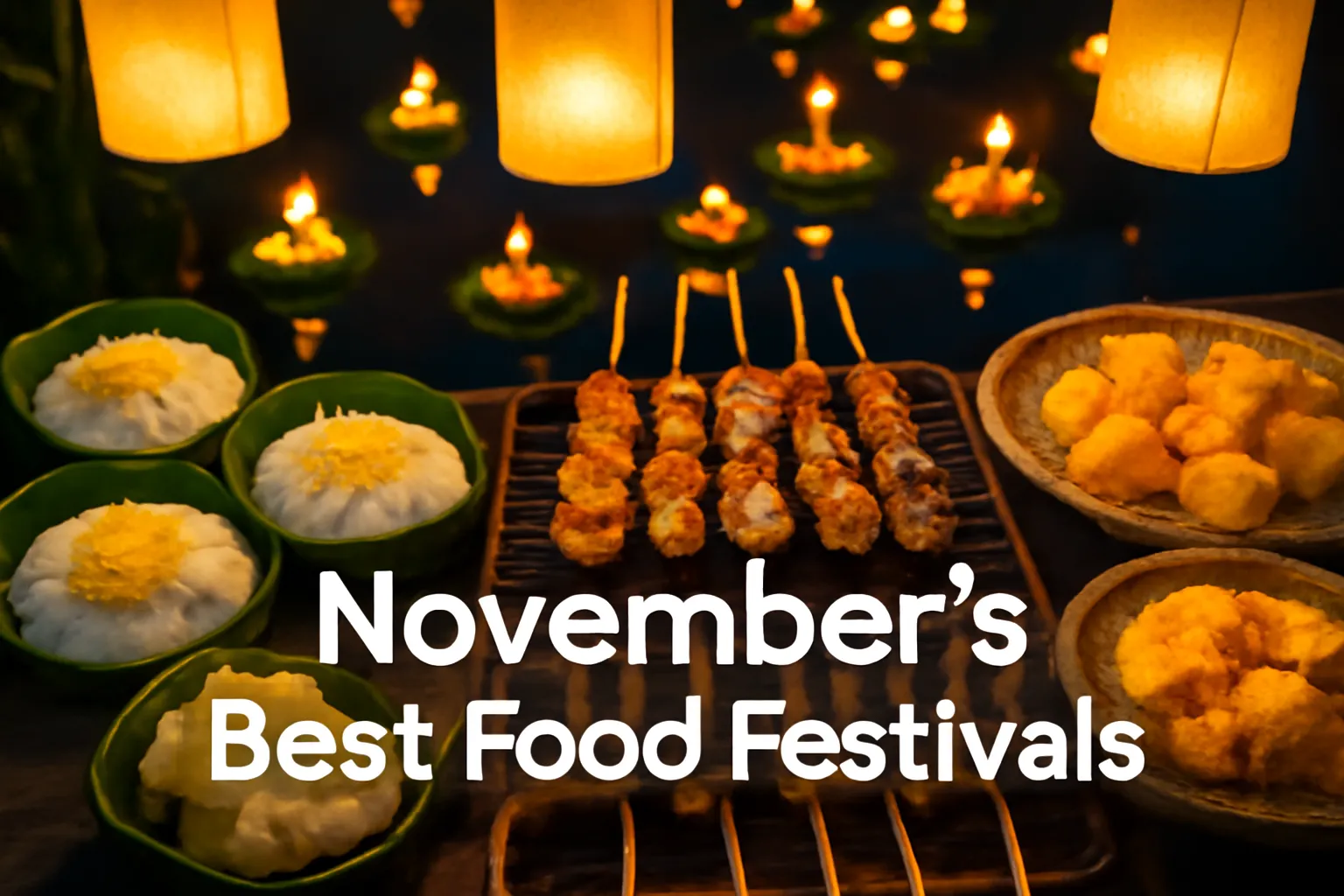
Loi Krathong falls on the full moon of the twelfth lunar month, which typically lands in mid-to-late November, and lasts approximately three days. If you want the most visually staggering version of this festival, Chiang Mai is the place — it combines Loi Krathong with Yi Peng, the sky lantern festival, and the result is genuinely one of the most beautiful things you will ever witness as a human being. But let’s talk about the food, because the temple stalls and floating market vendors that appear during this period are extraordinary. We have a deeper dive into Thailand’s food scene over on our Thailand destination guide, but for Loi Krathong specifically, your must-eat list should include khao tom (a comforting rice soup that vendors ladle out at midnight along the riverbanks), khanom krok (those tiny, cloud-like coconut rice pancakes cooked in cast iron pans over open flame), and mango sticky rice freshly prepared at floating market stalls. The atmosphere is incense-scented and golden — candlelit krathong floats drift down the Ping River while vendors fan their grills and the air smells of lemongrass, caramelized banana, and woodsmoke. Budget around 200–500 Thai Baht (roughly $6–$15 USD) per person for a serious street food crawl. Book your accommodation in Chiang Mai at least two months ahead — this festival draws enormous crowds and riverside guesthouses sell out fast. Insider tip: arrive at the Mae Ping riverside stalls by 7 PM before the main lantern release crowds everything out.
Día de los Muertos Food Culture — Oaxaca & Mexico City, Mexico
Dates, Vibe & What to Eat
Technically, Día de los Muertos is November 1st and 2nd, but the food events, market fairs, and community celebrations in cities like Oaxaca and Mexico City ripple across the entire first week of the month. This is one of the most culturally sacred food experiences on this entire list, and I want to be direct about something: being a respectful food tourist here matters enormously. Día de los Muertos is not a Halloween extension — it is a deeply spiritual Indigenous Mexican tradition of welcoming the souls of deceased loved ones back to the world. Food placed on ofrendas (altars) is sacred. Photograph respectfully, ask before joining private cemetery vigils, and prioritize spending your money at locally owned stalls and cooperatives rather than tourist-facing pop-ups. That said, the food itself is among the most profound culinary experiences available on Earth. Pan de muerto — a soft, anise-scented sweet bread decorated with bone-shaped dough — is baked fresh daily and best eaten warm from a local panadería. Mole negro, Oaxaca’s complex, chile-dark signature sauce served over turkey or chicken, appears at communal feasts and restaurant specials throughout the week. And the sugar skull-making workshops at local mercados are interactive, edible art experiences that cost around 150–300 Mexican Pesos ($8–$16 USD). The atmosphere in Oaxacan cemeteries during the night vigil is candlelit, marigold-drenched, and genuinely moving. Check out our Mexico travel content for more on planning your trip around this incredible tradition. Book at least three months in advance — Oaxaca in early November is one of the most sought-after travel experiences in Latin America.
Beaujolais Nouveau Celebrations — Lyon & Beaujolais Region, France
Dates, Vibe & What to Eat
The third Thursday of November. Mark it in your calendar right now. At midnight on that date, Beaujolais Nouveau — the year’s first young red wine made from Gamay grapes harvested just weeks earlier — is legally released across France, and the entire Beaujolais region erupts in celebration. The surrounding week transforms the wine villages of Beaujeu, Belleville-en-Beaujolais, and the streets of nearby Lyon into one long, gloriously indulgent food-and-wine party. The november food events international calendar doesn’t get more classically French than this. For food pairings, lean into the regional classics: charcuterie boards loaded with rosette de Lyon (a coarse pork salami that is deeply, almost unreasonably delicious), quenelles de brochet (the silky pike dumplings that Lyon insists you eat before you leave), and tarte aux pralines — a shockingly pink, almond-studded tart that is basically Lyon’s dessert identity card. Wine caves and bistros offer tasting menus featuring Beaujolais Nouveau prominently for around €25–€50 per person. The atmosphere is jovial, noisy, slightly wine-stained, and absolutely wonderful — locals queue up at cave cooperatives from early morning on release day. Insider tip: skip the big tourist traps in central Lyon and take the 45-minute train to Villefranche-sur-Saône instead, where the village celebrations are more authentic and the producers are pouring generously. Book a wine-country gîte or chambres d’hôtes for the week — it’s cheaper than Lyon hotels and infinitely more atmospheric.
Melbourne Cup Carnival Food Events — Melbourne, Australia
Dates, Vibe & What to Eat
The Melbourne Cup Carnival runs across approximately four days in early November, centered on the famous horse race held at Flemington Racecourse on the first Tuesday of the month. But here’s the angle that food travelers often miss: this is one of the most sophisticated food-racing fusions in the world. The champagne marquees, hospitality pavilions, and trackside restaurants at Flemington feature some of Australia’s best chefs producing elevated, occasion-worthy menus that draw as much attention as the horses. This is very much a food travel November destination for people who like their culinary experiences dressed up and poured into a champagne flute. Must-eats include Moreton Bay bugs (a Queensland crustacean that appears on every upscale Melbourne menu in spring), pavlova topped with fresh seasonal berries (Australian spring means strawberries and passionfruit are magnificent right now), and the extraordinary artisan cheese boards curated from Victorian dairy producers that hospitality tents stock with genuine pride. Trackside dining packages start around AUD $200–$500 per person for the premium marquee experience, though you can eat brilliantly around Flemington for far less. The vibe oscillates between glamorous-hat chaos and genuinely lovely al fresco dining as Melbourne spring weather cooperates (pack layers — it will also try to rain on you). Book hospitality packages at least six to eight weeks out; the best marquee experiences sell out early through the official Victoria Racing Club website.
The Neck Wrap That Saved Me at November’s Outdoor Food Markets
November food festivals mean standing outside for hours in unpredictable weather—sometimes in genuine cold—while your hands are full of samples and your attention is on the food, not your temperature. A good heated neck wrap turns what could be a miserable experience into something you can actually focus on and enjoy.
What works
- Stays warm for hours without needing to be plugged in, which matters when you’re moving between market stalls and can’t babysit a device
- Doesn’t get in the way of eating or drinking—unlike a bulky scarf, it sits right where you need heat without blocking your mouth
- Small enough to fit in a day bag, so you can carry it to your next festival without it taking up suitcase real estate
What doesn’t
- The heat eventually fades after a few hours, so it’s more of a “take the edge off” solution than an all-day guarantee
- If you sweat easily or end up indoors frequently, it becomes annoying to remove and store rather than just wearing a regular jacket
I was skeptical it would stay warm long enough during a full morning at the Modena Food Festival until I realized I’d stopped thinking about the cold entirely and was fully present for my fifth tasting. That’s when I knew it was worth it: Girasol Heated Neck Wrap
This post contains affiliate links. As an Amazon Associate, I earn from qualifying purchases at no extra cost to you.