Three separate trips, three separate itineraries redrawn around what was on a plate. I have detoured a road trip for nothing more than a cheese shop. I have let a train leave the station without me because a salumiere and I were locked in a heated debate about the correct fat-to-lean ratio in culatello. Given that track record, take it seriously when I say October is Italy’s finest month for eating — and I do not toss that claim around casually. This is white truffle season, and the truffle festivals scattered across Italy in October and November amount to the most luxurious food gatherings you will find anywhere on earth. We’re talking about a fungus priced at €3,000–€5,000 a kilogram, sliced tableside like some kind of sacrament, alongside Barolo in dining rooms that have stood for centuries in Piedmont. If your fall travel has any theme at all, make it this one.
Why Truffle Festivals Italy Are in a League of Their Own
Truffles have a strange way of uniting chefs who can’t agree on anything else — everyone concedes that a proper shaving of white truffle turns a good dish into something extraordinary. Italy grows the best specimens on the planet and marks the occasion with a level of organized, full-hearted enthusiasm you’d otherwise expect at a football final. Before diving into individual festivals, here’s the quick rundown on what exactly you’re chasing.
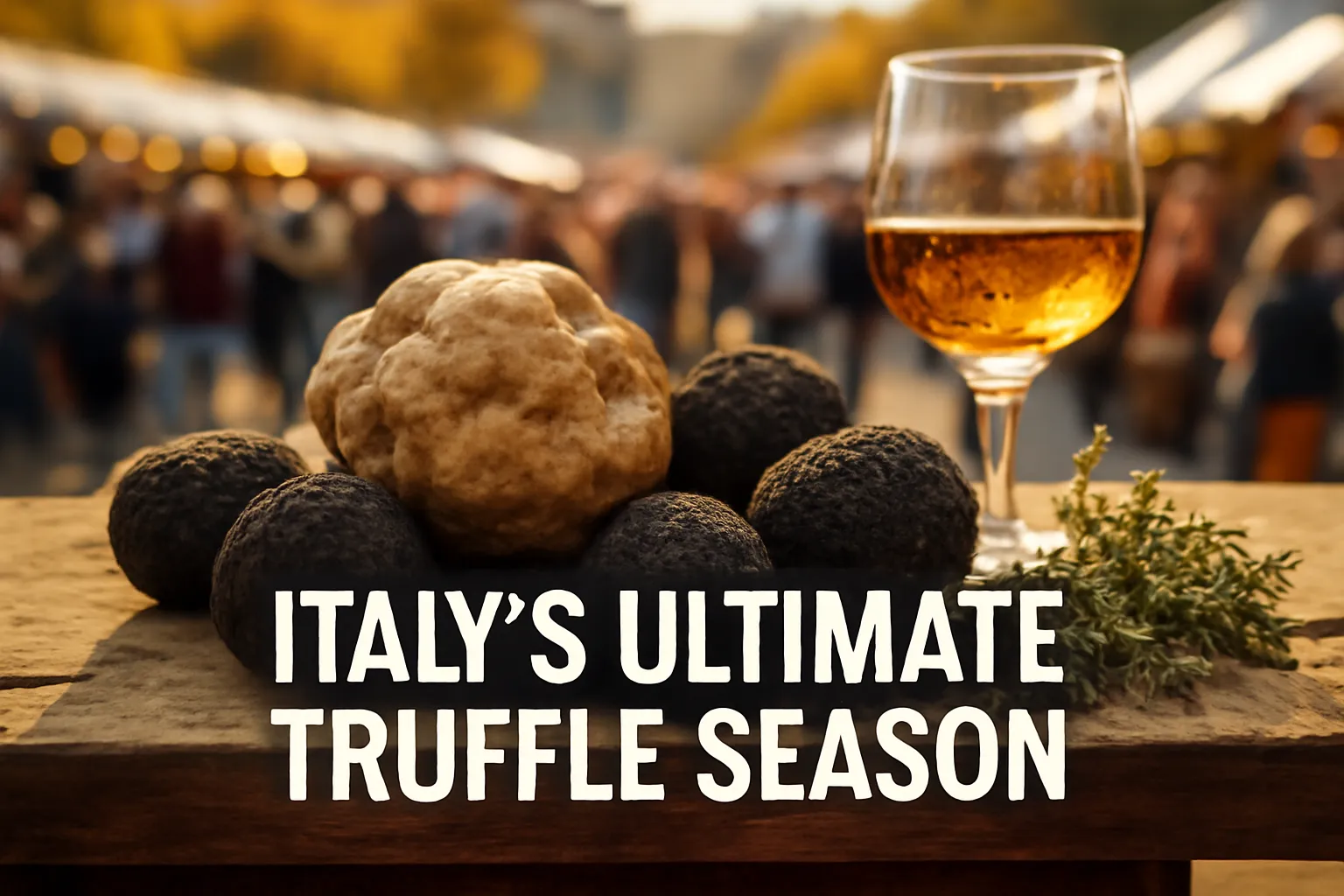
White truffles (Tuber magnatum pico) are the headline act — pungent, garlicky, intensely fragrant, gathered mainly around Piedmont and Tuscany between October and December. No one has figured out how to farm them, which explains the eye-watering price tags. Count on €3,000–€5,000 per kilogram during peak weeks, with rare specimens fetching multiples of that at auction. Black truffles (Tuber melanosporum) show up more often, cost less, and arguably work harder in the kitchen — they take center stage at winter festivals throughout Umbria and Marche from November into March. Both deserve your undivided attention and a truly unreasonable slice of your travel budget.
Alba International White Truffle Fair: The Reigning Champion of Europe’s Truffle Scene
If you skip everything else here, don’t skip Alba. The Fiera Internazionale del Tartufo Bianco d’Alba takes place every weekend from mid-October through late November in Alba’s medieval old town, tucked into the Langhe wine hills of Piedmont — the very same slopes behind Barolo and Barbaresco. Call it the finest truffle event in Europe, maybe the world, and buyers fly in from Tokyo, New York, and every point between to prove it. The 2024 edition stretches from October 5 through November 24, and the opening weekend brings the charity auction, where a single truffle can sell for tens of thousands of euros toward a good cause.
The vibe: Polished yet welcoming — classic Piedmont, where real culinary expertise sits comfortably beside genuine warmth. The old center transforms into a truffle marketplace where certified sellers weigh out white truffles, and the whole town smells faintly of money and mushrooms in the best way imaginable. Reserve your evening tasting dinners weeks ahead, because local restaurants fill up fast.
Must-try dishes: Tajarin al tartufo (Piedmont’s thin egg pasta, lightly sauced and heaped with shaved white truffle — worth the plane ticket on its own), fonduta with truffle (a molten Fontina fondue crowned with shavings you won’t forget), and simple fried eggs topped with truffle — modest-sounding, priced well above your hotel’s breakfast tab.
Practical tip: Lock in a room in Alba or nearby Barolo two to three months ahead for any October weekend. Weekday visits to the fair are calmer, cheaper, and honestly more enjoyable — smaller crowds and more real conversation with vendors. For an Alba truffle festival experience that includes hunting, book a morning outing through the fair’s official program or a local agriturismo, then spend the afternoon at the market. Figure on €60–€120 per person for a guided hunt with a trained Lagotto Romagnolo.
San Miniato Truffle Festival: Tuscany’s Smaller, Closer-Knit Version
Set on a hilltop between Florence and Pisa, the modest Tuscan town of San Miniato runs its white truffle celebration over three back-to-back November weekends — usually the last two of the month plus the first weekend of December. Where Alba goes big and international, San Miniato stays personal and rooted in the neighborhood. The festival winds through stone piazzas and medieval lanes, with producers setting up stalls and local restaurants offering truffle menus priced far more reasonably than what you’ll find in Piedmont.
The vibe: A true small-town Italian affair — where the vendor selling you truffles likely dug them up that same morning and will half-tell you where. Locals, families, and an increasing number of clued-in food travelers share the space easily. It slots beautifully into a wider Tuscany trip, with Florence and the Chianti countryside both a short hop away.
Must-try dishes: Pappardelle al tartufo bianco, local bistecca finished with truffle butter, and ribollita given depth by a light touch of black truffle.
Practical tip: Do it as a day trip from Florence (roughly 45 minutes by train to Empoli, then a quick taxi ride), or stay the night in San Miniato for the complete experience. November lodging here is much simpler to book than in Alba, and it’s noticeably kinder to your wallet too.
Acqualagna Truffle Fair: Marche’s Under-the-Radar Find
Acqualagna, in Marche, might be the quietest name on this list, but locals will mention — with a hint of pride — that it’s actually one of Italy’s most significant truffle trading centers. The Fiera Nazionale del Tartufo spans several weekends from late October through November, with the October dates focused squarely on white truffles and the November stretch covering both white and black. Serious Italian buyers come here to do business, which keeps the quality high and the tourist markups mercifully absent.
The vibe: Unmistakably local — you’ll hear far more Italian than English, the schedule includes actual truffle-hunting competitions rather than just market booths, and the whole thing feels like an honest glimpse of how Italians actually eat. For anyone chasing truffle hunting food travel through Italy, Acqualagna makes a natural match with the wider Marche region, which remains bafflingly overlooked.
Must-try dishes: Pasta al tartufo made with local hand-rolled stringozzi, grilled meats finished with truffle sauce, and simple truffle bruschetta on good bread — unfussy and unforgettable.
Practical tip: Rent a car for this stop — public transport barely reaches Acqualagna. Pair it with the striking Furlo Gorge and the hill town of Urbino for a memorable long weekend somewhere even Italian tourists tend to skip.
Città di Castello Truffle Festival: Umbria at Its Most Unfiltered
Città di Castello, up in northern Umbria near the Tuscan border, throws a November truffle festival that’s about as far from a curated tourist photo op as a genuine truffle event can get. This town takes its truffles seriously — it’s home base for Urbani Truffles, one of the biggest truffle traders anywhere — and the festival reflects generations of living alongside the fungus, not a recently discovered marketing angle.
The vibe: Local through and through, with zero pretense. The crowd is mostly Italian, the food stalls belong to nonnas and neighborhood restaurants rather than festival contractors, and the truffle prices at market reflect actual cost rather than any tourist premium you’d meet elsewhere.
Must-try dishes: Black truffle crostini (Umbria’s signature bite), pasta alla norcina with black truffle, and local sheep’s milk pecorino shaved with truffle — a pairing that quietly ranks among the best things I’ve eaten at any festival, anywhere.
Practical tip: Combine Città di Castello with Perugia and Assisi for a full Umbrian route. To arrange a truffle hunt here, reach out to local agriturismos directly — expect €40–€70 per person, meal included afterward, which is a remarkable deal.
Outside Italy: Europe’s Other Standout Truffle Festivals
Here’s my small act of heresy: Italy doesn’t own truffle season outright. If you’re building out a broader truffle festival calendar across Europe, two regions earn a firm place on it — Istria in Croatia and Provence in France. Same fungus, completely different personalities, and often noticeably gentler prices. Think of these as the essential additions to any truffle-festival itinerary across the continent.
Zigante Truffle Days: Croatia’s Istria Answers Alba with White Truffles of Its Own
The small village of Livade, tucked into the wooded Mirna valley of inland Istria, hosts Zigante Truffle Days on weekends from early October through early November — timed conveniently with white truffle season. Admission costs nothing, dozens of stalls crowd the main tent selling Istrian truffles, olive oils, and wine, and Livade has earned its unofficial title as Istria’s truffle capital. Croatian white truffles emerge from the same kind of damp oak forest as Piedmont’s, and which region wins a blind tasting remains genuinely up for debate.
The vibe: Loose, generous, unpretentious — Alba’s easygoing cousin, charging less and pouring more. Expect a blend of serious food lovers and curious day-trippers from Slovenia, Italy, Austria, and beyond.
Must-try dishes: Fuži (Istria’s hand-rolled pasta) with white truffle, truffled fritaja (a rustic scrambled-egg dish, Istria’s answer to Alba’s fried eggs), and a glass of local Malvazija to wash it down.
Practical tip: Stay in nearby Motovun, the strikingly photogenic hill town overlooking the truffle forests, and rent a car — inland Istria isn’t friendly to public transit. I’ve written an entire tribute to this region’s food culture in my guide to Istria, Croatia’s gastronomic gem, and every word of it still holds up.
Richerenches Truffle Market: Provence’s Black Truffle Trading Floor
Richerenches, a tiny village in the Vaucluse in northern Provence, hosts what’s commonly called Europe’s biggest black truffle market — every Saturday morning, roughly mid-November through mid-March. This isn’t a single-weekend event but an entire winter of steady trading: the market traces back to 1922, and several hundred kilos of Tuber melanosporum reportedly change hands weekly, with wholesale deals happening along the Cours du Mistral and retail stalls where ordinary buyers like us can actually make a purchase.
The vibe: Business first, Provençal charm second — brokers, chefs, and growers haggling out of car trunks and coat pockets while everyone else pokes around the retail stalls, pretending they can distinguish a great truffle from a merely good one.
Must-try dishes: Brouillade aux truffes (slow-scrambled eggs loaded with black truffle), Picodon goat cheese laced with truffle from the surrounding Drôme Provençale, and whatever’s chalked on a local café’s winter menu board.
Practical tip: Get there early — the market only runs Saturday mornings, and the good retail truffles vanish fast. Richerenches pairs naturally with the wine villages of the southern Rhône; Châteauneuf-du-Pape is within easy reach.
Aups Black Truffle Festival: The Var Region’s Winter Party
Aups, in the Var near the Gorges du Verdon, ranks among Provence’s key black truffle towns, and it shows it two ways: a weekly Thursday market running roughly November through March, and the Fête de la Truffe Noire — a genuine village festival held over a late-January weekend, free to enter, with a fresh truffle market, tastings, truffle-dog demonstrations, Provençal dancing, and fireworks in honor of the “black diamond.”
The vibe: An authentic small French village celebration — the whole town shows up, the dogs get all the attention, and nobody’s performing for social media. If Richerenches is the trading floor, Aups is the celebration afterward.
Must-try dishes: A truffle omelette straight from a festival stall, tapenade with truffle crostini, and a glass of local Côtes de Provence while watching the cavage (truffle-hunting) demonstrations.
Practical tip: January in inland Provence runs cold but blissfully empty of crowds — book a village guesthouse, pack a real coat, and let the festival anchor a slow winter weekend in the Verdon backcountry.
The Truffle Slicer That Rescued My Alba Haul
You could fly 4,000 miles to Alba, drop serious money on white truffles at the fair, and then butcher them back at the hotel with a dull blade and unsteady hands. A decent truffle slicer isn’t a luxury — it’s the entire gap between paper-thin, ideal slices and clumsy, wasteful chunks.
What works
- The blade holds a genuine edge, so you’re not pressing down like you’ve got a grudge against the truffle — useful at 11 p.m. in a Piedmont apartment kitchen over a plate of pasta.
- The stainless steel picks up no odors or flavors, so slicing several truffles across multiple days — or reusing the tool for other kitchen jobs later — won’t cross-contaminate anything delicate.
- It packs small enough for a carry-on, not hogging space the way a full knife roll would, which counts for something once your festival hauls start crowding your luggage.
What doesn’t
- The blade guard feels flimsy and doesn’t build much trust, so you’ll still worry about it shifting inside your suitcase — I ended up wrapping mine in a kitchen towel just in case.
- It’s built around the truffle’s shape, not your hand, so a small or irregular truffle means improvising your grip and losing whatever ergonomic edge it was supposed to offer.
I almost sent it back after my first use because I expected restaurant-grade weight and got something that felt almost toy-like in my hand, but then I actually tasted the difference those uniform slices made on risotto, and I kept it. Get the Wenplus Professional Stainless Steel Truffle Slicer.
Frequently Asked Questions
When is white truffle season in Italy?
White truffle season runs from October through December, with the major festivals taking place in October and November. This is when Italian truffle festivals reach their peak, particularly in Piedmont and Tuscany, making it Italy’s finest month for eating truffles.
How much do white truffles cost per kilogram?
White truffles are priced at €3,000–€5,000 per kilogram during peak weeks, with rare specimens fetching multiples of that at auction. The eye-watering prices reflect the fact that no one has figured out how to farm them commercially.
How much does a truffle hunt cost in Italy?
Guided truffle hunts vary by region. In Alba, expect €60–€120 per person with a trained Lagotto Romagnolo. In Città di Castello, agriturismos offer hunts for €40–€70 per person with a meal included afterward, which is notably more affordable.
What are the dates for Alba truffle festival 2024?
The 2024 Alba International White Truffle Fair runs from October 5 through November 24, taking place every weekend in Alba’s medieval old town in Piedmont’s Langhe wine hills.
About This Article

Written by Elena Vasquez. Elena Vasquez is a full-time traveler and the founder of Witty Passport. Over fifteen years and more than 50 countries across six continents — including a stretch spent leading groups professionally through Southeast Asia and the remote highlands of South America — she's written the kind of destination guides she always wished existed: practical, specific, and built on real experience rather than recycled itineraries. More about this site.
Scope and limits. Elena is a full-time traveler, not a licensed travel agent or immigration adviser. Entry requirements, visa rules, and advisories change without notice — always confirm against the official government source for your destination and passport before booking.
Verify this against a primary source
Specifics change, and your situation may differ from the one described here. These are the authorities worth checking directly:
- U.S. Department of State — entry requirements and travel advisories
- CDC Travelers' Health — vaccination and health notices by destination
- TSA — current carry-on and screening rules