

Paying €10 a day for gravel protection beats losing your deposit over a cracked bumper, every single time — and I know that because I ran the opposite experiment. I was standing at a gravel pullout near Vík while a rental agent photographed every chip and scratch on my bumper, doing math in his head that I didn’t want to watch. I’d skipped the gravel coverage to save what felt like pocket change. That pocket change came back around with interest. That afternoon taught me more about renting a car in Iceland than any blog post ever managed — and the tuition was steep. Consider everything below the refund on that lesson.
What Car Should You Actually Rent in Iceland?
The counter is where things start to wobble. You’ll arrive groggy off the overnight flight into Keflavík, and the agent will smile and suggest — quite persuasively — that you need a 4WD SUV with a roof box, maybe a snorkel kit bolted to the intake. A small fuel tank, while they’re at it. The honest answer to what every first-timer actually needs is less exciting than the pitch: it depends entirely on your route and your season.
Stick to paved Route 1 for a summer loop — June through August — and a plain 2WD compact, something like a Toyota Yaris, handles it fine. The tarmac is smooth and well kept, and thousands of visitors drive the whole Ring Road every year in nothing sturdier than an economy hatchback. That 4WD camper loaded with extras the agent’s pushing is mostly margin, not necessity. Keep the money and spend it on a puffin-watching boat instead.
Everything changes the second F-roads enter the plan. These highland tracks call for a genuine 4WD with real ground clearance — not all-wheel-drive, not a crossover with clever marketing copy, but something built like a Toyota Land Cruiser or a Dacia Duster. Some highland routes also include unbridged river crossings, which are their own separate adventure entirely. If you’ve never driven a car through a glacial river, get local guidance first — Road.is publishes current river conditions, and rental desks can walk you through technique. Attempt an F-road in a 2WD and you’re not only voiding your insurance; you risk getting stranded somewhere with zero cell signal and only a handful of unbothered ravens for company.
Winter is a different conversation altogether. Passes like Öxnadalsheiði or Vatnsskarð ice over — reliably — and a front-wheel-drive compact turns into an expensive toboggan. Come winter, 4WD or AWD isn’t a luxury upgrade; it’s a safety requirement. Check Road.is before every departure — I mean every single one. I’ve watched a calm, sunny morning in Akureyri collapse into a whiteout on the pass before I’d finished my second coffee.
Insurance for Icelandic Rentals: Where the Real Costs Hide
Insurance is exactly where first-timers lose money, and I say that as someone who’s lost it. Here’s a straight walkthrough of what’s actually sitting in that rental agreement before you sign.
Every contract in Iceland bundles in a basic CDW — Collision Damage Waiver — as the mandatory starting point. You can’t opt out of it, and it covers far less than you’d hope. What it leaves out — and what Iceland delights in throwing at rental cars — is gravel damage. Even the paved roads here kick up stones that find windshields, headlights, and any panel unlucky enough to be nearby. Gravel Protection (GP) typically runs €10–15 a day, and since my afternoon near Vík, I’ve bought it on every trip since without hesitating. Skip GP on an Iceland rental and there’s a good chance you’ll end up paying for a cracked windshield anyway. The math isn’t complicated.
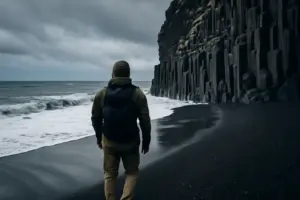
If black-sand beaches or active volcanic areas are on your route — and Reynisfjara alone makes the case for going — add Sand and Ash Protection (SAAP). Wind-driven black sand behaves like fine sandpaper and can strip paint in under ten minutes on a gusty day. I’ve watched it happen: a rental car looked pristine one moment, and after half an hour of coastal wind, the finish had gone dull in a way it clearly hadn’t started out.
Call your credit card company before you book anything. Certain premium travel cards include collision coverage automatically when the rental goes on that card. Coverage varies enormously by provider, and some explicitly exclude Iceland because of the gravel and volcanic-ash risk — but a fifteen-minute call could save you €150 in add-on fees. Just get whatever they tell you confirmed in writing.
The Driving Rules That Catch First-Timers Off Guard in Iceland
Iceland has a set of driving rules that will surprise you if you’re expecting mainland-Europe norms. Get the Road.is app on your phone before you leave home. It’s the Icelandic Road Administration’s live feed, covering closures, surface conditions, and status for every road in the country. Handy in summer, non-negotiable in shoulder season. I check it every morning over breakfast the way some people scroll the news.
Run it alongside Vedur.is, the weather app from Iceland’s Meteorological Office. The weather here doesn’t just shift daily — it shifts hourly, sometimes valley to valley. Clear skies at your guesthouse say nothing about what’s happening on a pass twenty kilometers north. Check both apps before every departure, without exception.
A few rules will spare you both money and embarrassment: headlights are legally required around the clock in Iceland, even during peak midnight sun — your rental should default to automatic, but confirm it does. Speed limits sit at 90 km/h on paved highways, 80 km/h on gravel roads, and 50 km/h through towns. Speed cameras are everywhere and the fines are steep with no room to negotiate. Fuel stations in the highlands can sit 100-plus kilometers apart, so top off whenever you spot a pump, even at half a tank. Single-lane bridges show up all along the Ring Road — yield to whoever’s already on the bridge, and don’t assume you have distance just because you can’t see it yet. And please, resist leaving the marked tracks entirely — off-road driving is illegal in Iceland, tears up moss that won’t recover for decades, and carries fines steep enough to wreck your trip budget.
Picking a Rental Location and Booking at the Right Time
Keflavík International Airport is the most practical pickup point — most visitors land, grab the keys, and head out without ever detouring into Reykjavík. All the familiar international names operate here: Europcar, Hertz, Budget. But don’t overlook homegrown Icelandic companies like Blue Car Rental and Lagoon Car Rental, which routinely beat the multinationals on price while handing over perfectly solid vehicles. I’ve booked with Lagoon twice without a single issue, and their customer service was refreshingly human when I called with a question at 7am on a Sunday.
Timing matters more than people expect. For peak season — roughly June through August — lock in your rental three to four months ahead. The decent vehicles at fair prices disappear fast, and arriving without a reservation leaves you choosing between whatever’s left or whatever’s overpriced. Winter gives you more room to breathe; last-minute deals do exist, but selection thins quickly, especially for the 4WD vehicles you’ll actually need. Most travelers run a full loop, picking up and dropping off at Keflavík, though one-way rentals are possible if you’d rather start or end in Akureyri or elsewhere. Budget for a one-way drop-off fee, and confirm availability well in advance.
Why a Paper Map Kept Me Out of a River Crossing GPS Nearly Routed Me Into
Iceland’s gravel roads look deceptively harmless on a phone screen, but GPS has a habit of routing you toward terrain that’s technically “passable” and absolutely something your rental car shouldn’t touch. A physical map forces you to actually read the landscape and understand what you’re driving into — exactly what I needed before I ended up on a road that resembled a creek more than a highway.
Where it earns its keep
- The level of detail makes it obvious right away whether you’re looking at a plain gravel road, a rough mountain pass, or genuine jeep-only terrain — you know what you’re committing to before you turn onto it.
- No battery to run flat, no signal to lose, and no 9 PM panic when your phone dies in the middle of nowhere with no charger in sight.
- Paired with GPS rather than swapped in for it, it actually speeds up navigation — you’re confirming what your phone claims is safe instead of trusting an algorithm that has no idea what your car’s clearance actually is.
Where it falls short
- It’s too bulky for a quick glance the way a phone allows — you have to actually pull over to read it properly, which means plotting your waypoints before you set off, not while you’re driving.
- Conditions shift with the seasons and after heavy rain, and even the best map can’t tell you a route washed out three days ago.
I almost left mine in the rental office to save luggage space, convinced my phone would be enough—until I spotted a washed-out section of road my GPS was still confidently directing me toward. National Geographic Adventure Map of Iceland (No. 3302)
National Geographic Adventure Map of Iceland (No. 3302)
I stopped trusting my phone’s routing in Iceland after this map showed me what the algorithm was missing.
Check Price on Amazon →This post contains affiliate links. As an Amazon Associate, I earn from qualifying purchases at no extra cost to you.