
One gasp, involuntary and slightly embarrassing since nobody was around to hear it, and about ninety seconds of hover time — that’s what it took above Kirkjufell for me to understand what this country does to aerial footage. From ground level, the mountain already earns its reputation: that arrowhead silhouette rising off the Snæfellsnes Peninsula like a set piece pulled straight out of a fantasy epic. But send a drone up and the whole scene reorganizes itself — twin waterfalls stitching silver threads through the green slopes below, the Atlantic catching light somewhere past the frame. I said “whoa” out loud, alone, like an idiot. That reaction is basically the thesis of this guide: how to get those shots in Iceland without stumbling through the legal fine print, guessing at locations, or watching your battery die right as the light turns gold.
Iceland ranks among the most permissive countries in Europe for drone work — step outside the marked restricted zones and you’re looking at wide-open airspace paired with scenery so cinematic it feels like cheating. Permissive isn’t the same as unregulated, though, and this country’s weather has grounded pilots with far more experience than mine. Whether you’re stringing together a full Ring Road circuit or camping out on the South Coast for a week, everything here — rules, standout locations, cold-weather gremlins, gear that actually holds up — is aimed at keeping your shoot from falling apart.
Note: If the Northern Lights are specifically what you’re chasing from above, that deserves its own writeup — we’ve got a dedicated aurora drone photography guide covering night-flight specifics. This one sticks to Iceland’s daytime scenery, which honestly needs no help looking dramatic.
Iceland Drone Laws and Regulations: What You Need to Know Before You Fly
Rules first, since skipping this part gets expensive fast. ICETRA — the Icelandic Transport Authority — oversees drone operations here, and once you understand the reasoning behind their framework, it holds together pretty logically.
Anything over 250 grams needs to be registered with ICETRA before it leaves the ground. That threshold snags most drones worth flying for photography — the DJI Mini lineup sits almost exactly on that line, which explains why the sub-250g class has become the go-to choice for photographers on the move. You can register online before you even board your flight, and there’s no reason not to. The penalty for flying unregistered dwarfs whatever fifteen minutes of paperwork you’re trying to dodge.
The baseline rules: stay under 120 meters altitude, keep the drone within your direct line of sight at all times, avoid flying over crowds, and hold a minimum 50-meter buffer from anyone not involved in your flight. None of this should surprise a pilot who’s flown anywhere else responsibly — it’s mostly instinct formalized.
The restricted zones need more attention. Central Reykjavik and the flight paths surrounding Keflavik International Airport are hard no-fly areas — don’t even set up gear near the airport perimeter. Inside national park boundaries — Þingvellir and Vatnajökull specifically — you’ll need a special permit before flying. Getting one isn’t a lost cause, but it takes lead time. Start the application through ICETRA or the park authority well ahead of your trip, since turnaround varies and certain permits are genuinely hard to secure.
No regulation warns you about the thing that actually causes the most trouble: wind. Ground-level averages sit at 25–30 km/h across Iceland, and altitude only makes it worse. My personal cutoff is 30 km/h at ground level — past that, the drone stays packed and the camera comes out instead. That’s not caution for caution’s sake; it’s the line between landing your drone safely and losing it somewhere over the North Atlantic. Pull up Vedur.is — Iceland’s meteorological office — every single morning before you fly. Nothing local beats it for accuracy.
Best Places to Fly a Drone in Iceland: Seven Locations Worth the Trip
Iceland doesn’t lack for dramatic scenery, but these seven spots stand out for a specific reason — either the view from above reveals something the ground never lets you see, or the landscape is simply too vast to register properly from eye level.
Kirkjufell Mountain and Kirkjufellsfoss (Snæfellsnes Peninsula)
This is the image everyone’s after. Kirkjufell is arguably Iceland’s single most photographed mountain, and once you’re airborne, it’s obvious why. Elevation is the whole trick: climb to roughly 60–80 meters and frame the shot so Kirkjufellsfoss cascades in the foreground while the mountain rises behind it. Standing on the ground, you’re forced to choose one or the other in your composition. Airborne, you get both at once, and that pairing is really what tells the story of this landscape. The mountain’s eastern face lights up beautifully in the morning, and summer golden hour bathes the whole scene in amber for a stretch that feels almost unreasonably long — which leads into one of the best perks of shooting drones in Iceland at all.
Reynisfjara Black Sand Beach (Near Vík)
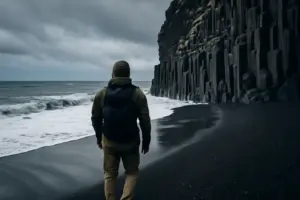
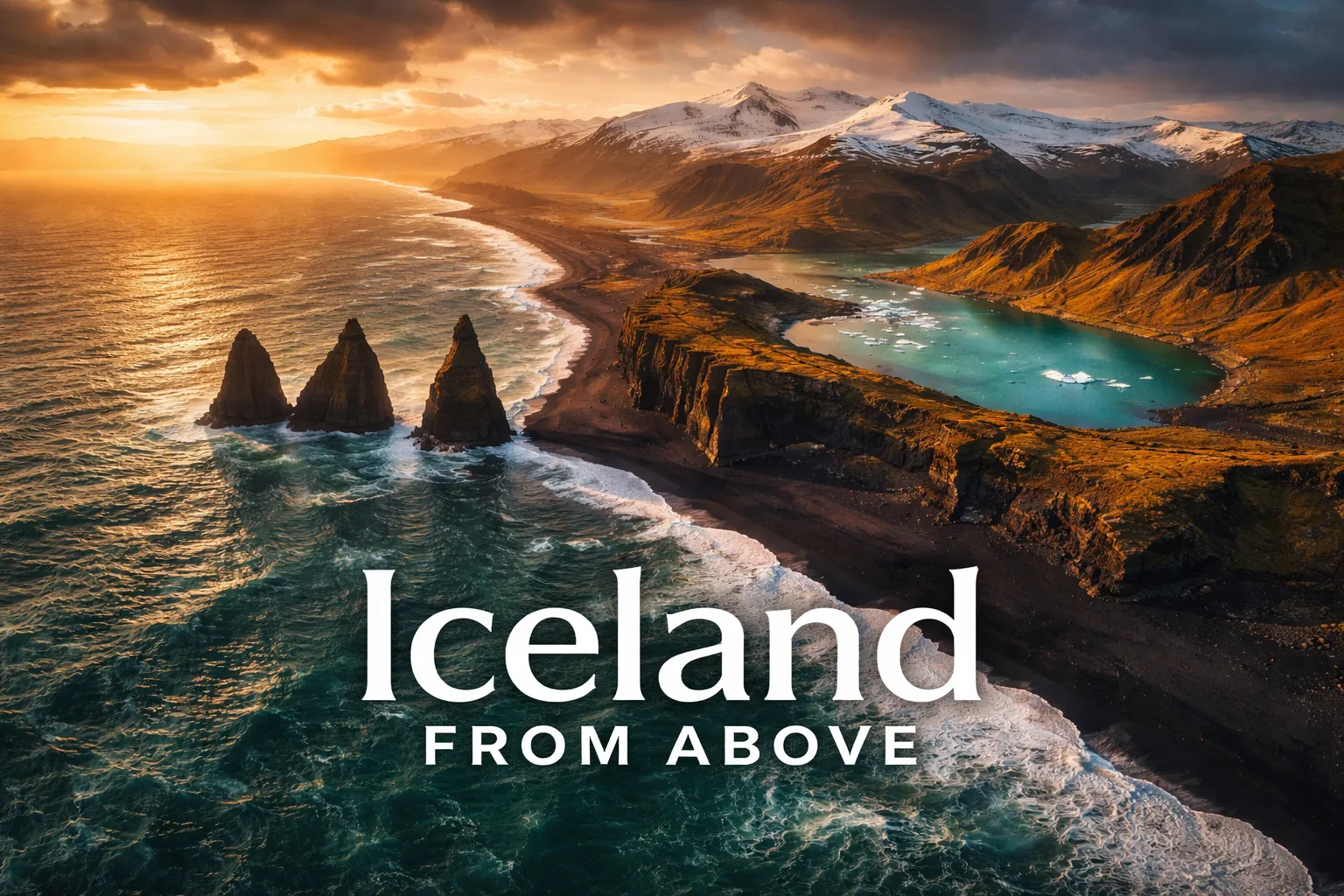
Reynisfjara’s basalt sea stacks already look sculptural from the beach. From above, they look extraterrestrial. The jet-black sand against white Atlantic surf against dark columnar rock creates something close to a monochrome image, and it’s genuinely striking. Aim for low tide, when wet sand reflects the sky back at you, and take off from the parking-lot end of the beach rather than near the cave formations, where foot traffic bunches up. Keep your altitude conservative here — the ocean breeze is erratic and can flip direction with no warning. Reynisfjara’s waves have a well-documented dangerous reputation, having claimed lives, so keep yourself, not just the drone, far from the water’s edge while flying.
Jökulsárlón Glacier Lagoon and Diamond Beach
Two hours circling Jökulsárlón, and not once did I feel like I’d repeated a shot. The icebergs read as almost alien from above — turquoise, white, occasionally a deep, saturated blue, drifting through near-black glacial water. The bigger payoff, though, sits just across the road at Diamond Beach, where broken ice washes ashore on black sand. Shooting from 40 to 50 meters, those scattered ice chunks look like shattered glass scattered across velvet. Go early, before the tour buses show up. The lagoon itself falls outside the national park boundary, so no permit is needed here — though it’s worth confirming current boundaries, since they do shift occasionally.
Seljalandsfoss Waterfall
Most visitors know Seljalandsfoss for the walkway behind the falling water. What they never see — and what makes this spot so worthwhile from the air — is the full shape of the cave hollowed out behind the curtain. Hover about 30 meters directly above the plunge pool and the rounded alcove carved into the cliff face comes into view, water arcing across it in a near-perfect curve. It’s one of the rare aerial shots that shows you something no ground angle ever could. Watch for spray, though — even at 40 meters, mist can reach the drone on a gusty day. Give your lens a check after you land.
Landmannalaugar (Summer Only)
If your trip lands in late July or August and you can manage the F-road drive out to Landmannalaugar, the rhyolite peaks here will rewrite what you thought “landscape color” meant. From above, the hillsides run through rust red, sulphur yellow, olive green, and dusty pink — closer to a painter’s palette than a mountain range. It’s reachable by 4WD along the F208, and the detour more than earns itself. No park permit applies here, just the standard ICETRA rules. Fly around midday, when the summer light is soft and even across the mountain faces.
Skaftafell and the Vatnajökull Glacier Tongues (Permit Required)
Few things in Europe photograph as strangely as the glacier tongues spilling off the Vatnajökull ice cap. From above, the crevasses, moraines, and meltwater channels form textures that resemble lunar photography more than anything from Earth. Because this falls within Vatnajökull National Park, you’ll need a permit from the park authority before flying. Apply 2–3 weeks out and the process is manageable. The paperwork is a small price for what you get.
Þingvellir Rift Valley (Boundary Restrictions Apply)
Þingvellir marks the spot where the North American and Eurasian tectonic plates are actively drifting apart, and the rift valley that creates is honestly humbling from altitude. The parallel fault lines, the river winding across the valley floor, and the sheer geological scale of it all read best from above. Keep in mind that the zone around Þingvallavatn lake sits inside the national park’s no-fly area. Certain stretches of the rift valley near the park’s edge do permit flying — research the exact boundary coordinates before you arrive, and if there’s any ambiguity, just apply for the permit.
Cold Weather Drone Tips for Iceland Aerial Photography
The cold here catches people off guard even in the middle of summer. This is what I’ve picked up the hard way.
Below 5°C, expect battery performance to drop 30–40%. That means a battery rated for 31 minutes might realistically give you 18–20 in typical Icelandic conditions. My rule: never carry fewer than three batteries per session, keep them tucked in an inside jacket pocket before launch so they stay warm, and never launch on a battery that’s gone cold. The onboard battery indicator also gets less trustworthy in the cold, so land at 30% instead of pushing your luck down to 15%.
Condensation causes trouble more slowly, but it’s just as serious. Bring a cold drone into a heated car or a warm room, and moisture starts forming on the electronics almost immediately. Give it at least 30 minutes before opening the case or plugging anything into your laptop. I’ve taken to leaving my drone bagged in an unheated car or an entryway for part of the warm-up period, just to slow that temperature swing down.
Here’s the upside: Icelandic summers hand you a golden hour that stretches 2–3 hours long. Through June and July, the sun barely slips below the horizon, so that warm, low, directional light lingers for a stretch that feels almost unfair. Photographers elsewhere set alarms for twenty-minute windows of light like this — here, you just get to keep shooting. Use every minute of it.
The Drone That Actually Fits in an Icelandic Backpack
The weather here flips without warning, and hauling a bulky drone rig across volcanic terrain doesn’t do you much good if you can’t get it out and airborne the instant the clouds break. I needed something light enough to carry without complaint, but capable enough to actually capture what I was seeing standing on those cliff edges.
What works
- It clocks in just over a pound, light enough that it actually comes along on the “quick hikes” to Seljalandsfoss or Skógafoss instead of getting left behind at the hostel because it’s too much of a hassle.
- It handles Iceland’s unpredictable coastal gusts better than expected — I’ve flown it in conditions that made me nervous, and it stayed steady exactly when it needed to.
- The Fly More Combo includes two batteries plus a charging hub, which turns out to matter a lot once you’re hopping between three shoot locations a day with unreliable power access out in remote areas.
What doesn’t
- Its range falls short of the heavier professional drones, so you can’t always push as deep into a valley or as far around a fjord as the terrain seems to be inviting you to.
- Near glacier edges, where thermal winds get strong — and Iceland has no shortage of those — the gimbal occasionally loses some smoothness, particularly shooting 4K at certain angles.
I almost turned back at Kirkjufell when I saw darker clouds rolling in and questioned whether the smaller battery would even last long enough to get the shot, but I flew anyway—and got everything I needed with juice to spare. If you’re serious about capturing Iceland’s drama without becoming a pack mule, grab the DJI Mini 5 Pro Fly More Combo with DJI RC-N3.
DJI Mini 5 Pro Fly More Combo with DJI RC-N3
I stopped leaving it behind because it weighs nothing, handles coastal wind, and the extra batteries keep me shooting all day across remote locations.
Check Price on Amazon →This post contains affiliate links. As an Amazon Associate, I earn from qualifying purchases at no extra cost to you.