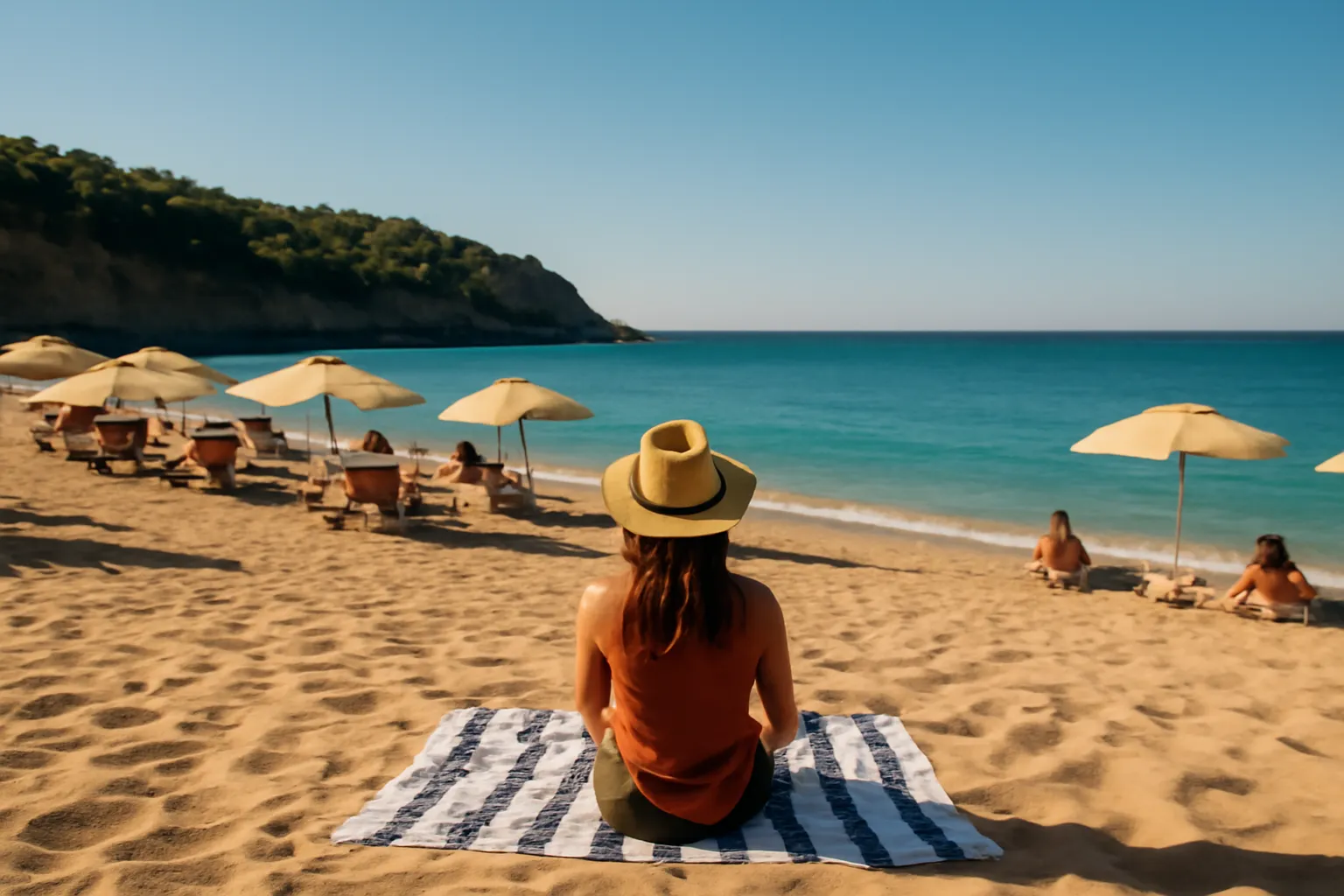
The trail had looked innocent enough on the map — a thin blue line winding down from the pine-covered cliffs above Brač island in Croatia, promising a “secluded cove” about forty minutes from the car park. I was sweaty, slightly sunburned on my shoulders, and carrying exactly the right amount of water for one person who had not anticipated a forty-five minute scramble each way. What I was not carrying — and this detail matters enormously — was any real understanding of clothing optional beaches in Europe: what to know before you accidentally stumble onto one. Because that is precisely what I did. The path curved around a final limestone outcropping, the Adriatic opened up in front of me in that particular shade of blue that makes you feel like the word “turquoise” was invented specifically for this moment, and there they were. About sixty people. On towels. In the sun. Entirely, comprehensively, cheerfully nude. All of them. I stood at the top of the beach path for what felt like a full minute, rucksack dangling, mouth open, while a middle-aged German couple walked past me toward the water with the casual energy of two people heading to their own kitchen. Nobody looked up. Nobody thought this was remotely unusual. That was my education in European naturist culture, and it began immediately.
Why Clothing-Optional Beach Culture in Europe Is More Widespread Than Anyone Warns You
Here is the thing nobody puts in the guidebooks: clothing-optional beaches in Europe are not a niche quirk. They are infrastructure. France alone has over 400 official naturist sites, with more than 100 designated naturist beaches stretching from Brittany down to the Côte d’Azur. Germany’s FKK beach etiquette guide — FKK standing for Freikörperkultur, or “free body culture” — dates back to the 1920s health movement and has designated sections on public beaches from Sylt in the north to the Baltic Sea coast in the east. Croatia, which I stumbled into so literally, has been officially welcoming naturist tourism since the 1930s. The island of Rab hosted the first official naturist beach in the Adriatic in 1934, allegedly after King Edward VIII asked for a private nude swimming area. The Croatian Tourism Board still uses this story with evident national pride.
The cultural geography matters enormously. In Germany, FKK is genuinely family-oriented — you will see grandparents, toddlers, and teenagers all occupying the same FKK section of a Baltic beach with zero awkwardness, because for many Germans this is simply how summer works. The island of Sylt, Germany’s glamorous North Sea retreat, has maintained FKK traditions since the 1960s, and the local attitude toward nudity carries roughly the same emotional weight as the attitude toward wearing socks. It is a body. It needs sun. This is fine.
France operates on a spectrum. Cap d’Agde in Languedoc is the largest naturist resort in Europe — a fully functioning town of 40,000 seasonal residents with its own banks, restaurants, supermarkets, and post office where clothing is actively discouraged rather than merely optional. Its two kilometers of beach are the most famous naturist stretch on the continent, but Cap d’Agde skews considerably more adult and sexually charged than your average FKK beach in Germany or a Croatian cove. This distinction matters if you are traveling with children or simply weren’t planning for that particular atmosphere on a Tuesday afternoon.
Then there is Platja des Cavallet on Ibiza’s southern tip — arguably the most beautiful beach on the island, a long arc of fine white sand backed by salt flats and protected dunes where the mix of naturists, LGBTQ+ travelers, and tourists who simply wandered past the textile section creates one of the most genuinely relaxed beach atmospheres in the Mediterranean. The water temperature around Ibiza in August sits comfortably at 28°C. The sun hits with absolute ferocity from about 11am. And the boundaries between the clothed and unclothed sections are, to put it diplomatically, approximate.
The core issue for first-timers isn’t embarrassment — it’s the unwritten etiquette. Nude beaches in Europe have strict social codes, and violating them will get you noticed in the worst way. You always sit on a towel, never directly on sand or a shared surface. You do not stare — not at bodies, not at faces, not in any sustained way that communicates appraisal. You absolutely do not photograph anyone without explicit consent, and in many cases photography is banned entirely on naturist beaches regardless of consent. Sexual behavior is not tolerated on family-oriented naturist beaches. Partial nudity — topless-only — is perfectly accepted everywhere and doesn’t require explanation. And yes, physiological responses happen to bodies in the sun; the universal protocol is to lie face down, wait calmly, and absolutely no one will acknowledge it because absolutely no one is watching you in the way you think they are.
The One Piece of Gear That Changed Everything About My Naturist Beach Days
After my involuntary education on that Croatian cove — I did eventually put down my rucksack, read the atmosphere correctly as welcoming, and spend two hours on a borrowed patch of pebble beach that turned out to be one of the most genuinely peaceful afternoons of the entire trip — I came home and researched sunscreen with the intensity of someone who had learned a very specific lesson about UV exposure in places that have never, in thirty-four years of existence, seen direct sunlight.
The sunscreen problem at naturist beaches is real and it is specific. You are covering skin that has essentially been in storage. It has never developed any incidental sun tolerance. It is also frequently skin in areas where chemical sunscreen filters — avobenzone, oxybenzone, octinoxate — cause genuine stinging, irritation, and discomfort on contact with mucous membranes or sensitive tissue. Mineral sunscreen, which sits on the skin surface rather than absorbing into it, doesn’t do this. Zinc oxide is genuinely non-irritating on sensitive areas in a way that chemical filters simply are not. And then there is the reef consideration: both Croatia and Ibiza have designated marine protected areas, France’s Mediterranean coastline falls under EU environmental directives, and chemical sunscreen filters are explicitly banned or strongly discouraged at an increasing number of Mediterranean beaches. This is not optional virtue signaling — it is increasingly the actual rule.
What I now bring to every European beach trip is the Reef Safe Mineral Sunscreen Spray SPF 50+ with Zinc Oxide — specifically the 2-pack of 6.76 oz spray bottles. Here is why this particular formulation works for this particular context. First, SPF 50+ broad spectrum with zinc oxide gives you genuine UVA and UVB protection without chemical filters, which means it works on every square centimeter of skin without stinging. Second, the spray format is essential — you cannot efficiently apply lotion to your own back and lower back without either a partner or a comedic sequence of contortions, and on a naturist beach you will need full-body coverage including areas that are genuinely difficult to reach. Third, the lightweight non-greasy formula means it doesn’t leave the thick white cast that older zinc sunscreens were notorious for — relevant both aesthetically and practically, because nobody wants to be the person with mineral sunscreen pooling visibly in awkward places. Fourth, it is water and sweat resistant, which matters because Mediterranean heat in July sits between 32°C and 38°C on the Croatian coast, and you will sweat while walking to and from the beach before you have even reached the water.
The honest limitation: the spray nozzle requires practice to get even coverage — hold it about six inches from skin and use sweeping motions rather than a fixed stream, or you will get uneven application. On a naturist beach, uneven SPF 50 application has consequences that are impossible to ignore the following morning. Practice at home first.
How I Actually Use This Sunscreen on European Naturist Beaches
The logistics of naturist beach sun protection require more planning than a regular beach day, and I’ve developed a system across several trips that has successfully kept me burn-free even on the brutal reflective-sand-plus-flat-water combination you get at Platja des Cavallet in August.
Full Application Before You Leave Accommodation
This is non-negotiable. Apply completely — and I mean completely — before leaving your hotel, apartment, or tent. Mineral sunscreen needs about ten to fifteen minutes to properly form its protective layer, and doing a full-body application on a crowded beach with limited privacy is both logistically awkward and rushed. The spray format makes pre-departure application genuinely fast; the 2-pack means you keep one in your beach bag and one at the accommodation so you’re never rationing.
The Reapplication Reality on Mediterranean Beaches
Water resistance ratings are tested in controlled conditions. The Adriatic and the Mediterranean are not controlled conditions. They are 28°C, incredibly inviting, and you will swim more than you planned. My rule is reapplication every ninety minutes regardless of whether I’ve been in the water, and immediately after any sustained swim. The spray format makes this genuinely quick — thirty seconds of coverage over key areas is realistic. Bring more sunscreen than you think you need. On a five-hour naturist beach day, two people will go through a surprising amount of SPF 50.
The Areas People Miss
Tops of feet. Back of knees. Ears. The back of your neck under your hairline. The area immediately below your lower back. All of these will burn badly and specifically in ways that make sitting, walking, and wearing clothing for the subsequent three days profoundly uncomfortable. The spray nozzle makes it easier to hit the backs of knees and feet without bending into origami. Use it.
Cap d’Agde Specifically
Cap d’Agde’s beach faces almost due south with minimal shade and fine pale sand that reflects UV upward. The sun exposure at Cap d’Agde is genuinely more intense than it feels because you are getting UV from below via reflection as well as from above. Factor SPF 50+ here is not conservative — it is correct. The resort has also been progressive about reef-safe requirements given the marine environment of the Étang de Thau nearby. Mineral formulations are the right choice here for environmental and practical reasons simultaneously.
Cultural Etiquette Tips That Will Actually Make Your Naturist Beach Experience Work
Understanding the written rules gets you onto the beach without incident. Understanding the unwritten ones gets you accepted as someone who belongs there, which is an entirely different and more comfortable experience.
- The towel rule is absolute. Always sit, lie, and stand on your own towel. Never on bare sand at a naturist beach, never on a shared surface, never on someone else’s towel edge. This is hygiene etiquette and social boundary simultaneously. Bring a large, fast-drying towel — the thin camping microfiber type works well.
- Eye contact is normal; sustained looking is not. On a naturist beach, making brief eye contact and nodding at your neighbors is normal social behavior. Staring at bodies — in assessment, curiosity, or any other mode — is the fastest way to mark yourself as someone who doesn’t belong and, at beaches with any kind of monitor or attendant, may result in being asked to leave.
- Photography is effectively banned. Even in a public space, photographing other beachgoers at a naturist beach without explicit consent is considered a serious violation of privacy. Several Croatian naturist resorts have posted signs explicitly prohibiting photography. Keep your phone in your bag or clearly pointed at the sea if you must have it out.
- Know which type of beach you’re on. Family-oriented FKK beaches in Germany and Croatia operate very differently from Cap d’Agde, which has a more adult-oriented atmosphere particularly after sunset. Do your research before you arrive, especially if you’re traveling with children.
- The “textile” boundary matters. Many European beaches have a clothed section and a naturist section. Respect the transition zone — don’t wander through the naturist section in full clothes photographing scenery, and don’t set up as a naturist in the textile section and then look confused about the response.
For broader context on dressing appropriately in culturally specific environments across Europe and beyond, the guides on temple dress codes at sacred sites worldwide and cultural clothing expectations by destination cover the full spectrum of situations where what you wear — or don’t wear — signals whether you understand where you are.
What I Wish Someone Had Told Me Before That Croatian Afternoon
The thing that surprised me most about naturist beaches in Europe was not the nudity. It was the atmosphere. I have never felt less objectified or more thoroughly ignored on any beach anywhere, and I say that as someone who has spent time on beach destinations across four continents. Naturist beach culture operates on a fundamental premise that bodies are simply bodies — they are not invitations, not performances, not topics of conversation. The result is a social atmosphere of remarkable relaxation. People read. They nap. They build sandcastles with their children. They have lunch from a cool bag and discuss what to have for dinner. The absence of the performative element that pervades most beach culture is genuinely striking once you notice it.
If you are considering a naturist beach first-time visit, my honest advice is this: start at a beach that has both a textile and a naturist section, so you can observe the atmosphere before committing. Croatia’s Brač and Hvar islands both have beaches like this. Stay for an hour before making any decisions. You will very likely find that the anxiety you arrived with was entirely about the anticipation and almost entirely absent once you are actually there.
The practical lesson is simpler: pack a towel, leave your phone in your bag, and bring enough sunscreen for every single centimeter of skin you own. You will need more than you expect. This is not a metaphor.
Everything You Need to Know About Clothing Optional Beaches in Europe Before You Go
If this post has covered clothing optional beaches in Europe: what to know for your upcoming trip, the short version is this: they are common, they are culturally serious, and they have rules that are enforced through social pressure rather than signage. Understanding those rules — the towel, the gaze, the photography ban, the boundary between textile and naturist sections — is what separates a genuinely wonderful afternoon from an awkward one.
For the sunscreen, I genuinely use the Reef Safe Mineral Sunscreen Spray SPF 50+ with Zinc Oxide on every warm-weather beach trip now — naturist or otherwise. The zinc oxide formula, the spray convenience, the reef-safe certification, and the water resistance have made it the one I reach for without thinking. The 2-pack is worth it; you will use more than one bottle.
But more than any product, what I want you to take from this post is a reason to book the trip. The Croatian coast, the beaches of Ibiza, the wild North Sea shores of Sylt, the improbable self-contained universe of Cap d’Agde — these are genuinely extraordinary places that deserve to be experienced without the anxiety of not knowing the rules. Now you know the rules. Go be magnificently, appropriately, sunscreen-equipped wherever the trail takes you.
Affiliate Disclosure: This post contains affiliate links. As an Amazon Associate, I earn from qualifying purchases. If you buy something through my links, I may earn a small commission at no extra cost to you. I only recommend gear I’ve actually used on the road.