
This post contains affiliate links. As an Amazon Associate, I earn from qualifying purchases at no extra cost to you.
Let me paint you a picture. It’s 11:47 p.m. in Tbilisi, Georgia. My phone is at 4%. My boarding pass is digital. My taxi is somewhere in the city, driver calling a number I can’t answer because — yes — my phone is at 4%. The airport is 30 minutes away. My backup battery, a cheap no-name brick I’d grabbed at a Bangkok market six months earlier, had quietly died somewhere over the Black Sea. That night cost me a missed flight, one very cold bench, and a hard lesson about travel gear I should have already learned. That’s the exact moment I started taking this Anker PowerCore portable charger travel review seriously — not as a nice-to-have, but as a non-negotiable.
After 16 years and 74 countries, I still manage to learn things the embarrassing way. But here’s the thing about hard lessons: they make for very decisive product research. Within a week of that Tbilisi disaster, I had read every battery pack review I could find, watched comparison videos until my eyes glazed over, and eventually landed on the Anker Power Bank, 20,000mAh Travel Essential Portable Charger with Built-in USB-C Cable. I’ve now used it across four continents and more airports than I care to count. Here’s my honest take.
Why I Chose the Anker PowerCore Over Everything Else
Before this, I had tried three other battery packs. One was the Bangkok market special (RIP). Another was a mid-range Mophie that was fine until it wasn’t. The third was a bulky Jackery that worked beautifully but weighed nearly as much as my laptop. None of them had a built-in cable, which meant I was always rooting around in my bag at gate B47 looking for a USB-C cord like some kind of frantic raccoon.
The built-in USB-C cable on this Anker was honestly the feature that made me pull the trigger. Travelling with fewer cables is a genuine quality-of-life upgrade — especially when you’re doing overnight buses in Vietnam or cramped train rides through Portugal’s Douro Valley. I also needed something that could handle my MacBook Air on a long-haul. The 87W max output meant it could actually charge my laptop meaningfully, not just trickle power into it while it slowly died anyway. That distinction matters more than most people realise.
Finally, I trusted the Anker brand. After years of buying gear, I’ve learned that the mid-tier trust brands — not the cheapest, not the flashiest — tend to hold up best over time. Anker has a long track record with travellers, and the warranty support is real. That matters when you’re in Kathmandu and something stops working.
First Impressions: Size, Weight, and Build Quality
The Anker Power Bank, 20,000mAh Travel Essential Portable Charger with Built-in USB-C Cable, 3-Port 87W Max Fast Charging Battery Pack arrives in that clean, no-nonsense Anker packaging. No unnecessary plastic, no flimsy instruction booklet in twelve languages that you’ll never read. The unit itself is black, matte, and solid-feeling in the hand — not premium-luxury, but robustly built.
It weighs around 445 grams. That’s not light. Let’s be honest about that right away. You’ll feel it in your day bag, especially if you’re also carrying a water bottle, a camera, and the general archaeology of a traveller’s pack. It’s roughly the size of a thick paperback novel — which, if you’re the kind of person who still carries those, gives you a useful mental image. It fit easily in the front pocket of my 28L Osprey Farpoint, and it slides into a jacket pocket if the jacket is reasonably generous.
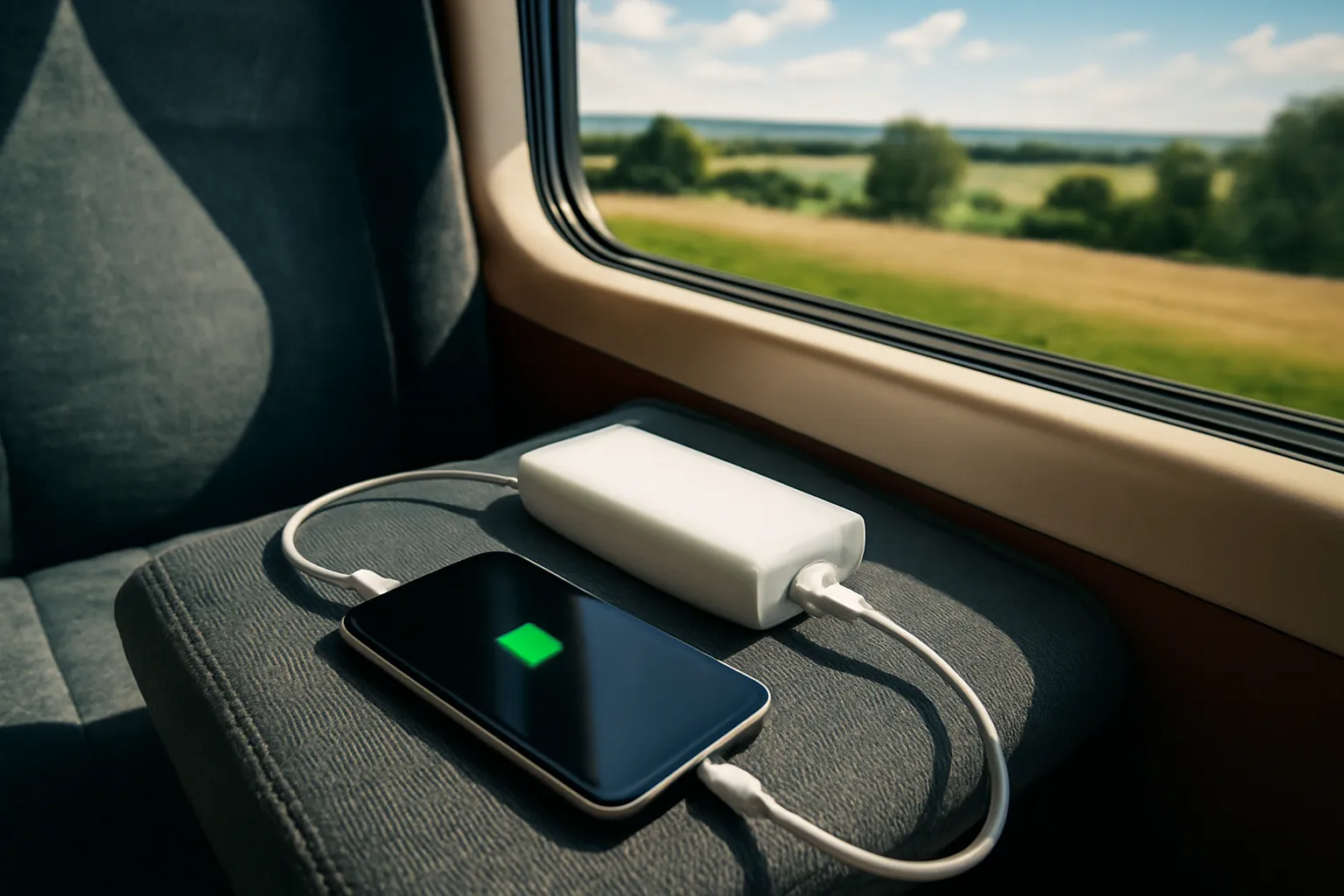
The built-in USB-C cable tucks neatly into a little groove on the side. It doesn’t dangle or snag. The three ports — two USB-C and one USB-A — are clearly labelled and well-spaced. The LED indicator shows four bars of battery status, which is simple but effective. Build quality feels durable without being overengineered. My initial impression was: this is a serious piece of kit made for people who actually use their gear.
On the Road: Real Use Across Multiple Trips
I’ve now run this battery pack through some genuinely demanding situations. Here’s where it has actually lived:
- A 16-hour travel day from Medellín to Tokyo (via Bogotá and Los Angeles): Phone, AirPods, and Nintendo Switch all kept alive. The bank still had one bar left at Narita.
- A three-day island-hopping trip in the Philippines (Palawan): Zero reliable electricity after 8 p.m. on two of those nights. This thing was my entire power infrastructure.
- A workation week in Lisbon: Used it daily to top up my MacBook Air in cafés when outlets were scarce — a very real Lisbon café problem, by the way.
- A rough overnight bus from Chiang Mai to Bangkok: Charged my phone fully twice in six hours while trying to sleep upright like a dignified person.
The 20,000mAh capacity translates, in real-world terms, to roughly four to five full charges of a modern iPhone or two to three solid top-ups for a MacBook Air. That’s the sweet spot for a trip of two to five days if you’re disciplined about charging the bank itself overnight when you have access to a wall outlet.
The fast-charging is noticeably real. In a long layover at Dubai International — Terminal 3, which is enormous and full of temptations that will drain your wallet faster than your phone — I plugged in during a coffee stop and watched my iPhone go from 20% to 80% in under an hour. That’s the kind of performance that changes your airport experience.
The Moment That Sold Me Completely
In Puerto Princesa, Philippines, my guesthouse had a brownout — a rolling power cut — that lasted most of the night. My roommate’s cheap power bank was dead by 6 a.m. Mine still had two bars. I charged both our phones that morning before a full day of travel. Small thing, maybe. But when your phone IS your boarding pass, your map, your translation app, and your emergency contact list, “small thing” is a dramatic understatement.
What Actually Held Up — And What Didn’t
After roughly eight months of active travel use, the Anker Power Bank, 20,000mAh Travel Essential Portable Charger with Built-in USB-C Cable, 3-Port 87W Max Fast Charging Battery Pack looks like a well-travelled piece of kit. There are scuffs on the casing. The matte finish has some micro-scratches. But the ports work perfectly, the built-in cable hasn’t frayed or weakened, and the battery capacity feels virtually unchanged from day one.
The built-in cable is legitimately one of the better design decisions in travel gear I’ve seen in years. After the first month, I stopped carrying a USB-C cable as a backup entirely. That might be optimistic of me, but it’s held up. The cable length is short — deliberately so — which means it’s good for top-ups while the bank sits in the same bag pocket as your phone. It’s not ideal if you want to leave the bank in your bag and have your phone on a table. Worth knowing in advance.
Charging the bank itself takes a while. Fully dead to fully charged via a 65W wall adapter took me about three hours. That’s fine overnight, but it’s not something you can do in a two-hour layover and walk away full. Plan accordingly — charge it every night you have access to power, not just when it’s nearly empty.
The Downsides: Honest Limitations
No product review from me is going to be a brochure. Here’s what I’d want to know before buying:
- It’s heavy. 445 grams is real weight. If you’re an ultralight packer, this will clash with your philosophy. There are lighter options at lower capacity.
- The built-in cable is short. Useful for same-bag charging. Not useful for charging your phone on a café table while the bank stays in your bag.
- Slow self-charging. Three-plus hours to recharge fully. Not a crisis, but plan for it.
- No wireless charging. If you’ve gone fully wireless in your daily life, you’ll need an adapter or cable anyway.
- It gets warm under heavy load. Charging a MacBook and a phone simultaneously generates noticeable heat. It’s within normal parameters, but don’t tuck it inside a sealed bag compartment when running at full output.
None of these are dealbreakers for me personally. But they might be for you, depending on your travel style. Know what you’re optimising for before you buy.
Final Verdict: Who Should Buy This Anker PowerCore Portable Charger
This Anker PowerCore portable charger travel review ends with a clear recommendation — but a specific one. This is the right battery pack for a particular kind of traveller.
Buy this if you:
- Regularly do travel days of eight hours or more
- Carry a MacBook, iPad, or other laptop and need real charging power
- Travel to places with unreliable electricity (Southeast Asia, parts of Africa, remote anything)
- Want to simplify your cable situation
- Value durability over weight savings
Skip this if you:
- Only travel for short city breaks with good outlet access
- Are an ultralight packer where every gram is a negotiation
- Need wireless charging as a hard requirement
- Only need to charge a single phone — smaller capacity options will serve you better at lower weight
For travellers who live in the gap between “needs a portable charger” and “needs a full laptop power station,” the Anker Power Bank, 20,000mAh Travel Essential Portable Charger with Built-in USB-C Cable, 3-Port 87W Max Fast Charging Battery Pack sits squarely in the sweet spot. It’s not cheap. It’s not weightless. But it works every single time, which — after years of gear that didn’t — is worth more to me than most specs on a sheet.
If You Need More Power: The Heavy-Duty Alternative
If your travel involves more intensive laptop use — think digital nomad life, filming gear, or back-to-back work trips where you genuinely can’t afford to run low — the Anker Laptop Power Bank, 25,000mAh Portable Charger with 165W Total Output and three USB-C ports is worth a serious look. It has retractable built-in cables, 100W output per port, and a larger capacity — and it’s still flight-ready. It’s heavier and more expensive, but if you’re running a MacBook Pro and shooting video every day, that trade-off makes sense. For most travellers, though, the 20,000mAh version above hits the right balance between power, portability, and price.