This post contains affiliate links. As an Amazon Associate, I earn from qualifying purchases at no extra cost to you.
Ho Chi Minh City, 2019. I was forty-eight hours into Vietnam, already sweating through my second shirt of the day, and standing in a guesthouse bathroom staring at a tap I absolutely did not trust. My water purification tablets were buried somewhere in my checked bag — which, naturally, the airline had sent to Hanoi instead. I had a half-empty plastic bottle I’d bought at the airport for roughly the price of a small vehicle, and I was three days away from a remote homestay in the Mekong Delta where bottled water wasn’t going to be a reliable option. That trip ended fine, mostly because I hoarded bottles like a survivalist and spent way too much money doing it. But it planted a seed. I needed a real solution. This Grayl GeoPress water purifier bottle travel review is the result of that seed eventually growing into something useful — after a lot of bad alternatives, a fair amount of research, and four more trips where I finally got it right.
I want to be clear about something upfront. I am not a gearhead. I do not get excited about gadgets for their own sake, and I have a personal policy against buying anything that requires me to read a manual longer than one page. I mention this because the GeoPress is the rare piece of travel equipment that actually changed how I move through the world. That’s a big claim. I don’t make it lightly. Sixty-something countries before I bought this thing, and I genuinely wish I’d had it sooner.
Why I Chose the Grayl GeoPress Over Everything Else
Before landing on the GRAYL GeoPress 24 oz Water Purifier Bottle, I had tried several alternatives. I used Lifestraw for a while. It works, but drinking through it feels vaguely like doing shots in reverse, and you cannot fill a cooking pot or give water to anyone else. I briefly owned a SteriPen, which I left in a hostel in Tbilisi because it required batteries, a charging cable I kept losing, and a level of daily attentiveness I apparently do not possess. Purification tablets work in a pinch but they leave a chemical aftertaste that makes everything taste like a swimming pool.
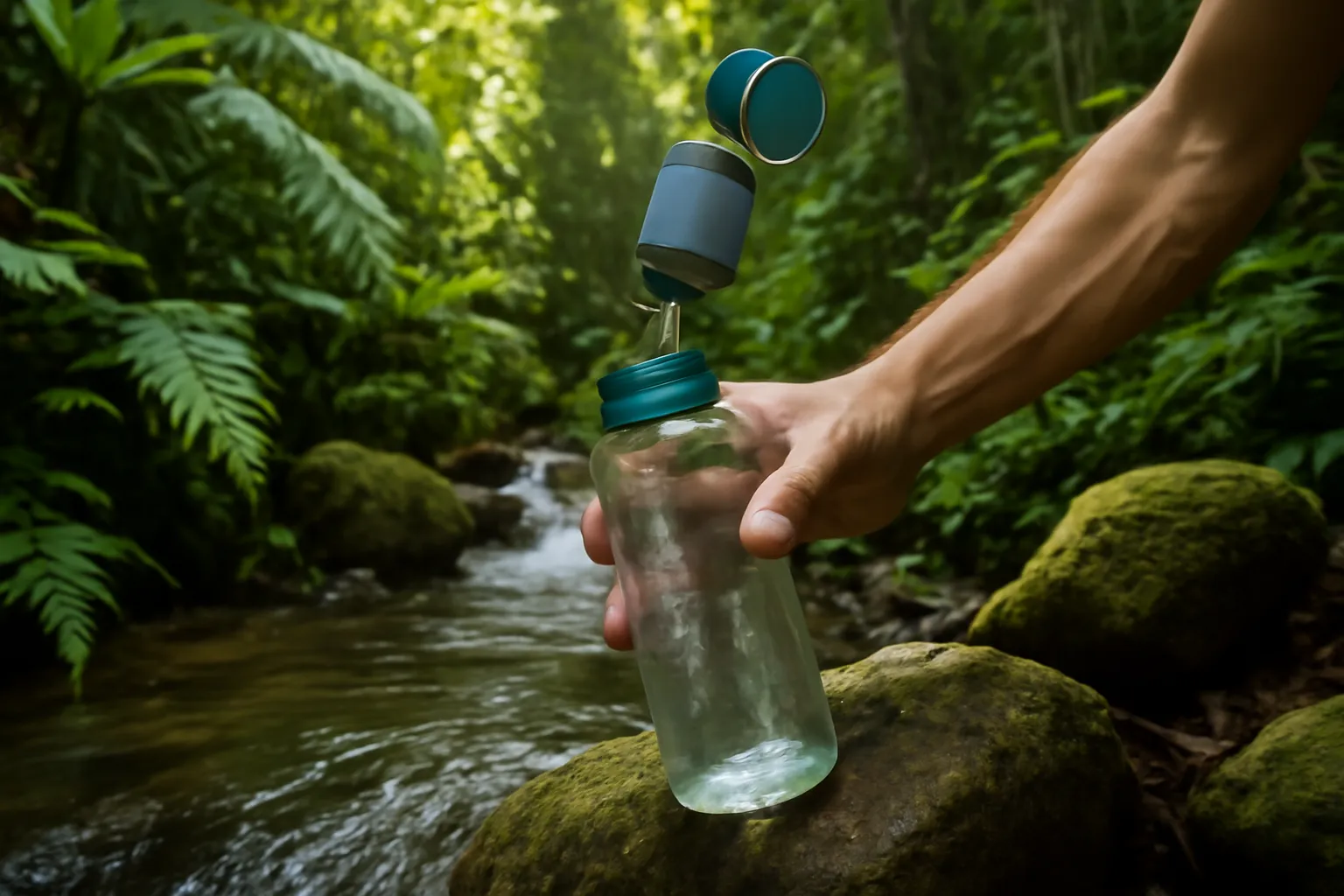
What finally tipped me toward the GeoPress was a combination of factors. First, the filter handles everything in one press — bacteria, protozoa, viruses, particulates, and even some chemicals. Most filters at this price point don’t cover viruses. In Southeast Asia and parts of South Asia, that matters enormously. Second, it works in eight seconds. You fill it, you press down the inner cylinder, and you drink. No waiting, no chemicals, no UV wand to charge. Third, and honestly most importantly for how I travel: it produces a full 24 ounces in a single press. That’s a meaningful amount of water.
First Impressions: Weight, Size, and Build Quality
The Black Camo colorway I ordered looks understated and matte — it doesn’t scream “expensive gear” in a way that draws attention, which I appreciate. The bottle itself is a solid, dense piece of kit. It weighs about 15.9 ounces empty, which is heavier than a standard Nalgene but lighter than carrying six plastic water bottles through a Bangkok market. The dimensions are roughly 10 inches tall and 3 inches in diameter. It fits in the side pocket of my Osprey Farpoint 40, though it’s a snug fit. In smaller daypacks it sometimes needs to go inside the main compartment, which is a mild inconvenience.
The construction feels serious. The outer shell is thick, BPA-free plastic. The press mechanism feels mechanical and deliberate rather than flimsy. My one early concern was the silicone gasket around the inner press cylinder — it looked like something that could degrade or slip. Two years and several countries later, it has not. The lid has a wide-mouth opening that makes filling from a tap, a river, or a questionable hotel sink straightforward. Everything about it communicates that someone actually thought about how travelers use things, rather than how things look in a product photo.
On the Road: Real Use Across Real Trips
My first proper trip with the GeoPress was Thailand and Cambodia in early 2022. I flew into Bangkok, spent four days there, then moved through Chiang Mai, crossed into Cambodia at the Poipet border crossing — which is, for the record, one of the more chaotic land borders on earth — and ended up in Siem Reap and Phnom Penh before flying home. Throughout that entire trip, I filled the bottle from hotel taps, guesthouse sinks, and once from a large water jug at a temple complex where they’d set up a communal refilling station for tourists.
I did not get sick. I want to attribute that entirely to the GeoPress, though I acknowledge that I also washed my hands compulsively and avoided one particular street food stall in Phnom Penh that looked aggressively optimistic about refrigeration. Still — the water part of the equation was completely handled. I stopped buying plastic bottles almost entirely. That felt good both financially and ethically. Plastic bottle waste in Southeast Asia is genuinely heartbreaking to witness at scale.
The second major test was Sri Lanka in late 2022. Water quality varies enormously by region there. In Colombo I might have been fine from the tap. In some of the smaller towns near Ella and the hill country, I was less confident. The GeoPress handled all of it without drama. I also used it during a day hike near Horton Plains, filling from a stream. The press took slightly more effort than usual — I suspect cooler water creates a bit more resistance — but it worked.
Indonesia followed in 2023, specifically Bali and a few days on Lombok. Bali’s tap water is not safe to drink unfiltered by any standard. Most travelers there spend a small fortune on bottled water or end up buying those big blue gallon jugs from minimarts. I pressed tap water all week without issue. The only adaptation I made was rinsing the outer bottle occasionally, because Bali tap water left a faint mineral residue on the outside over time. Minor cosmetic issue, nothing functional.
What Actually Held Up — and What Didn’t
After roughly eighteen months of consistent travel use, the GRAYL GeoPress 24 oz Water Purifier Bottle has held up well on almost every front. The filter is rated for 350 uses before replacement, which at my pace of travel works out to roughly one filter per year. Replacement filters are available on Amazon and cost around $30, which is significantly less than what I was spending on bottled water per trip. The math here is not subtle.
The press mechanism has never failed. The gasket has never leaked. The lid has survived being dropped twice on tile floors. The bottle survived a fall off a motorbike seat in Canggu — full of water, onto pavement — with nothing worse than a small scuff on the outer casing. These are not lab conditions. Real travel is rough on equipment, and this thing has absorbed that roughness without complaint.
One thing that pleasantly surprised me: the bottle doesn’t retain taste or odor between fills, even after weeks of daily use. I’d been slightly worried about this based on past experience with soft-sided water reservoirs. Not an issue here. Water from the GeoPress consistently tastes clean and neutral. That sounds like a low bar, but if you’ve ever drunk from a Platypus bladder on day six of a trekking trip, you understand why it matters.
The Downsides: Being Honest About the Limitations
No product review from me is going to be all sunshine. Here’s where the GeoPress falls short, or at least falls complicated.
- The weight is real. At just under a pound empty, it adds meaningful weight to a daypack. If you’re a hardcore ultralight backpacker counting grams, this will bother you. For city travel or general backpacking, I personally don’t find it a dealbreaker — but it’s worth acknowledging.
- The pressing force takes some getting used to. You need to brace the bottom of the outer bottle against something — your leg, a table, the floor — to press the inner cylinder down. It requires real effort, especially with a new or cold filter. Standing up and pressing freehand is doable, but awkward.
- It doesn’t keep water cold. The GeoPress is not insulated. On a hot day in Bangkok it will not keep your water cool. If you want cold water, you need a separate insulated bottle to transfer into, which is an extra step most people won’t bother with.
- The 24-ounce capacity is limiting for hot climates. You’ll press and drink, press and drink. On full-day excursions in high heat, you’ll need to refill multiple times. That’s fine if you have tap access. In the field, it means planning your water sources more carefully.
- Filter replacement tracking is manual. There’s no indicator telling you when the filter is spent. You count uses yourself, or you approximate based on time. I err on the side of replacing earlier than necessary, which costs a little extra but gives me peace of mind.
None of these killed the product for me. But two of them — the weight and the press effort — are real enough that I’d factor them in before recommending this to certain travelers.
Final Verdict on This Grayl GeoPress Water Purifier Bottle Travel Review
The GRAYL GeoPress 24 oz Water Purifier Bottle in Black Camo is the best single piece of travel gear I have bought in the last three years. That’s a short list to top, but it’s also a genuine statement. It solved a real problem — clean drinking water in places where tap water is unsafe — in a way that is fast, reliable, and increasingly second nature. I no longer think about water logistics when I travel in Southeast Asia. That mental bandwidth freed up is worth something.
Buy This If You:
- Travel frequently to Southeast Asia, South Asia, Central America, or Africa
- Want to dramatically reduce single-use plastic bottle consumption
- Hike, trek, or spend time in places without reliable bottled water access
- Are going somewhere where viruses in water are a realistic concern (most of Asia and sub-Saharan Africa)
- Value simplicity over complexity in your gear
Skip This If You:
- Only travel to Western Europe, the US, Canada, Australia, or other places with reliably safe tap water
- Are an ultralight backpacker for whom every gram is a negotiation
- Need a large-volume water storage solution for multi-day wilderness expeditions
- Want insulation — this is purely a filtration bottle
For the record, I’ve also seen the GRAYL GeoPress in Bali Blue in the wild, and it’s a genuinely lovely colorway if Black Camo feels too tactical for your aesthetic. Same bottle, same performance, different vibe — and honestly, the name “Bali Blue” is fitting given where you’ll probably be using it. Either one will serve you well. I chose the Black Camo specifically because it’s less conspicuous in crowded transit situations and looks less obviously like expensive gear. Your priorities may differ.
Sixteen years of travel has taught me to be skeptical of anything that claims to solve a problem completely. The GeoPress comes closer than almost anything else in my pack. Go get one before your next trip to somewhere that will make you question your relationship with tap water. You’ll thank yourself somewhere around day three.