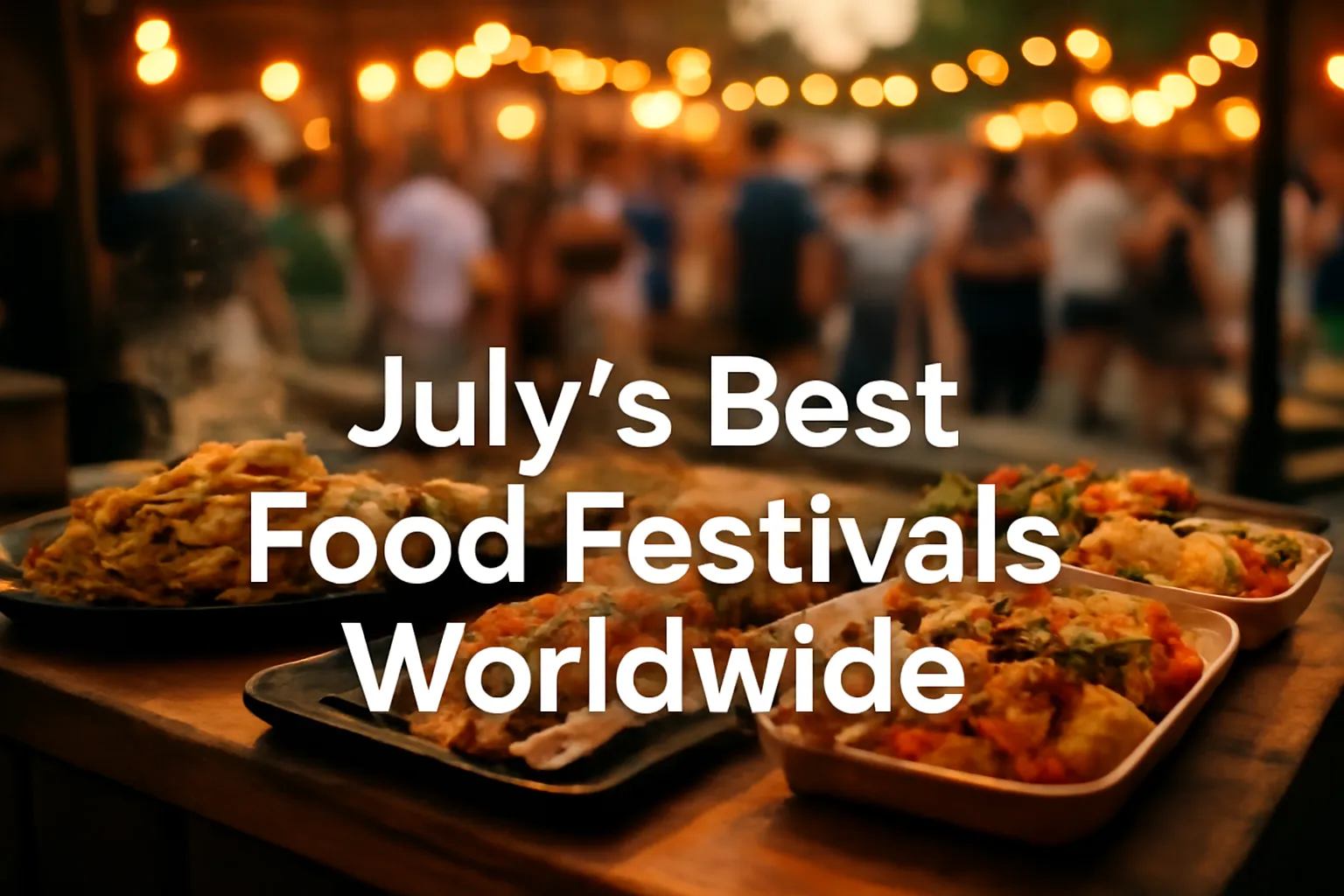
There was a group I led through Southeast Asia years back who nearly missed an entire scheduled lunch stop because one traveler refused to leave a noodle stall we’d already walked past — twenty minutes down the road, dessert plans dead, whole itinerary thrown off. I get it now more than ever, because I’ve done bigger versions of that myself: rerouting a layover just to eat one dish in one city, building three weeks of travel around nothing but a festival calendar. July is the month where that kind of obsession stops sounding ridiculous and starts sounding like actual strategy. This month’s international food festival lineup is stacked, genuinely one of the strongest stretches of the year to plan a trip around. Peak summer in the northern hemisphere means outdoor venues are humming, harvests are coming in strong, and whole cities are basically turning their streets into dining rooms. Whether you’ve built a trip like this before or you’re only just realizing your vacations need better snacks, here’s how to plan your July around it.
Why July Is the Peak Month for Food Travel Destinations
It’s not a coincidence that so many of the best July food events cluster in the same handful of weeks. This is the month summer produce peaks, outdoor festival logistics finally cooperate, and tourism infrastructure everywhere is running at full capacity. Farmers’ markets overflow, harbor towns get loud and crowded, and local communities roll out their biggest, most ambitious food events of the year. The catch is the heat. Depending on where you land, that might mean 85°F in Chicago, 95°F along the Croatian coast, or a sticky, humid night wandering a Japanese lantern festival. Traveling smart for food in July means planning around the heat as deliberately as you plan around the menu — more on that shortly. First, though, the festivals themselves, because this month’s roster is genuinely something else.
The July Food Festivals Worth Building a Trip Around
1. Taste of Chicago — Chicago, Illinois, USA
Taste of Chicago is what happens when a food festival stops being polite and goes enormous. Set in Grant Park along the shimmering edge of Lake Michigan, it’s consistently counted among the largest food festivals anywhere, and the scale isn’t hype — over a million people show up across roughly five days in early-to-mid July, with dozens of the city’s best restaurants running booths that swing from deep-dish pizza to Thai street noodles to dessert tacos. Best part: getting in costs nothing. You pay for food tickets (sold in bundles), but simply walking through the gates and soaking up the scene is free.
- Typical Dates: Early-to-mid July, roughly five days
- Must-Try Dishes: Chicago-style deep-dish pizza, Eli’s cheesecake (basically a festival landmark by now), and whatever fusion experiment a local chef decides to debut that year
- The Vibe: Full mega-festival mode — crowds topping 100,000 on the busiest days, live music stages, families, solo food obsessives with sauce down their shirts, everyone winning
- Practical Tip: Weekdays beat weekends by a mile here — weekend afternoons turn into shoulder-to-shoulder crowds with long waits. Show up when gates open around 11am to beat the lines at popular booths, and budget roughly $30–$50 for a solid afternoon of tasting
2. Dubrovnik Summer Festival — Dubrovnik, Croatia
This one needs a caveat: the Dubrovnik Summer Festival is, at its heart, a cultural event — theater, music, dance, open-air performances scattered across the Old Town’s stunning backdrop — but the food side of it earns real attention too. Programming runs from mid-July into mid-August, roughly 45 days total, and while the ancient squares and fortress walls become evening stages, nearby restaurants, konobas (traditional Croatian taverns), and market stalls respond with menus that step up for the occasion. Eating here during the festival feels like having dinner inside a UNESCO World Heritage Site that’s simultaneously throwing the best party of the summer.
- Typical Dates: Mid-July into mid-August (roughly 45 days)
- Must-Try Dishes: Black risotto (crni rižoto) colored with cuttlefish ink, sea bream grilled fresh off local fishing boats, and peka — meat or seafood slow-cooked beneath an iron bell — which restaurants prepare specifically for the festival-season crowds
- The Vibe: Small-scale and theatrical, the opposite of a mega-festival — think wandering cobblestone lanes with a glass of Plavac Mali and accidentally stumbling into an outdoor opera
- Practical Tip: Lock in accommodation at least three months out — July in Dubrovnik is peak season and prices climb accordingly. Basing yourself just outside the Old Town walls, somewhere like Lapad, keeps both your budget and your stress levels lower. Pair this with a wider Croatia itinerary to get more value out of your flights; wittypassport.com’s Croatia content goes deeper on destination planning
3. Gilroy Garlic Festival — Gilroy, California, USA
Most food festivals spread across dozens of dishes. The Gilroy Garlic Festival commits to exactly one ingredient, so hard it will hand you garlic ice cream without blinking. Held in late July in Gilroy, California — self-declared “Garlic Capital of the World” — the festival has been running since 1979 and draws around 100,000 visitors annually to Christmas Hill Park over three days. It sits somewhere between a county fair and a culinary showcase, and commits fully to both. Local chefs face off in cooking competitions, garlic braids hang from nearly every surface, and the sauté-pan smell reaches you three blocks out. That’s a compliment, coming from me.
- Typical Dates: Last full weekend of July, roughly three days
- Must-Try Dishes: Garlic bread (yes, obviously, but this version is next-level), garlic-stuffed mushrooms, and — trust me on this — garlic ice cream, which lands closer to dessert than you’d guess
- The Vibe: Warm, community-run, proudly odd — families, garlic diehards, food bloggers doing exactly what you’re picturing, and a cooking competition that takes itself dead seriously
- Practical Tip: General admission runs about $20–$25 per adult. Gilroy sits roughly 30 miles south of San Jose, making it an easy day trip from the Bay Area or a natural stop on a California coastal drive. Grab parking passes ahead of time — the shuttle system is the smarter move on the busiest days
4. Obon Festival Food Stalls — Japan (Nationwide)
Obon ranks among Japan’s most cherished Buddhist traditions — typically mid-July, though some regions shift it to August — a time when families honor ancestral spirits and whole communities gather for lantern ceremonies, Bon Odori dancing, and street food that will make any food-focused traveler go quietly emotional. The festival itself spans roughly a week and unfolds across the entire country at once, so wherever you happen to be in Japan during that window — Tokyo, Kyoto, some small rural town — there’s likely a neighborhood festival ground within walking distance, lined with yatai (food stalls). This isn’t something you buy a ticket for; it’s something you fall into just by being in Japan in July. If a Japan trip is already on your radar, consider this your cue to time it around Obon.
- Typical Dates: Mid-July (the 13th–16th by the lunar calendar in many regions; some areas hold it in August)
- Must-Try Dishes: Yakisoba (stir-fried buckwheat noodles with pork and cabbage), takoyaki (octopus-filled batter balls topped with bonito flakes), and kakigori (Japanese shaved ice with syrup — essential once the July heat kicks in)
- The Vibe: Communal in a way that quietly gets to you, festive without trying too hard — families in yukata, paper lanterns drifting on water, the scent of yakisoba carrying through the warm night air
- Practical Tip: Carry cash — yatai vendors mostly don’t take cards. Budget roughly ¥500–¥1,000 (about $4–$7) per street food item. This fits naturally into a broader Japan trip; wittypassport.com’s Japan travel guides have itinerary ideas built around this exact window
How a Cooling Towel Got Me Through Five Festivals in Fourteen Days
July food festivals put you in direct sun, packed into crowds, standing in line for a two-hour tasting event that peaks right around noon. Somewhere around your third or fourth festival, you realize hunger isn’t really the enemy anymore — it’s heat exhaustion, and it’s actively working against you actually tasting what you paid for.
Where it delivers
- The 40-inch length actually wraps fully around your neck and drapes over your shoulders, not just your collarbone, which matters when you’re stuck in direct sun for three hours straight.
- Dunk it in a festival bathroom sink or drinking fountain and it reactivates right away — I’ve recharged mine five separate times in a single day with zero drop in performance.
- A four-pack means you can leave one soaking back at the hotel, wear one, and keep two spares dry in your bag — exactly the kind of backup solo travelers actually need.
Where it falls short
- The cooling effect fades after about 45 minutes and creeps up to body temperature — workable at a festival, but don’t expect one activation to carry you all day.
- Wear it wet against anything nice and it’ll leave a damp mark — and European summer linen wrinkles as dramatically as a raisin auditioning for a commercial.
I genuinely considered ditching the towel halfway through week two because I thought I was just being precious about summer heat—until I got lightheaded waiting for the paella tasting in Valencia and remembered why I packed it. Get the CADONO 4 Pack Cooling Towel (40″x12″).
Frequently Asked Questions
What is the general admission price for Gilroy Garlic Festival?
General admission runs about $20–$25 per adult. The festival takes place the last full weekend of July over three days at Christmas Hill Park in Gilroy, California, and draws around 100,000 visitors annually.
Is Taste of Chicago free to enter?
Yes, entry to Taste of Chicago is free. The festival runs early-to-mid July across roughly five days in Grant Park. You pay separately for food tickets sold in bundles, but simply walking through the gates costs nothing.
When does Obon Festival happen in Japan?
Obon typically occurs mid-July, specifically the 13th–16th by the lunar calendar in many regions, though some areas hold it in August. The festival spans roughly a week and unfolds across the entire country, with neighborhood festival grounds and yatai food stalls in most areas.
How long does Dubrovnik Summer Festival run?
Dubrovnik Summer Festival runs from mid-July into mid-August, roughly 45 days total. Programming includes theater, music, dance, and open-air performances scattered across the Old Town, with nearby restaurants and market stalls offering special menus during the festival season.
About This Article

Written by Elena Vasquez. Elena Vasquez is a full-time traveler and the founder of Witty Passport. Over fifteen years and more than 50 countries across six continents — including a stretch spent leading groups professionally through Southeast Asia and the remote highlands of South America — she's written the kind of destination guides she always wished existed: practical, specific, and built on real experience rather than recycled itineraries. More about this site.
Scope and limits. Elena is a full-time traveler, not a licensed travel agent or immigration adviser. Entry requirements, visa rules, and advisories change without notice — always confirm against the official government source for your destination and passport before booking.
Verify this against a primary source
Specifics change, and your situation may differ from the one described here. These are the authorities worth checking directly:
- U.S. Department of State — entry requirements and travel advisories
- CDC Travelers' Health — vaccination and health notices by destination
- TSA — current carry-on and screening rules