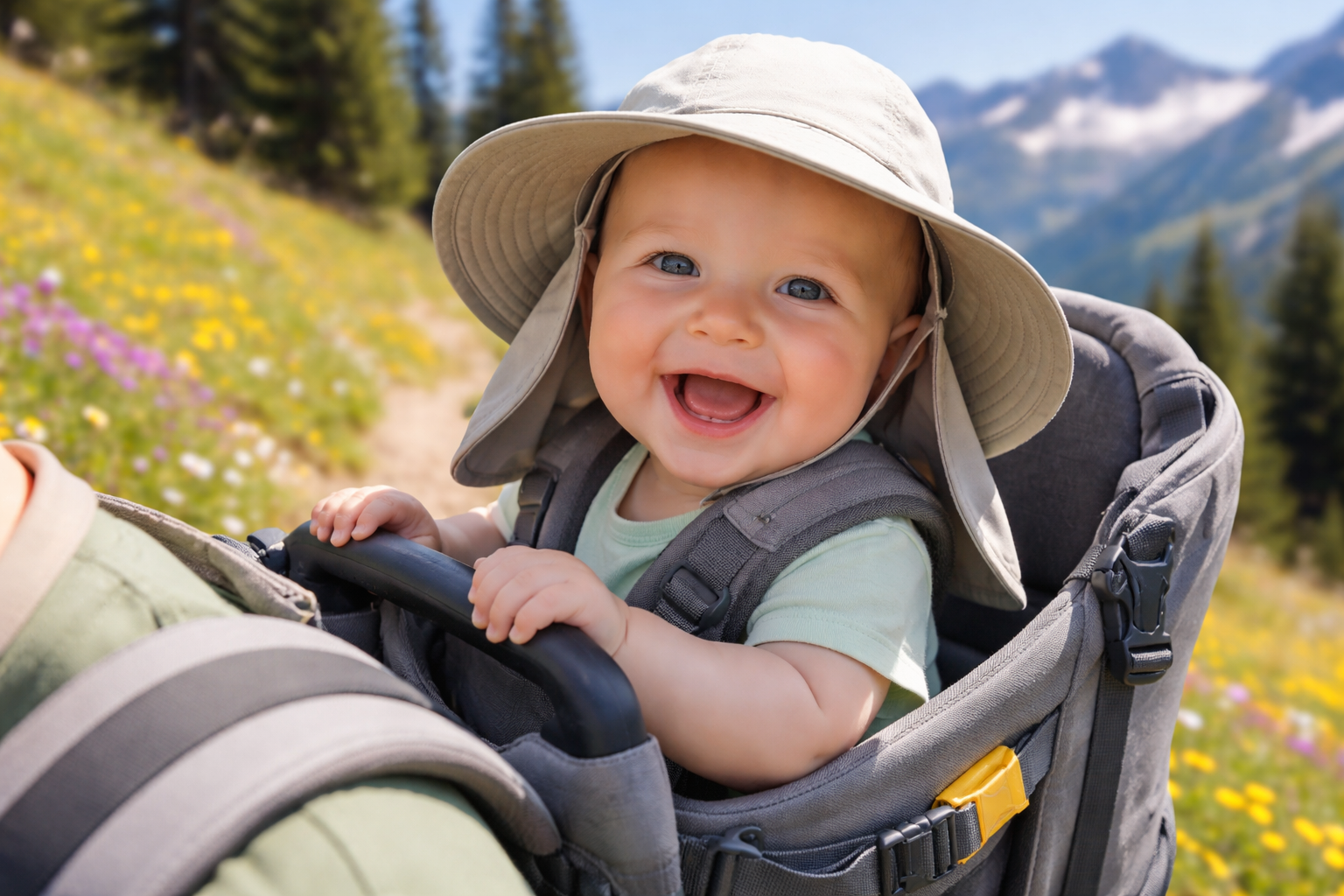
A floppy cotton sun hat feels like protection right up until you’re a mile into a climb and it’s tumbling downhill without your kid attached to it. That’s roughly the lesson I got handed above 9,000 feet on the trail to Emerald Lake in Rocky Mountain National Park, glancing back at my then-ten-month-old strapped into the carrier on my partner’s back, her face tipped straight up into a cloudless Colorado sky with absolutely nothing shading her skin. She’d kicked that hat off somewhere around mile one, and I didn’t have a single spare stashed anywhere in my pack. That gap is what sent me down the rabbit hole of figuring out what the best baby sun hat for hiking UPF 50 protection actually looks like — and it rewired how I pack for every trail we’ve done since.
Why This Matters for Traveling Families
Nobody really warns you about this before you buckle a baby into a hiking carrier: they’re perched up high, entirely exposed, with no canopy, no tree cover, not even your own body throwing a shadow over them. Sitting at roughly adult shoulder height in a front carrier or frame pack sounds harmless until you factor in that UV intensity climbs somewhere around 10 to 12 percent for every 1,000 meters of elevation gained. Picture the Narrows in Zion sitting at 4,000 feet, or that final summit approach at Rocky Mountain. Altitude doesn’t just make the sun feel stronger — it genuinely is stronger, and infant and toddler skin absorbs that UV damage far more easily than adult skin ever does.
Sunscreen alone won’t fix it, either. I’m firmly in the mineral-sunscreen camp — every exposed inch gets coated — but the back of a baby’s neck and the curled tops of tiny ears are exactly the spots that get skipped, exactly the spots you can’t realistically reapply mid-trail, and honestly it’s a little painful repeatedly smearing sunscreen on a wriggling toddler who has firm opinions about being touched. A good hat just quietly handles that job, hour after hour, without the battle.
Then comes the removal problem. Anyone who’s hiked with a baby or toddler already knows this one. A poorly fitted hat gets yanked off with the single-minded focus of a tiny escape artist. Brims that are too wide flop down into their eyes. Hats sized too big spin around loosely. Hats with no chin strap simply take flight in canyon wind. None of that means hats are a lost cause — it means you need the right one, not just any one.
Sun hats aren’t all built the same, and that distinction matters more than most people assume. A plain cotton bucket hat looks like sufficient coverage, but untreated cotton only filters out around 50% of UV radiation. A hat carrying a UPF 50+ rating blocks 98% of UV rays instead — and that’s not a small gap. That’s the line between a hat that photographs nicely and a hat that actually earns its keep on a long trail day.
The Hat That Won’t Blow Off at 9,000 Feet
Once a cotton sun hat becomes trail debris by mile one, what you actually need is gear built to hold its ground against wind and constant movement — especially at altitude, carrier strapped to your back and both hands occupied, with zero chance of digging a backup out of your pack mid-hike.
Where it delivers
- The chin strap genuinely holds — I’ve pushed it through exposed ridgelines and real mountain gusts, and it stays put without digging into soft baby skin the way flimsier straps tend to.
- The brim reaches far enough back and out to the sides that neck, ears, and face all stay shaded even when your baby cranes straight up toward that open sky — which they will do, constantly.
- It’s light enough that getting it soaked — a stream crossing, an unplanned downpour — doesn’t turn it into dead weight on a ten-month-old’s head during those last exhausted miles back to the trailhead.
Where it falls short
- The tradeoff for packing so light is thinner material — it’s clearly less rugged than heavier swim-style hats, and after a season or two of serious hiking, the edges start to fray.
- It comes in just one size range, so a baby on the smaller or larger end of the curve ends up with a fit that’s snug or loose rather than genuinely dialed in.
I had a moment on our second high-altitude hike where I watched the chin strap slip just slightly and thought, “Here we go again”—but it held, and it’s held on every trail since. Grab the SwimZip Wide Brim Sun Hat and pack a backup anyway, but you’ll likely find you don’t need it.
Frequently Asked Questions
How much stronger is UV at high altitude while hiking?
UV intensity climbs somewhere around 10 to 12 percent for every 1,000 meters of elevation gained. This means babies in hiking carriers are exposed to significantly stronger UV radiation than at sea level, making sun protection essential on mountain trails.
What percentage of UV does untreated cotton block?
Untreated cotton filters out around 50% of UV radiation, whereas a hat with a UPF 50+ rating blocks 98% of UV rays instead. This substantial difference makes UPF-rated hats far more effective for protecting infant and toddler skin on long trail days.
Why is a chin strap important for baby hiking hats?
A chin strap that holds securely is crucial because babies and toddlers will constantly try to remove their hats, and wind at altitude can easily blow an unsecured hat away. A properly fitted strap keeps the hat in place without pinching soft baby skin during active hiking.
What’s the main drawback of lightweight hiking sun hats?
The tradeoff for packing light is thinner material that’s clearly less rugged than heavier swim-style hats. After a season or two of serious hiking, the edges start to fray, though the hat remains functional for protecting your baby on the trail.
About This Article

Written by Elena Vasquez. Elena Vasquez is a full-time traveler and the founder of Witty Passport. Over fifteen years and more than 50 countries across six continents — including a stretch spent leading groups professionally through Southeast Asia and the remote highlands of South America — she's written the kind of destination guides she always wished existed: practical, specific, and built on real experience rather than recycled itineraries. More about this site.
Scope and limits. Elena is a full-time traveler, not a licensed travel agent or immigration adviser. Entry requirements, visa rules, and advisories change without notice — always confirm against the official government source for your destination and passport before booking.
Verify this against a primary source
Specifics change, and your situation may differ from the one described here. These are the authorities worth checking directly:
- U.S. Department of State — entry requirements and travel advisories
- CDC Travelers' Health — vaccination and health notices by destination
- TSA — current carry-on and screening rules