- Water — more than you think: At least one liter per person for any hike over a mile, more in summer heat or at elevation.
- Snacks: Trail mix, fruit pouches, granola bars — hunger turns a beautiful hike into a standoff very quickly.
- Sunscreen and a hat: The granite reflects UV rays intensely; reapply often.
- Layers: Valley mornings are cool even in summer; Tuolumne Meadows can be downright cold. Pack a fleece.
- Rain jacket or packable poncho: Especially near the waterfalls — that mist is real.
- A small pack for each kid: Giving children their own pack is a genuine game-changer for hiking enthusiasm. My kids each carry their own water bottle, snacks, and their Junior Ranger booklet. We love the IVYGREEN Little Kids Hiking Backpack (Purple) — it is sized perfectly for small hikers, fits a water bottle and trail snacks without being overwhelming, and comes in fun colors that make kids actually want to wear it. There is also a Rose version and a
Kid-Friendly Hikes in Yosemite at a Glance
Not sure where to start? Here is a quick overview of every trail covered in this guide so you can match the hike to your crew’s energy level, ages, and gear situation before you even lace up.
Trail Distance Difficulty Stroller-Friendly Best Ages Lower Yosemite Fall Trail 1 mi loop Easy ✅ Yes All ages Cook’s Meadow Loop 1 mi loop Easy ✅ Yes All ages Bridalveil Fall Trail 0.5 mi RT Easy–Moderate ⚠️ Challenging All ages (3+ walking) Mirror Lake/Meadow Loop 2 mi to lake / 5 mi full loop Easy ✅ To the lake All ages Tuolumne Meadows – Soda Springs 1.5 mi RT Easy ✅ Yes All ages Sentinel Dome 2.2 mi RT Moderate ❌ No 5 and up 1. Lower Yosemite Fall Trail — The One Everyone Should Do First
- Distance: 1-mile loop
- Elevation Gain: Minimal
- Surface: Paved and packed gravel
- Stroller Rating: Fully stroller-friendly
- Best Ages: All ages, including infants in carriers
- Best Season: May through June for peak waterfall flow
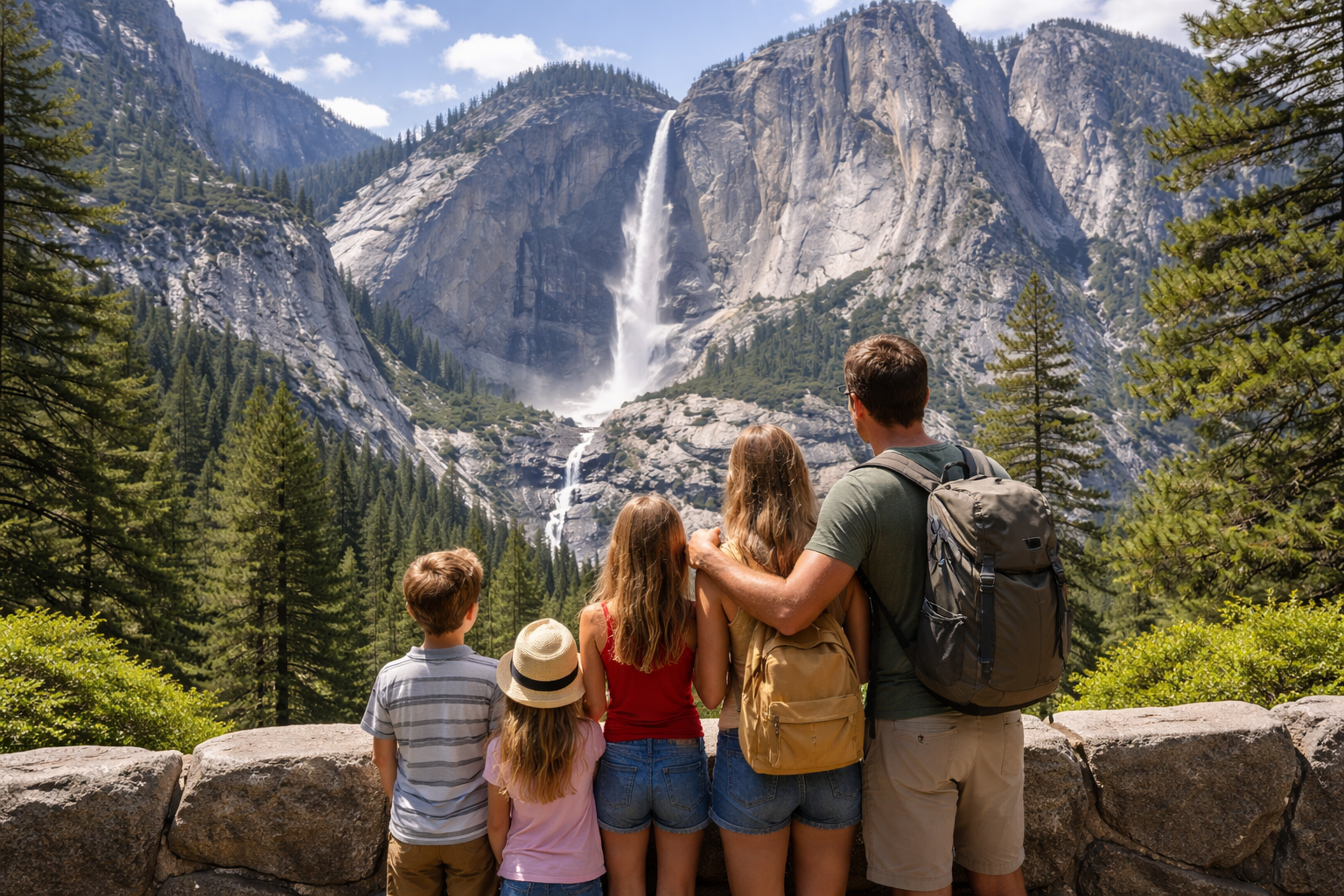
If I could only take families on one hike in Yosemite Valley, it would be this one — no contest. The Lower Yosemite Fall Trail is a one-mile paved loop that ends at the base of the tallest waterfall in North America. We are talking about a 2,425-foot cascade of water thundering down toward you while your kids stand there completely speechless (a parenting miracle, honestly). The trail itself is wide, mostly flat, and entirely doable with a jogging stroller. In May and June, the snowmelt pushes the falls to their most dramatic peak, and the mist at the base is heavy enough to soak everyone in the best possible way. My daughter called it “the world’s biggest sprinkler.” She was not wrong.
Practical tips: The trailhead is located near Yosemite Valley Lodge and is easily accessible via the free Valley shuttle (stop 6). This is one of the busiest trails in the park, so arrive early — before 9 a.m. if you are driving — or use the shuttle and skip the parking scramble entirely. There are restrooms and water fountains near the trailhead. The bridge at the base of the falls is the sweet spot for photos and mist, but hold small children’s hands — the rocks can be slippery.
2. Cook’s Meadow Loop — The Best Bang-for-Buck Stroll in the Valley
- Distance: 1-mile loop
- Elevation Gain: Virtually none
- Surface: Fully paved
- Stroller Rating: Perfect — as flat and smooth as it gets
- Best Ages: All ages
- Best Season: Spring through fall; gorgeous in winter too
Cook’s Meadow Loop is my secret weapon for days when the kids are low on energy or when we have a very early morning with tired legs ahead of us. This flat, fully paved one-mile loop through the heart of Yosemite Valley offers unobstructed views of Half Dome, Yosemite Falls, and Sentinel Rock — essentially the greatest hits of the entire park — without a single significant incline. I have done this loop with a newborn in a carrier, with a stubborn two-year-old who refused to walk, and with a double stroller full of snacks and attitude. Every time, the scenery made me stop and catch my breath.
Practical tips: The loop connects with the Lower Yosemite Fall Trail, so you can easily combine both into a relaxed two-mile morning outing. Deer are frequently spotted grazing in the meadow at dawn and dusk — a huge hit with kids. Keep voices low and stay on the trail to protect the fragile meadow grasses. Valley shuttle stop 5 (Yosemite Village) puts you right at the start.
3. Bridalveil Fall Trail — Short, Dramatic, and Delightfully Misty
- Distance: 0.5 miles round trip
- Elevation Gain: About 75 feet
- Surface: Paved, with a noticeable grade near the end
- Stroller Rating: Challenging — the final incline is steep and rocky near the viewpoint
- Best Ages: All ages; walking toddlers (3+) will love it
- Best Season: Year-round, but heaviest flow in spring
Bridalveil Fall is almost always the first waterfall families see as they enter Yosemite Valley from the west, and there is a very good reason it stops everyone in their tracks. The trail to the base is just a quarter mile each way, making it one of the shortest hikes in the park — but do not let that fool you. The last stretch steepens and gets rocky, and the mist near the base soaks you faster than you expect. My kids think getting drenched by a waterfall is the single greatest experience nature has to offer, so this trail is permanently on our Yosemite rotation. Stroller users: you can get partway there on the paved path, but the final push to the viewpoint is genuinely difficult to navigate with wheels. A carrier or leaving the stroller at the bottom is the smarter call.
Practical tips: There is a dedicated Bridalveil Fall parking lot right off Highway 41, which is often less congested than main Valley parking areas. Pack a light rain jacket or accept the soaking — there is no in-between at this waterfall. The rocks at the base can be very slippery, so supervise little ones closely and keep them away from the edge of the stream.
4. Mirror Lake and Meadow Loop — Reflections of Half Dome and Room to Run
- Distance: 2 miles round trip to the lake; 5-mile full loop
- Elevation Gain: Minimal
- Surface: Paved to the lake, then dirt trail for the loop
- Stroller Rating: Yes, to Mirror Lake; full loop is stroller-possible but unpaved
- Best Ages: All ages for the lake; 4+ for the full loop
- Best Season: Spring for the best reflections; the lake dries into a meadow by late summer
Mirror Lake earns its name in April and May, when the still water reflects a perfect upside-down image of Half Dome that honestly looks like a postcard filter someone forgot to turn off. The two-mile round trip out to the lake is flat and paved, making it completely manageable with a stroller or a toddler on foot — and there is a large sandy beach area at the lake where kids can skip stones, splash in the shallows, and generally do what kids do best (chaos near water). If your crew has the energy, the full five-mile loop continues around the meadow through pine forest with continued Half Dome views and feels genuinely adventurous without being hard.
Practical tips: Take the Valley shuttle to stop 17 (Mirror Lake Junction) — there is no dedicated parking lot for this trail, and driving here is unnecessarily stressful. Note that by late summer, Mirror Lake transforms into Mirror Meadow as the water recedes, which is beautiful in its own right but eliminates the famous reflections. Go in spring if the photos are the mission.
5. Soda Springs Trail, Tuolumne Meadows — The Coolest Science Experiment on a Hike
- Distance: 1.5 miles round trip
- Elevation Gain: Negligible
- Surface: Dirt trail, generally well-maintained and flat
- Stroller Rating: Yes, on most surfaces; a jogging or all-terrain stroller is ideal
- Best Ages: All ages
- Best Season: Summer only — Tioga Road (Highway 120) typically opens late May or June and closes in early November
Tuolumne Meadows sits at 8,600 feet elevation along Tioga Road, and it is a completely different world from the valley floor — wide-open subalpine meadows, granite domes, and the cleanest air you have ever breathed. The Soda Springs trail is the perfect family introduction to this area. The star attraction is a natural carbonated spring that bubbles up from the ground in a rusty iron pool, and watching my kids try to process the fact that sparkling water just comes out of the earth here was genuinely one of my favorite parenting moments. They were fascinated. My six-year-old still talks about it.
Practical tips: The trailhead starts from the Tuolumne Meadows Visitor Center parking area. At 8,600 feet, altitude can affect both kids and adults — take it slow, drink extra water, and watch toddlers especially for signs of fatigue. The meadow itself is a protected ecosystem, so stay on the trail. This is also excellent wildlife-watching territory: marmots, pikas, and even the occasional black bear make appearances in summer.
6. Sentinel Dome — The Big Kid Hike with the Best View in the Park
- Distance: 2.2 miles round trip
- Elevation Gain: About 400 feet
- Surface: Dirt trail with exposed granite scramble at the summit
- Stroller Rating: Not suitable
- Best Ages: 5 and up; confident walkers only
- Best Season: Late spring through fall; Glacier Point Road typically opens in late May
When the kids are ready for their first real summit, Sentinel Dome is my go-to recommendation. The hike to the top is 2.2 miles round trip with a manageable 400-foot elevation gain — challenging enough that kids feel genuinely accomplished, but not so brutal that you end up carrying anyone. The final approach involves a short scramble up exposed granite, which thrills most children ages five and up (parental comfort level with heights may vary). The reward at the top is a 360-degree panoramic view that stretches from Half Dome to El Capitan to the High Sierra backcountry. My six-year-old pumped her fist at the summit like she had just won something. She had.
Practical tips: The trailhead is off Glacier Point Road near the Taft Point parking lot. There is no shade on the dome itself, so go early in the morning, apply sunscreen generously, and bring more water than you think you need. The granite near the top can be slippery if wet — skip this one on rainy days. This hike is not for very young toddlers; the drop-offs near the summit require careful supervision of children who tend to wander.
A note on Mist Trail to Vernal Fall: This is one of the most popular hikes in Yosemite and it comes up in every family conversation. I want to be honest with you: Mist Trail involves steep, wet, slippery granite steps with significant drop-offs, and the spray from Vernal Fall can make those steps genuinely treacherous. I recommend this trail for confident hikers ages seven and up only. It is a beautiful hike, but it is not the casual waterfall stroll some blog posts make it sound like. Save it for when your kids have a few solid hikes under their belts.
Family Tips for Yosemite National Park
Reservations and Entry
During peak season (typically late May through early September), Yosemite requires timed-entry reservations for day visitors arriving between 5 a.m. and 4 p.m. These sell out fast — often within minutes of release. Check the official National Park Service website (nps.gov/yose) for the current reservation calendar and book as soon as your window opens. Overnight lodging and campground guests are generally exempt, which is one of many reasons staying inside the park makes family logistics dramatically easier.
Parking Strategy
Yosemite Valley parking is notoriously limited and fills up by mid-morning on busy days. Your two best options: arrive before 9 a.m. to snag a spot, or arrive after 4 p.m. when day visitors begin leaving. In between? Use the free Valley shuttle system, which runs frequently and stops at nearly every major trailhead and attraction. I genuinely prefer the shuttle — it eliminates parking stress entirely and my kids think riding it is an adventure in itself.
Bear Safety and Food Storage
Yosemite has an active black bear population, and food storage is not optional — it is the law. Bear boxes are located at every major trailhead and picnic area. Do not leave food, scented items, or even empty wrappers in your car. This is a great teachable moment for kids: explain why we store food properly, and suddenly the bear boxes become exciting rather than inconvenient. My daughter now takes bear box duty very seriously.
Junior Ranger Program
Pick up a Junior Ranger activity booklet at any Yosemite Visitor Center (they are free). Kids complete age-appropriate activities throughout their visit and earn an official Junior Ranger badge from a park ranger. This program is one of the best trail-motivation tools I have ever encountered — my six-year-old hiked an extra mile just to spot a bird she needed for her booklet.
Seasonal Considerations
- Spring (April–June): Peak waterfall season; some roads may still be closed; wildflower meadows are stunning.
- Summer (July–August): Busy but Tioga Road is open, giving access to Tuolumne Meadows; book everything well in advance.
- Fall (September–October): Crowds thin, weather is lovely, waterfalls are lower but the light is golden and gorgeous.
- Winter (November–March): Valley roads may require chains; many facilities close; but a snowy Yosemite Valley is one of the most magical things I have ever seen with my children.
What to Pack for Hiking Yosemite with Kids
Yosemite does not require extreme gear, but a few key items make the difference between a great day and a miserable one. Here is what we never leave the car without:
- Water — more than you think: At least one liter per person for any hike over a mile, more in summer heat or at elevation.
- Snacks: Trail mix, fruit pouches, granola bars — hunger turns a beautiful hike into a standoff very quickly.
- Sunscreen and a hat: The granite reflects UV rays intensely; reapply often.
- Layers: Valley mornings are cool even in summer; Tuolumne Meadows can be downright cold. Pack a fleece.
- Rain jacket or packable poncho: Especially near the waterfalls — that mist is real.
- A small pack for each kid: Giving children their own pack is a genuine game-changer for hiking enthusiasm. My kids each carry their own water bottle, snacks, and their Junior Ranger booklet. We love the IVYGREEN Little Kids Hiking Backpack (Purple) — it is sized perfectly for small hikers, fits a water bottle and trail snacks without being overwhelming, and comes in fun colors that make kids actually want to wear it. There is also a Rose version and a
Categories Uncategorized
You might also enjoy