This post contains affiliate links. As an Amazon Associate, I earn from qualifying purchases at no extra cost to you.
The Universal Travel Adapter That Has Never Failed Me in 74 Countries
It was 11:43 PM in Hanoi. My phone was at 4%. My laptop was dead. The guesthouse outlet was a baffling Type A socket that my European adapter laughed at and refused to engage. I had a 5 AM bus to Ha Long Bay, a boarding pass I hadn’t screenshotted, and a contact number saved only in my email. That night, I borrowed a charger from a very patient Dutch backpacker named Bas, who I still owe a beer. That humiliation — and a string of similar ones across Morocco, Sri Lanka, and rural Japan — is exactly what pushed me to finally do a proper universal travel adapter review. Best believe I tested half a dozen options before landing on the one I’ve now carried to 74 countries without a single failure.
I know what you’re thinking. “It’s just an adapter. How much could there possibly be to say?” A lot, as it turns out. Not all adapters handle real voltage variation. Some fall apart after three months. Others are so bulky they eat your entire outlet and block the one next to it, which earns you zero friends in a hostel common room. I’ve had adapters spark in Budapest, refuse to lock in Auckland, and slide straight out of the wall in a guesthouse in Chiang Mai. The wrong adapter isn’t just inconvenient — in certain situations, it’s a genuine safety issue.
After all that, I found the All in One Universal USB Travel Power Adapter with 3 USB Port and Type-C International Wall Charger. It’s been in my bag ever since. This is the full, honest story of why I trust it — and where it still has room to improve.
Why I Chose This Adapter (And What I Rejected First)
Before this, I rotated between a cheap set of four plug adapters I bought at Heathrow and a slightly fancier model from a travel accessories brand whose name I’ve blocked out after it melted slightly in a Portuguese wall socket. My requirements were simple but non-negotiable. The adapter had to cover UK, EU, AU, and Asian plug types. It needed built-in USB ports — ideally more than one — so I could charge multiple devices without hunting for a power strip. And it had to be compact enough to not embarrass me at security.
What pushed me toward the All in One Universal USB Travel Power Adapter with 3 USB Port and Type-C International Wall Charger specifically was the combination of Type-C output alongside three standard USB-A ports. That mattered because by 2022, half my gear — headphones, power bank, Kindle — had migrated to USB-C. Having both in one unit meant I could charge four things simultaneously without a tangle of separate bricks. The price point also made the decision easier. Under $30 for something I’d use every single day of every trip felt like a no-brainer.
First Impressions: Weight, Size, and Build Quality
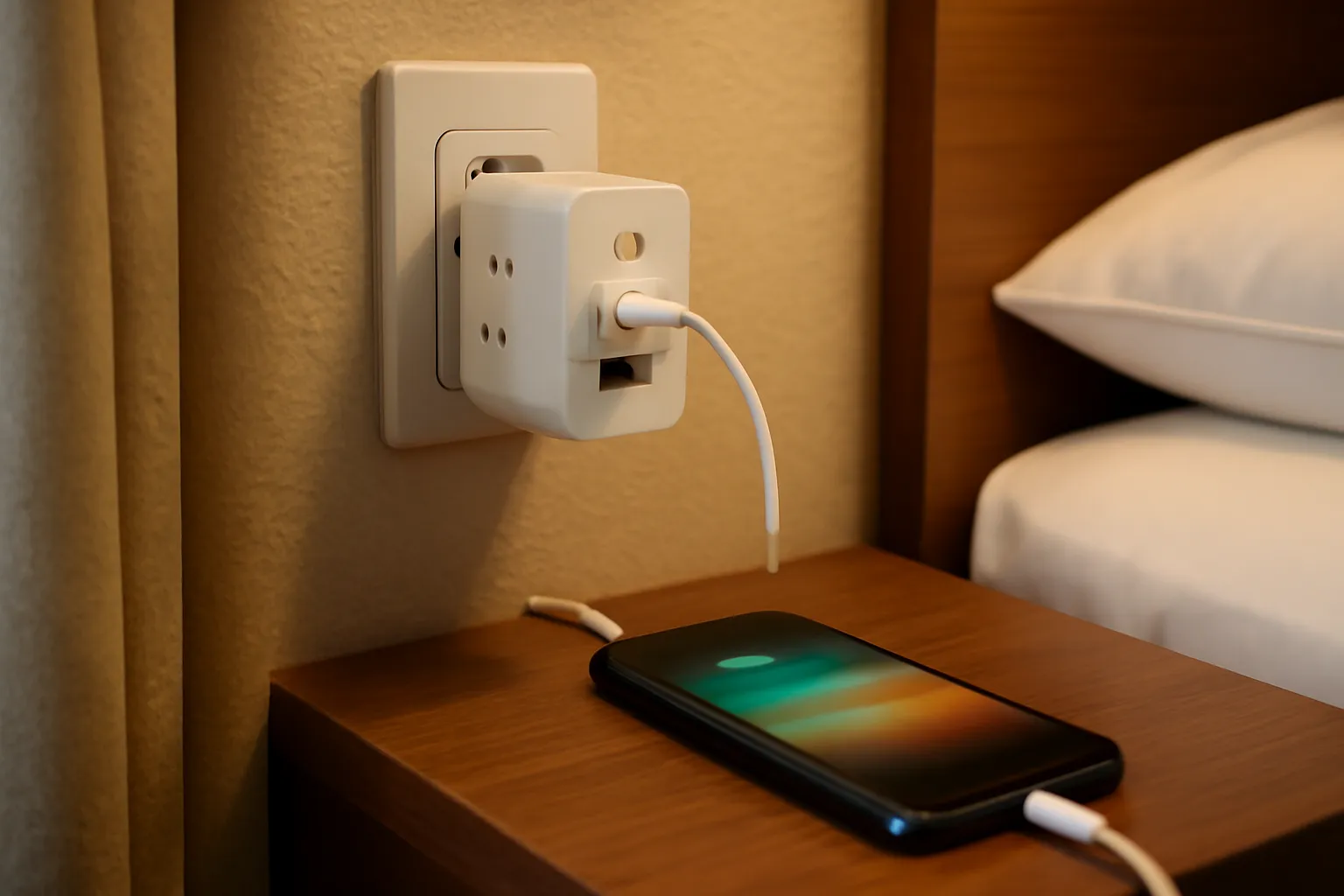
The box arrived and I immediately did what all obsessive travelers do: I weighed it. It comes in at around 180 grams — noticeable but not punishing. It’s roughly the size of a large matchbox, maybe slightly thicker. In a backpack, it slots neatly into any side pocket or cable organizer pouch without drama.
Build quality feels solid for the price range. The plug arms slide out with a satisfying click and don’t wobble once deployed. The housing is hard matte plastic — not premium, but not the hollow, rattly kind that makes you nervous. The USB ports have a reassuring firmness when you plug cables in. Nothing feels flimsy on first inspection.
One thing I noticed immediately: the Type-C port is slightly recessed. That’s actually useful. It means cables seat properly and don’t pull loose if someone trips over the cord — which happens more than I’d like to admit in cramped Tokyo Airbnbs.
The 8-pin AC socket on the unit itself accepts most standard two- and three-prong plugs from North America, though I want to be clear: this is a plug adapter, not a voltage converter. If you’re traveling with something that runs only on 110V — like a very old hair dryer — you still need a separate converter. Most modern electronics, though, handle 100–240V automatically. Check your device before you plug in. This is non-negotiable travel wisdom that I learned the hard way with a hair straightener in Seoul in 2011.
On the Road: Real-World Use Across Trips and Countries
I’ve now run this adapter through situations that would stress-test most gear. Here’s a cross-section of where it’s been put to work.
Europe: The Easy Rounds
The EU plug arm performed flawlessly across Portugal, Poland, Greece, and the Netherlands. Walls in older buildings — especially that 1920s pension in Lisbon — sometimes have loose sockets, and the adapter stayed put regardless. In Amsterdam, I had it charging a laptop via cable, a phone on USB-A, and AirPods on USB-C simultaneously. No heat issues. No flicker. Just quiet, reliable power.
Southeast Asia: The Real Test
Southeast Asia is where adapters go to die. Voltage fluctuates. Sockets are sometimes installed upside-down, sideways, or at angles that defy geometry. In Cambodia, I used the adapter in a guesthouse in Siem Reap where the wall outlet smelled faintly of something I chose not to investigate. The adapter worked fine. In Vietnam — including that same Hanoi where I’d suffered without one — it handled Type A sockets without any issues once I had the correct adapter arm deployed. In Thailand, I used it daily for two weeks across Bangkok, Chiang Mai, and Pai.
The UK and Australia: The Satisfying Clunk
British sockets have a very particular feel — heavy, deliberate, slightly judgmental. The UK arm on this adapter engages properly and stays engaged. In Edinburgh, I ran it for four nights in an old stone B&B with no complaints. In Melbourne and Sydney, the Australian arm worked equally well. I also used it briefly in New Zealand, where AU-type plugs are standard, and had zero issues.
Japan and South Korea: The Precision Markets
Japan uses Type A sockets, same as North America. For US-based travelers, you technically don’t need an adapter there — but the USB ports on this unit are still worth having. In Kyoto, I sat in a 300-year-old machiya guesthouse charging three devices off one wall outlet. Discreet, compact, and the host didn’t bat an eye.
What Actually Held Up — And What Didn’t
After roughly two years of active use across four continents, the housing still feels intact. No cracks, no loose joints, no discoloration from heat. The USB-A ports show minor wear — the plastic lips are slightly scuffed — but they still grip cables properly. The Type-C port remains firm and reliable.
The moment this adapter genuinely saved me was in Nairobi. I’d arrived on a red-eye from Istanbul with a dead phone and no local SIM yet. The hotel lobby had a single accessible outlet near the front desk. With the All in One Universal USB Travel Power Adapter’s three USB ports, I charged my phone, topped up my power bank, and ran my e-reader — all while standing awkwardly by the reception desk for 20 minutes. A lesser adapter would have forced me to choose. This one didn’t.
Where it has occasionally struggled: very old, recessed wall sockets — the kind you find in some Eastern European apartments and older Indian hotels — where the adapter’s body is slightly too wide to seat flush. It’s a minor frustration, not a failure. But it’s worth knowing.
The Downsides: Honest Limitations
No adapter is perfect. Here’s where this one falls short, because you deserve the full picture.
- No fast charging on USB-A: The three USB-A ports are standard speed, not Quick Charge. If you’re trying to top up a large-capacity phone battery in 45 minutes before a flight, you’ll notice the difference.
- Type-C output is limited: The USB-C port delivers power, but it’s not full PD (Power Delivery) speed. Charging a MacBook or iPad Pro this way is more of a trickle than a flood.
- No surge protection labeling: The product doesn’t explicitly advertise surge protection. For countries with notoriously unstable grids — parts of West Africa, rural India — I’d still recommend adding a small surge protector strip to your kit.
- Width can block adjacent outlets: In multi-socket power strips or some continental European wall plates, the body is wide enough to partially block the neighboring socket. Not always, but occasionally.
- No carrying pouch included: Minor, but after two years the edges have scratched other things in my cable pouch. A small included sleeve would be a thoughtful addition.
None of these issues have made me reach for a replacement. But if fast charging is a genuine priority for you, keep reading — I have a note on that below.
Universal Travel Adapter Review Best Verdict: Who Should Buy This
After 74 countries, I’ve become ruthlessly unsentimental about gear. Things earn their place in my bag or they don’t. The All in One Universal USB Travel Power Adapter with 3 USB Port and Type-C International Wall Charger Worldwide AC Power Plug 8 Pin AC Socket for Multi-Nation Travel has earned its place.
Buy this if you:
- Travel to multiple regions and need one adapter that genuinely covers UK, EU, AU, and Asian plug types
- Travel with 3–4 devices and hate hunting for power strips
- Want a reliable, affordable option that won’t blow up your budget before the trip even starts
- Mostly charge phones, tablets, e-readers, cameras, and earbuds — not power-hungry laptops
- Travel solo or with a partner and want the flexibility of multiple simultaneous charges
Skip this if you:
- Rely heavily on fast-charging for large devices like MacBooks or flagship Android phones
- Only ever visit one region — you don’t need a universal adapter for a single annual trip to France
- Require certified surge protection for highly sensitive or expensive equipment
For the vast majority of travelers — backpackers, long-term nomads, frequent business travelers, and gap-year adventurers — this is genuinely the best universal travel adapter for the price. It does what it promises, survives real travel conditions, and has never once left me powerless when it mattered.
One Alternative Worth Knowing About
If fast charging is the priority, take a look at the Travel Adapter USB C Universal All in One Worldwide Travel Adapter with GaN PD3.0 Fast Charge. It features GaN technology and PD3.0, which means noticeably faster charging for laptops and USB-C devices. It’s a solid runner-up — particularly for power users who live on their MacBooks. The trade-off is a slightly higher price and a marginally larger footprint. For most travelers, the primary adapter I’ve reviewed does the job better at the value tier. But if you’re power-hungry and budget-flexible, the GaN option is worth a serious look.
Either way: stop borrowing chargers from Dutch backpackers in Hanoi. Bas deserves better than that. And frankly, so do you.
—