Let me be honest with you: I do not plan trips around museums, historical landmarks, or even beaches. I plan them around food. And December? December is the single greatest month on the planet for food-obsessed travelers who want an excuse to eat their weight in carbs while pretending it’s all “cultural enrichment.” The best christmas food festivals december has to offer are not just pretty Instagram backdrops — they are full-blown pilgrimages for people who believe the best souvenirs are the ones you eat before you even leave the market. This list is your guide to the festivals worth booking flights for, the dishes you cannot skip, and the unspoken rules of navigating Europe’s most magical (and occasionally overwhelming) food markets without collapsing by day three.
Why Christmas Food Festivals in December Deserve Their Own Trip
There is a very specific kind of magic that happens in December when a city leans all the way into the season. Streets glow with fairy lights, steam rises from copper pots of mulled wine, and strangers share tiny wooden benches while clutching paper cups of something warm and boozy. But here is where most tourists go wrong: they treat every Christmas market like it is interchangeable. They grab a generic bratwurst, down three cups of glühwein before noon, and wonder why they feel vaguely disappointed by day two. The secret to doing these festivals right is understanding that each one has a distinct food identity — and chasing those regional specialties is what separates a forgettable holiday trip from the kind of December you talk about for years.
Vienna Christkindlmarkt: The Gold Standard of Christmas Market Food
Location: Vienna, Austria | Dates: Mid-November through December 24 (~4 weeks) | Vibe: Grand, imperial, slightly theatrical — like eating inside a snow globe designed by someone with very good taste
Vienna does not have one Christmas market — it has approximately fifteen, scattered across the city like edible landmarks. The main one on Rathausplatz is the postcard version, but food obsessives know to also hit the market at Schönbrunn Palace and the charming Spittelberg market in the seventh district. The food scene here is genuinely worth the flight. Kartoffelpuffer (crispy potato pancakes served with sour cream or applesauce) are your first stop — they arrive at the table almost audibly crunching, and they are exactly what cold hands and a hungry stomach need. Maroni (roasted chestnuts) are sold by vendors on nearly every corner, and eating them straight from the paper cone while wandering cobblestone streets is a cliché I refuse to apologize for embracing. Then there is Punsch — Vienna’s answer to mulled wine, a warm punch made with fruit juices, rum, and spices that is considerably more sophisticated than anything served in a plastic cup at your local holiday party.
Practical tip: Avoid the main Rathausplatz market on weekends between 3–7 PM if you have any interest in actually moving. Visit on a weekday morning when the crowds thin and vendors are friendliest. Budget roughly €15–25 for a solid food crawl through one market. And yes, the commemorative Punsch mugs are worth buying — you get a deposit back if you return them, but you won’t.
Strasbourg Christmas Market: The Best Christmas Market Food Europe Has Anywhere
Location: Strasbourg, France | Dates: Late November through December 24 (~4 weeks) | Vibe: Alsatian fairy tale — half French elegance, half German heartiness, entirely irresistible
Strasbourg’s Christkindelsmärik is widely considered the oldest Christmas market in Europe, dating back to 1570, and the food scene reflects centuries of Alsatian culinary pride. This is not a market where you sleepwalk through identical stalls — the regional specialties here are distinct enough to justify the trip on their own. Bredele are the Alsatian Christmas cookies you need in your life immediately: small, buttery, spiced with cinnamon and anise, sold in tins that become the best gift you will bring home. Vin chaud (hot wine) is technically the French version of mulled wine, but Alsatian vin chaud has a lightness and citrus brightness that makes it feel entirely different from its German counterpart. And then there is foie gras — yes, at a Christmas market, yes, it is worth every euro, and yes, you will spend the rest of the trip trying to figure out how to pack jars of it in your carry-on without incident.
Practical tip: Strasbourg is extremely walkable and the markets are spread across several squares, each with a slightly different character. Pick up a market map from the tourist office near Place Kléber. Train connections from Paris (TGV, about 1h45m) or from nearby Basel make this an easy add-on. Budget €20–30 for a full food crawl, more if foie gras gets involved (and it will).
Copenhagen at Christmas: Tivoli, Gløgg, and the Most Underrated December Food Scene in Europe
Location: Copenhagen, Denmark | Dates: Mid-November through January 1 (~5 weeks) | Vibe: Hygge made edible — warm, intimate, designed to make you feel like the world is actually fine
Copenhagen in December operates at a different emotional frequency than anywhere else. Tivoli Gardens transforms into what I can only describe as the most beautiful place on earth to eat fried dough, and the surrounding city markets add layers of Nordic food culture that most visitors entirely miss. Æbleskiver are the move here — round, puffy Danish pancakes dusted with powdered sugar and served with raspberry jam, eaten standing up in the cold while feeling unreasonably happy. Gløgg is Denmark’s mulled wine, and the Danish version comes with almonds and raisins sunk into the bottom of the cup, which you fish out with a tiny spoon like a delicious treasure hunt. For something more substantial, seek out smørrebrød — open-faced rye bread sandwiches piled high with pickled herring, roast beef, or egg and shrimp — available at the sit-down restaurants surrounding the markets and representing the best possible December lunch for under €15.
Practical tip: Tivoli entry costs around €20, but the food and atmosphere justify it completely. Go on a Sunday afternoon for the fullest experience. Copenhagen is expensive by European standards, so budget €30–40 for a solid day of Christmas market eating. The markets outside Tivoli — particularly around Nørreport and in the Meatpacking District — are free to enter and equally worth your time.
Oaxaca’s Night of the Radishes: The Most Unique December Food Event You’ve Never Heard Of
Location: Oaxaca, Mexico | Dates: December 23 (one night only) | Vibe: Chaotic, joyful, completely singular — the kind of event that reminds you why leaving the European Christmas market circuit is always a good idea
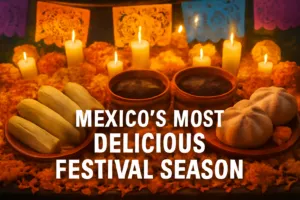
Here is the pitch: on December 23rd every year, the main square in Oaxaca fills with elaborate sculptures carved entirely from giant radishes. Nativity scenes, historical figures, fantastical creatures — all made of root vegetables, all absurdly impressive, all part of a tradition dating back to the 1800s. But the food surrounding this event is what makes it a genuine december food event to travel for. Vendors line the streets selling buñuelos — crispy fried dough discs drizzled with piloncillo syrup that you eat and then smash the ceramic plate for good luck (this is real and extremely satisfying). Ponche, a warm fruit punch made with tejocotes, guavas, and sugar cane, appears everywhere and is the Mexican answer to every European mulled wine you’ve ever had. Atole — a thick, warm corn-based drink flavored with cinnamon and chocolate — is the late-night comfort drink that caps the evening perfectly.
Practical tip: Book accommodation in Oaxaca months in advance — December 23rd draws enormous crowds and hotels fill up fast, particularly anything near the Zócalo. Arrive by late afternoon to secure a good viewing spot for the radish competition. Budget €10–15 for a full evening of street food, which is one of the most joyful ways to spend money on this planet. If you are already planning a Mexico trip, wittypassport.com has more destination content to help you build out the full itinerary.
The Christmas Market Food Crawl: How to Do Multiple European Cities Without Burning Out
The multi-city Christmas market trip is a beautiful idea that can quietly destroy you if you approach it wrong. By day four of eating sausage and drinking mulled wine in three different countries, your body starts quietly filing a complaint. Here is how to pace yourself like a professional.
The golden rule: one market per city, done properly, beats five markets per city done at a sprint. Pick the market in each city that has the most distinct regional food identity and go deep on it rather than skimming every stall for the same bratwurst.
A suggested three-city itinerary that actually works:
- Days 1–3: Strasbourg — Start here. Alsatian food is the most distinct Christmas market cuisine in Europe. Use these days to calibrate your appetite and establish your vin chaud tolerance.
- Days 4–6: Vienna — Train or fly to Vienna. The shift from French to Austrian food culture is dramatic enough to feel like a genuine reset. Focus on the Schönbrunn and Spittelberg markets for a less crowded, more local experience.
- Days 7–9: Copenhagen — Fly north. The Nordic food scene here is different enough from everything you have eaten in the previous six days that your appetite will feel genuinely renewed. End the crawl with æbleskiver and gløgg at Tivoli.
The glühwein rule: Limit yourself to two cups of mulled wine per day, maximum. I know this sounds like the advice of someone who has never stood in front of a beautiful wooden stall in the snow. I am giving you this advice as someone who violated it in Cologne and spent an afternoon napping under a Christmas tree like an extremely festive sloth.
The Gloves That Saved My Hands at Vienna’s Christkindlmarkt (When I Stupidly Forgot My Own)
Spending four hours wandering between Christmas market stalls in Vienna in early December means your hands are either wrapped around a warm mug of Punsch or slowly turning into icicles. I learned this the hard way when I realized my gloves were still in my apartment across the city.
What works
- The merino wool actually breathes, so when you’re walking between markets or ducking into shops, your hands don’t get clammy and then freeze the second you step back outside.
- Thin enough that you can still operate your phone camera without that awkward “remove one glove, take photo, replace glove” dance that costs you feeling in your fingertips.
- They stayed in my pocket through multiple market visits and never fell out, even when I was rummaging for cash or vendor business cards.
What doesn’t
- The fit is snug enough that if your hands run large, they’ll feel restrictive rather than cozy after an hour of wear.
- For genuinely brutal cold (below freezing for extended periods), these are more “comfortable while moving around” than “standing still in a blizzard” protection.
I almost didn’t buy the emergency replacement pair because the price felt high for what I thought was a “temporary fix,” but they outlasted three subsequent trips and I still use them for fall markets back home. TRENDOUX Merino Wool Gloves
This post contains affiliate links. As an Amazon Associate, I earn from qualifying purchases at no extra cost to you.