
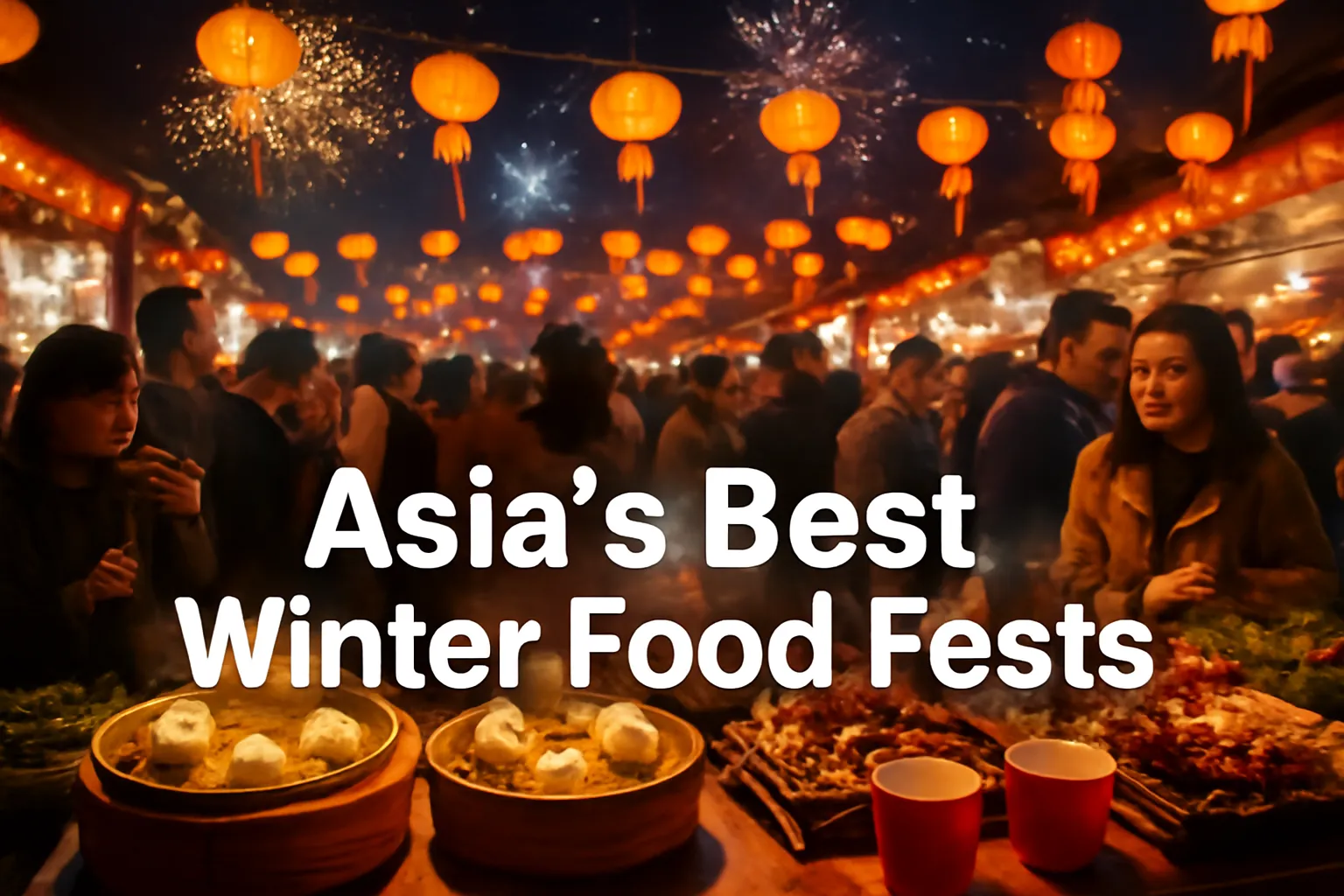
Let me be completely honest with you: I do not plan trips around landmarks. I plan them around meals. Specifically, I plan them around the kind of meals that only exist once a year, in one place, eaten standing up with grease on my chin and zero regrets. January and February in Asia? That is arguably the most delicious window of the entire travel calendar. If you have been searching for the best food festivals Asia January February has to offer, buckle up — because this list is going to make you rethink your whole year.
Why Food Festivals Asia January February Are Worth Booking a Flight For
Here is the thing about Asian food festivals in winter — they hit differently. The cold air in Sapporo makes hot ramen taste like a religious experience. The chaos of Chinese New Year crowds somehow makes dumplings taste better. There is a communal electricity in these festivals that you simply cannot manufacture. Festival-only dishes appear for two weeks and then vanish for another year. Vendors who have perfected a single recipe over three generations set up stalls next to grandmothers selling snacks from folding tables. The best time for food travel in Asia is genuinely a debate worth having, but January and February make a very compelling case. Let us get into it.
Chinese New Year Food Festivals: Hong Kong, Singapore, and Taipei
Chinese New Year is not one festival — it is a rolling, fifteen-day feast that travels across Asia like the world’s most delicious relay race. Each city does it differently, and if you are ambitious enough, you could theoretically eat your way through all three. The festival typically falls anywhere between late January and mid-February depending on the lunar calendar, so check the exact dates each year before booking. Across all three cities, the food culture centers on communal eating: sharing dishes symbolizes prosperity, and showing up hungry is basically a personality requirement.
Hong Kong: Flower Markets, Temple Fairs, and Pineapple Buns at Midnight
Hong Kong’s Chinese New Year celebrations feel like the city cranked its already-intense food energy up to eleven. Victoria Park hosts one of the largest flower markets in Asia, and the surrounding streets fill with food stalls selling everything that is lucky, golden, or sticky. The atmosphere is loud, bright, and completely intoxicating — this is street food festivals Asia energy at its absolute peak.
- Must-Try Dishes: Nian gao (sticky rice cake), turnip cake (lo bak go) from street stalls, pineapple buns from any cha chaan teng that stays open late
- Practical Tip: Book accommodation at least two to three months in advance — hotels fill up fast and prices spike hard. Aim for Kowloon side for easier street food access without the Central premium price tag.
- Expect to Spend: Street snacks run HK$15–50 per item; a proper CNY dinner at a restaurant could run HK$300–600 per person.
Singapore: Hawker Centres Dressed Up for the New Year
Singapore turns Chinese New Year into a month-long spectacle centered on Chinatown, and the food is the whole point. The famous yu sheng (raw fish salad tossed high for good luck) appears exclusively during this season and is one of those dishes that genuinely does not exist the rest of the year in the same ceremonial way. The energy here is more polished than Hong Kong — Singapore does everything with a certain slick precision — but no less delicious.
- Must-Try Dishes: Yu sheng toss (lo hei) at a hawker centre, bak kwa (dried barbecue pork that lines every shop window), pineapple tarts that people genuinely gift as luxury items
- Practical Tip: Get to Chinatown before 10am if you want to browse stalls without the full crush of the afternoon crowd. The light-up street installations are best after 8pm.
- Expect to Spend: Hawker meals SGD $4–12; yu sheng at a sit-down restaurant SGD $30–80 depending on the fish.
Taipei: Temple Food and the Most Underrated CNY Scene in Asia
Taipei is criminally underrated on the Chinese New Year circuit. Longshan Temple becomes the emotional heart of the city’s celebrations, and the surrounding night market stalls go absolutely wild with seasonal specials. Taiwan’s CNY food culture leans into temple offerings and family-style hot pot, but the street stalls are what will keep you wandering until 2am.
- Must-Try Dishes: Tang yuan (glutinous rice balls in sweet soup), braised pork rice (lu rou fan) from stalls that have been operating for decades, and oyster vermicelli at Huaxi Street Night Market
- Practical Tip: The MRT runs extended hours during CNY in Taipei. Get an EasyCard loaded before you start your food crawl so you can hop between night markets without burning time.
- Expect to Spend: Night market snacks TWD $40–120; a full hot pot dinner TWD $400–800 per person.
Sapporo Snow Festival Food Stalls: Japan’s Coldest, Most Delicious Event
Every February, Sapporo builds enormous ice sculptures in Odori Park and then — crucially — surrounds them with food stalls designed to keep you from freezing to death. The Sapporo Snow Festival runs for approximately seven days in early February, and while the sculptures are genuinely impressive, the real draw for food-obsessed travelers is the eating culture that wraps around them. This is Japan’s cold-weather food scene in full swing, and it is one of the best asian food festivals winter experiences on the planet.
- Must-Try Dishes: Sapporo-style miso ramen (richer and heavier than Tokyo ramen, built for this exact weather), Hokkaido king crab legs grilled right in front of you, and corn soup served in a cup that will warm your hands and your soul simultaneously
- Practical Tip: Dress in genuine winter layers — this is not decorative cold, this is Hokkaido cold. A bowl of ramen mid-festival is not optional; it is survival. Most food stalls accept cash only, so carry ¥5,000–10,000 on you.
- Expect to Spend: Ramen ¥900–1,400; crab legs ¥1,500–3,000 depending on size; budget ¥3,000–5,000 for a full stall-hopping session.
Taiwan Lantern Festival: Two Weeks of Night Market Magic
The Lantern Festival falls on the fifteenth day of Chinese New Year — so typically mid-to-late February — and Taiwan does it better than anywhere else in the world. The Pingxi sky lantern release is the image everyone knows, but the food culture surrounding the entire two-week lead-up is what food travelers need to know about. Night markets across Taiwan roll out Lantern Festival specials that are genuinely seasonal, genuinely limited, and genuinely worth planning around.
- Must-Try Dishes: Yuan xiao (sweet glutinous rice balls — different from tang yuan in subtle but important ways), savory sesame-stuffed versions from temple fair vendors, and the full theatrical spread at Shilin Night Market which goes extra during this period
- Practical Tip: If you are heading to Pingxi for the sky lantern release, book your train tickets weeks in advance — the line fills quickly. Combine the trip with the Jiufen food stalls for a full day of eating with a side of scenery.
- Expect to Spend: Sky lantern kits TWD $150–200; night market food TWD $50–150 per item; budget TWD $500–800 for a full evening food crawl.
India International Food & Hospitality Fair, Delhi: Late January’s Hidden Gem
Less known internationally but completely worth your attention, the India International Food and Hospitality Fair in Delhi typically runs for approximately four days in late January. This is less street festival and more industry showcase — but it is open to the public in ways that matter, and the sheer scale of regional Indian cuisine on display in one place is genuinely staggering. Delhi in January is also blissfully cool by Indian standards, making this one of the most comfortable times to eat your way through the city’s legendary street food scene simultaneously.
- Must-Try Dishes: Regional specialties from states you may never have tried — Chhattisgarhi cuisine, Northeast Indian food that rarely appears outside its home region, and Delhi’s own chaat scene which reaches peak performance in the cooler months
- Practical Tip: For dietary needs — vegetarian, vegan, halal, or allergy-related — Delhi is actually one of the easier Asian cities to navigate. Learning a few words in Hindi (“shakahari” means vegetarian) helps enormously. Carry a dietary card translated into Hindi if you have serious restrictions.
- Expect to Spend: Entry fees vary by day and category; street food in Old Delhi runs ₹20–150 per item; a proper sit-down meal ₹300–800 per person.
Chopsticks You Won’t Lose in a Night Market Crowd
When you’re eating your way through Taipei’s shilin night market or Hong Kong’s street stalls, the last thing you need is to be fumbling for utensils or leaving them behind in a food stall. A compact, case-protected pair of chopsticks means you’re never eating with whatever random utensils the vendor hands you—which, let’s be honest, you can’t always trust.
What works
- The pull-design case actually stays closed in your bag—I’ve had collapsible chopsticks roll around loose and poke through wet tissue packets for an entire day in Singapore.
- They’re lightweight enough that you don’t notice them in a day pack, but substantial enough that you’re not fighting with flimsy wood or plastic when you need actual grip on slippery dumplings.
- The black phoenix design is subtle enough that you won’t feel self-conscious pulling them out at a busy street vendor stall—it reads as travel-savvy, not tourist gimmick.
What doesn’t
- The case is small enough to lose if you’re not deliberate about where you stash it—I’ve left mine on a table at a Hong Kong dai pai dong and had to backtrack twenty minutes later.
- They’re not going to perform miracles with extremely slippery foods; noodles in broth still require actual skill, and these chopsticks won’t compensate for your lack of technique.
I almost ditched mine halfway through a two-week Taiwan trip because the case felt fussy to deal with between meals, but by day five I realized I was actually using them at every single food stop—and that’s when I knew I’d made the right call. Grab the Portable Chopsticks with Pull Design Case (Black Phoenix).
This post contains affiliate links. As an Amazon Associate, I earn from qualifying purchases at no extra cost to you.