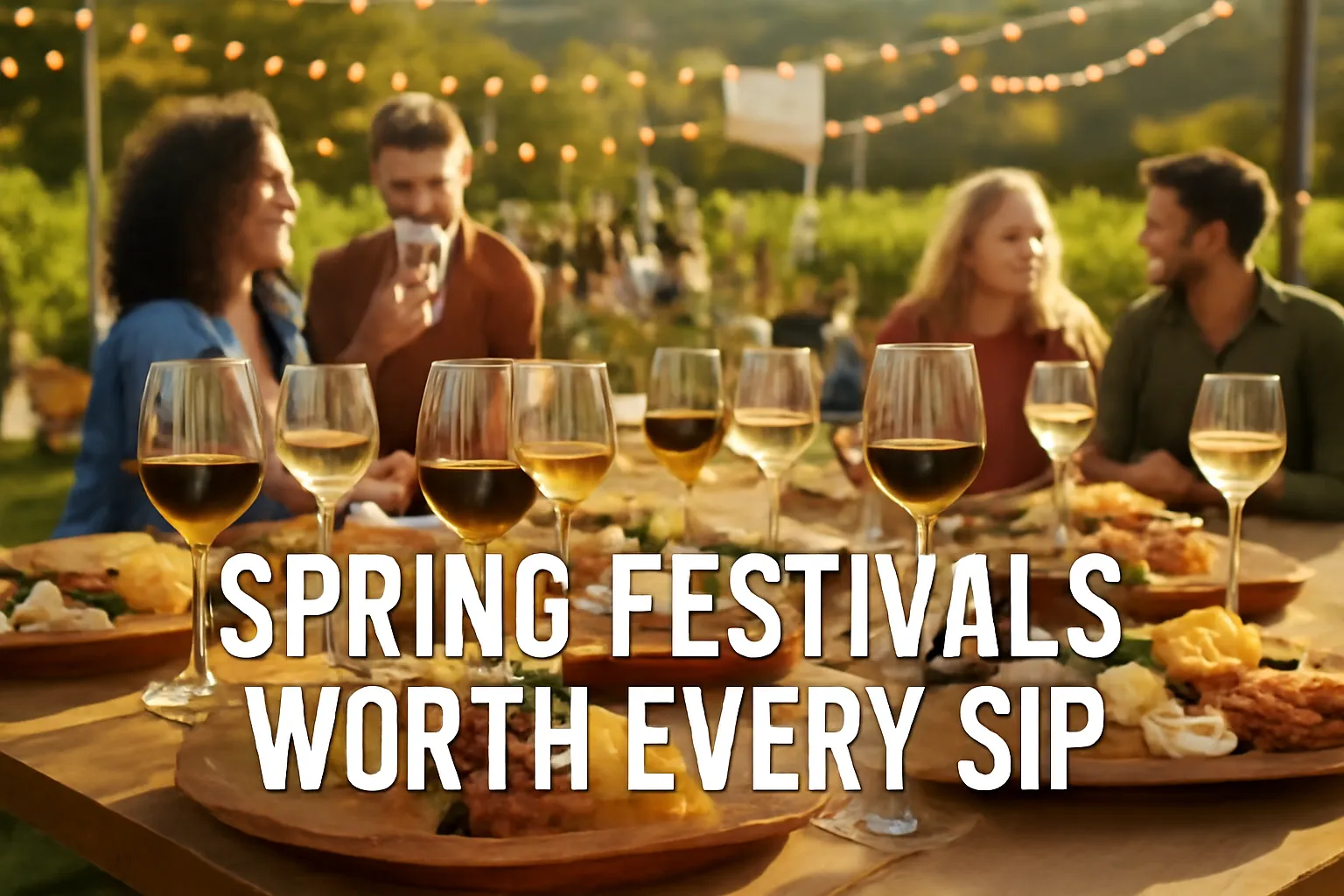
Let me be completely honest with you: I have never once planned a trip around a museum. I have, however, rerouted an entire European itinerary because a four-day wine festival in Verona fell on the exact dates I’d originally booked for Milan. Zero regrets. If you’re the kind of traveler who researches a destination’s food scene before you even check hotel prices, then spring is essentially your Super Bowl. The best wine and food festivals spring has to offer are concentrated in March and April — that glorious window before summer crowds arrive and after winter has finally loosened its grip on the good produce. These aren’t just events you attend; they’re the entire reason you book the flight.
Why Spring Food and Wine Travel Hits Different
Spring festivals occupy this magical culinary sweet spot. Winemakers are emerging from harvest reflection mode in the Southern Hemisphere while Northern Hemisphere producers are previewing new vintages. Chefs are leaning into transitional ingredients — spring lamb, early asparagus, citrus at its peak — which makes food and wine travel spring genuinely exciting in a way that a midsummer festival sometimes isn’t. You’re tasting things that feel alive and in-the-moment. You’re also, frankly, not melting. The four festivals below span two continents and represent a range of experiences: from a massive Italian trade event that still welcomes passionate amateurs, to an intimate Australian escape that feels like crashing the world’s most delicious house party. I’ve organized them not by size but by the type of trip they anchor best.
Best Wine and Food Festivals Spring: The Big Four Worth Building a Trip Around
1. Vinitaly — Verona, Italy
Typical Dates: First full week of April (usually 4 days) | Location: Verona Expo, Verona, Veneto
Vinitaly is the wine world’s version of Fashion Week — overwhelming, intoxicating, and absolutely not something you do halfway. Held annually at the Veronafiere exhibition grounds, this is one of the largest wine exhibitions on the planet, pulling in over 4,000 exhibitors from 140+ countries and roughly 93,000 visitors. Sounds like chaos? It can be. But that’s exactly why you budget a full week in the region rather than just the four festival days. The event operates on two tracks: a professional trade component (where importers and sommeliers do serious business) and a public-facing experience that rewards the genuinely curious. General public tickets run approximately €30–€45 per day, and the tasting included in that price is, frankly, ridiculous value when you consider you can sample world-class Amarone, Soave, and Barolo from hundreds of producers in a single afternoon.
The food-wine pairing philosophy here is deeply regional. You’re in the Veneto, which means must-try pairings include risotto all’Amarone (a rich, slow-cooked risotto made with Amarone wine and bone marrow — find it at local restaurants, not inside the fair), a classic Valpolicella with horse meat braised in the traditional Veronese style, and any excuse to sit down with a glass of Lugana and a plate of fresh lake fish from nearby Garda. You do not need to be a wine expert to enjoy Vinitaly — you just need curiosity and comfortable shoes. Insider tip: book accommodation in central Verona (the old city is stunning and walkable) at least four months in advance, because the entire region fills up. And if you’re already planning an Italy trip, check out our broader Italy destination content on wittypassport.com for region-hopping ideas before and after the festival.
2. Devour! The Food and Film Festival — Wolfville, Nova Scotia (Honourable Mention: Devour Culinary Classic, Phoenix)
2. Devour Culinary Classic — Phoenix, Arizona, USA
Typical Dates: Late March (2 days, expanding programming) | Location: Desert Botanical Garden, Phoenix, AZ
Phoenix doesn’t immediately come to mind as a wine destination, but that’s exactly what makes the Devour Culinary Classic such a delightful surprise. Set against the surreal backdrop of the Desert Botanical Garden — saguaro cacti, blooming palo verde, and late-afternoon golden light — this festival has been growing steadily in both reputation and scale. It’s an intimate-leaning event compared to its European counterparts, which means you actually get to talk to the chefs. That’s not a small thing. The programming revolves around pairing Arizona’s increasingly serious wine scene (Sonoita and Willcox AVAs are producing genuinely compelling Rhône-style reds and Spanish varietals) with the region’s bold, fire-driven cuisine.
Must-try experiences: mesquite-smoked brisket paired with an Arizona Petite Sirah, Sonoran-style tacos with a chilled Malvasia from a local small-batch producer, and whatever the guest chef tasting dinner is doing — these headline dinners (typically $150–$250 per person) sell out weeks in advance. Day tickets hover around $95–$125, which covers most tastings. The vibe is upscale-casual: people dress well but nobody’s stuffy, and the desert setting creates this naturally convivial atmosphere where strangers share tables and swap recommendations. Tip: book the Friday evening kickoff event separately if it’s available — smaller crowd, better access to the winemakers.
3. Margaret River Gourmet Escape — Margaret River, Western Australia
Typical Dates: Typically November, but satellite events and cellar door seasons run March–April | Location: Margaret River Region, Western Australia
Full transparency: the marquee Margaret River Gourmet Escape festival traditionally lands in November, but the region’s cellar door festival season and smaller gourmet events absolutely justify a March or April visit — and the shoulder season timing means you’ll have the wine roads almost to yourself. Margaret River is one of Australia’s most celebrated wine regions, producing some of the country’s finest Cabernet Sauvignon and Chardonnay within about 90 minutes of the surf beaches in Western Australia’s southwest corner. If you’re already planning an Australia trip (and we have deep destination content on wittypassport.com to help you build it), adding Margaret River to the itinerary in autumn is a no-brainer.
The food-wine philosophy here is farm-to-glass and deeply local: the same red soils that produce the Cabernet also grow incredible grass-fed beef, the Indian Ocean delivers outstanding marron (freshwater crayfish) and abalone, and the artisan cheese scene is punching well above its weight. Must-try pairings: a classic Margaret River Cab with slow-roasted lamb shoulder at one of the estate restaurants, a Chardonnay with fresh marron, and any excuse to do a “cheese and current vintage” tasting at a boutique producer like Voyager Estate or Vasse Felix. The vibe is relaxed, pastoral, and extremely Instagram-friendly without being performative about it. Tip: rent a car — you cannot do this region without one, full stop. Budget around AUD $80–$150 for a proper cellar door day across two or three estates.
4. Fête de la Gastronomie — France (Various Regions)
Typical Dates: Last weekend of March into early April (regional calendars vary) | Location: Nationwide, France — Burgundy, Lyon, Bordeaux, Alsace highlights
The Fête de la Gastronomie is less a single festival and more a national excuse for France to remind the world that it invented the concept of eating well. This multi-day, multi-city celebration of French culinary heritage spills across regions with pop-up tastings, chef dinners, market events, wine cellar openings, and cooking demonstrations. For the food and wine traveler, this is simultaneously the most logistically complex and most rewarding option on this list — because it rewards planning. Choose a base region. Burgundy during Fête season means Pinot Noir tastings and bœuf bourguignon that will restructure your understanding of what a braise can be. Alsace means Riesling paired with choucroute garnie and flammekueche in settings that look like they were set-dressed for a period film.
Must-try food-wine pairings by region: Burgundy — a village-level Gevrey-Chambertin with coq au vin; Lyon — Beaujolais with quenelles de brochet and a proper bouchon lunch that lasts three hours; Bordeaux — a classified Médoc with entrecôte à la bordelaise. Many of the Fête events are free or low-cost (market tastings, restaurant open days), with special dinners ranging from €60 to €200+ per person. The vibe varies wildly: Lyon is boisterous and communal, Burgundy is reverent and intimate, Bordeaux is elegant and slightly formal. You don’t need wine expertise — you need a good appetite and a willingness to ask questions in broken French, which the locals find endearing. We have France destination guides on wittypassport.com that pair beautifully with this kind of regional itinerary. Tip: check regional tourism board websites in January for the confirmed Fête calendars, as specific events are announced on a rolling basis.
The Wine Aerator That Saved Me at a Packed Verona Tasting
When you’re at a spring wine festival with mediocre glasses and hundreds of people fighting for tastings, the wine itself isn’t always going to be the limiting factor—your ability to actually experience it is. I learned this the hard way at the Verona festival, standing in a crush of elbows with a plastic cup of honestly unremarkable regional red that needed serious help to taste like anything other than regret.
What works
- The electric pouring function actually speeds up aeration in real time—no more standing there manually tilting a decanter like you’re performing surgery while crowds push past you.
- It’s compact enough to pack in a carry-on, which means you can legitimately bring it to a festival if you’re staying in an apartment or Airbnb with a kitchen.
- USB rechargeable means you’re not hunting for batteries between wine regions, and the charge actually lasts through multiple tastings or a full evening of testing festival samples.
What doesn’t
- It’s genuinely too much to bring to a crowded public tasting—you’ll look like you’re operating a wine science experiment, and festival staff will give you the look.
- The spout design works better with standard wine bottle openings than with festival pour-spouts, so it’s really a tool for post-festival enjoyment, not in-the-moment rescue.
I doubted this would actually make a meaningful difference on a trip—until I used it on a mediocre bottle I’d bought at the Verona festival and realized I’d genuinely misjudged the wine the first time. MolaMolamoy Wine Aerator Electric Wine Decanter
This post contains affiliate links. As an Amazon Associate, I earn from qualifying purchases at no extra cost to you.