Three weeks after my relationship ended, I did the only thing that made sense: I booked a solo trip somewhere I’d always wanted to go but had been waiting for the “right time” to visit together. Provence had lived on that list for years — the lavender fields, the crumbling hilltop villages, the markets piled high with olives and herbs — and I was done waiting. What unfolded over three days in Provence and the Luberon was exactly the kind of trip I hadn’t known I needed: slow mornings in sun-drenched villages, wandering ancient Roman ruins without an agenda, and eating far too much cheese with no one to negotiate the itinerary with. This guide is the exact three-day route I followed, blending the region’s most iconic sights with a few quieter corners that don’t always make the highlight reels.
What I Recommend
Before you head to France, an RFID-blocking passport holder is worth its weight in euros. Pickpocketing happens in train stations and crowded markets, and this simple piece of gear gives you peace of mind while exploring Provence’s villages and avoiding the “accidental” brush-bys on regional trains.
I always travel with a travel document organizer to keep my passport, hotel confirmations, and train tickets in one place. When you’re moving between charming Luberon towns every day, the last thing you need is to panic about where you put your reservation confirmation for that mas you booked.
A quality travel adapter is non-negotiable for France—your US devices won’t work without one, and French outlets are different from what you might expect. I’ve learned this the hard way too many times, so grab one before you leave and thank yourself when you’re charging your phone in your Avignon hotel room.
If you want to avoid roaming charges while navigating between Gordes and Bonnieux, a European SIM card is a game-changer. Pop it in when you land, and you’ll have affordable local data for GPS, messaging, and those Instagram-worthy sunset photos without worrying about your bill.
A portable power bank has saved me countless times when my phone battery dies mid-hike through the lavender fields or while trying to find a restaurant in a winding medieval street. I always keep one in my day pack—it’s insurance against dead batteries and dead ends.
Honestly, a travel guidebook for Provence is worth having alongside your phone. There’s something about flipping through recommendations for hiking trails, wine estates, and hidden restaurants that helps you plan your three days smarter—and it works when your battery dies.
Even if you speak some French, a phrase book tucked in your pocket is clutch for ordering at rural cafés or chatting with locals in Lourmarin. The French appreciate effort, and having the right words ready makes interactions warmer and more memorable.
Packing cubes make switching between three different towns feel less like a logistical nightmare. I use them to separate clean clothes, toiletries, and “dinner outfit” so I’m not living out of my suitcase for three days straight.
If you’re trying to fit three days of Provence into a carry-on, compression bags are absolute magic. They’ve saved me from checked baggage fees more times than I can count, which means more money for wine tastings in Châteauneuf-du-Pape.
A TSA-approved luggage tag is a small detail that makes a big difference when you’re moving between airports and hotels. It’s bright, durable, and makes your bag easier to spot on the carousel after your flight into Marseille.
I always throw a luggage cover on my suitcase for European train travel—regional trains to and from Provence can be rough on luggage, and this adds a layer of protection (plus it looks less tempting to thieves).
A Bluetooth luggage tracker gives me real peace of mind when I’m moving between hotels in the Luberon. If my suitcase somehow gets separated from me, I can track it down without the panic that would otherwise derail my vacation.
Long flights to France deserve an inflatable travel neck pillow—trust me on this one. You’ll arrive in Provence more refreshed and ready to explore instead of nursing a stiff neck and regretting every decision that led to sleeping upright in economy.
A travel blanket is my secret weapon for flights and those chilly evenings when you’re sitting outside a café in the lavender region. Lightweight, compact, and way warmer than you’d expect—it’s earned its spot in my carry-on permanently.
I never travel without a travel eye mask—it’s especially useful on overnight flights so you actually arrive in Provence looking human. It’s a tiny thing, but sleeping on the plane makes a massive difference in how you enjoy your first day.
A travel first aid kit is essential for any trip, especially when you’re hiking through Provençal countryside or exploring rocky villages. Blister prevention and pain relief have saved countless afternoons and kept me from limping through Avignon.
A filtered water bottle pays for itself immediately in Europe—tap water is safe in France, but carrying your own bottle keeps you hydrated during long days of sightseeing without constantly buying plastic bottles. Plus, refilling at fountains is a classic European experience.
A portable phone tripod transforms your photography in Provence—those golden-hour shots of vineyards and village streets are so much better when you’re actually in the frame, not contorted trying to angle a selfie stick. It’s lightweight enough to toss in your day pack.
If you’re a photographer bringing a mirrorless camera, a portable camera battery charger is insurance against missing sunset shots in the Luberon. Trust me, running out of battery halfway through golden hour in Ménerbes is a regret you don’t want to carry home.
As an Amazon Associate, I earn from qualifying purchases.
I Got Outwitted by a Lavender Field (and Drank Wine in a Cave to Recover)
Our guide, Thierry, had the kind of unhurried confidence that only comes from knowing your region is objectively beautiful and knowing you know it. He picked us up early from Gordes in a nine-seat van, and within twenty minutes we were standing at the edge of a Valensole plateau watching the lavender roll toward the horizon in fat purple stripes. The smell hits you before the view does — sweet, almost medicinal, a little overwhelming in the best way. Thierry told us that Provence produces around 80% of the world’s natural lavender essence, and that the Valensole plateau’s dry, stony soil and scorching summers create conditions the plant loves so much it practically volunteers to be there. The bees, apparently, agree — the lavender honey from this region is sold out at every local market before July is even finished. I inhaled so aggressively trying to memorize the scent that I slightly alarmed the couple next to me.
The funny moment came at Roussillon, which is where the ochre cliffs live — these blazing red and orange rock formations that look like someone spilled a sunset and forgot to mop it up. Thierry warned us that the ochre dust stains everything. I nodded confidently and walked directly into the most pigmented section of the trail. My white sneakers are now a shade best described as “crime scene terracotta.” Thierry laughed first, which at least made it funnier. He explained that Roussillon was once Europe’s leading producer of ochre pigment, used in everything from paint to cosmetics, until synthetic dyes put the industry out of business in the 1950s — so in a way, I was just carrying on a local tradition. I chose to accept that framing. We finished the day in a medieval wine cellar carved directly into the rock beneath a village estate in Gordes, tasting a cool, slightly mineral rosé while Thierry explained that the cellar dated back to the 12th century and had been in continuous use ever since. Sitting in a thousand-year-old room, slightly ochre-dusted, sipping rosé — honestly, peak Provence.
If this sounds like your kind of afternoon, it absolutely should be. Small-group tours like this one are worth every euro — you get the local context, the hidden stops, and someone who catches you before you ruin a second pair of shoes. You can browse similar France tours on Viator to find lavender field and hilltop village experiences that fit your dates and travel style.
Day 1: Arrival in Avignon & Papal History
Your Provençal adventure begins in the historic city of Avignon. After settling into your accommodation, head straight to the city’s monumental heart. Your main destination is the Palais des Papes (Palace of the Popes). This imposing Gothic fortress was the seat of Western Christianity in the 14th century. Indeed, its sheer scale is breathtaking. You can explore grand halls, private papal apartments, and serene courtyards. The audio guide provides fascinating stories about the popes who lived here.
Next, walk to the famous Pont d’Avignon, officially the Pont Saint-Bénézet. While only four of the original 22 arches remain, it offers lovely views of the Rhône River. In the evening, enjoy your first Provençal dinner. Find a restaurant in the Place de l’Horloge, the city’s main square. Here, you can savor regional specialties like ratatouille or daube provençale. Avignon’s historical core is a designated UNESCO World Heritage site, a testament to its global importance . Source. Roussillon – Official Tourism Website
Day 2: The Ochre Cliffs of Roussillon & Hilltop Gordes
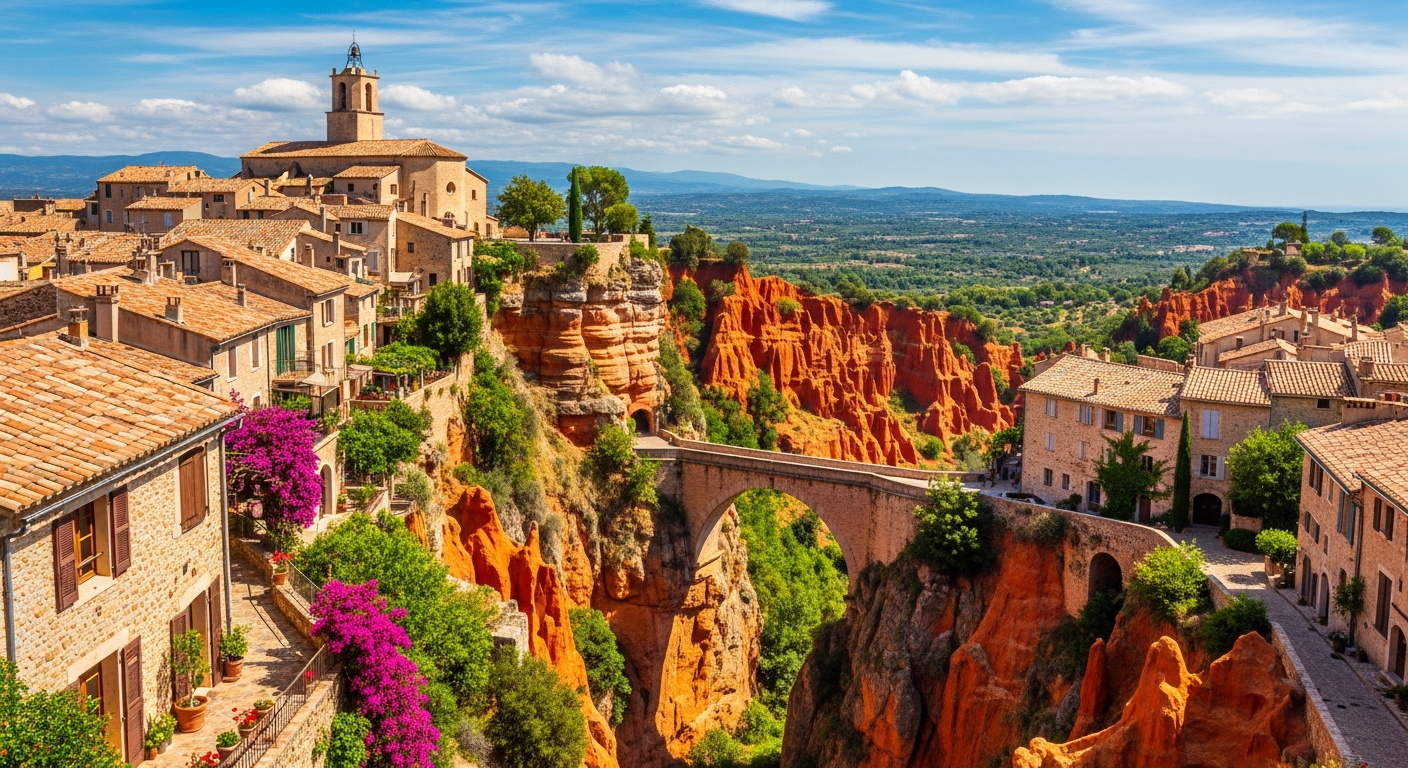
On your second day, pick up your rental car and drive into the Luberon Natural Regional Park. Your first stop is Roussillon, a village famous for its striking red and yellow ochre cliffs. The buildings themselves glow with warm, earthy tones. You can walk the Sentier des Ocres (Ochre Trail), a short path that winds through the former quarries. The colors are truly spectacular, especially in the morning light. Consequently, it’s a paradise for photographers.
. Gordes – Official Provence Tourism Guide
In the afternoon, drive to the nearby village of Gordes. This iconic village clings dramatically to a hillside, offering panoramic views of the Luberon valley. Its stone houses and narrow cobblestone streets are incredibly charming. At the top, you will find a Renaissance château and a historic church. Gordes is a perfect place to simply wander and get lost. Enjoy a coffee at a café with a view before heading to your accommodation for the night, perhaps in a traditional stone farmhouse known as a mas.
Day 3: The Luberon’s Golden Triangle
…Golden Triangle of Provence, a moniker perfectly capturing the region’s unparalleled concentration of picturesque hilltop villages, sun-drenched landscapes, and rich historical tapestry. Prepare to be captivated as you wander the ancient, labyrinthine lanes of places like Gordes, its honey-hued stone architecture seemingly carved directly from the rock face, offering breathtaking panoramic views across the valley. Discover Roussillon, a village ablaze with the vibrant reds and oranges of its ochre cliffs and quarries, where every building seems to glow under the Provençal sun. Or perhaps Ménerbes, a fortified village perched majestically on a ridge, exuding an air of timeless tranquility and artistic inspiration that once drew luminaries like Peter Mayle.
Each village, a unique jewel, invites leisurely strolls past centuries-old fountains, through bustling local markets brimming with regional delicacies, and into charming artisan boutiques showcasing local crafts and produce. You’ll find yourself pausing often, whether to admire a perfectly preserved Renaissance façade, sample a glass of rosé on a shaded terrace, or simply soak in the profound sense of history that permeates every cobblestone street. Beyond their individual beauty, it’s the collective charm and the sense of stepping back in time that truly defines the Luberon, solidifying its reputation as a quintessential slice of French paradise.